Travel Guide · Festivals & Events · Updated August 2026
Hanuman Jayanti 2027: Date, Significance and How It Is Celebrated
By Gurudutt, Experience My India·31 August 2026
Quick Answer
Quick Enquiry
Key facts at a glance
Detail | Information |
Date (North India) | Tuesday, April 20, 2027 |
Occasion | Birth of Lord Hanuman (Hanuman Janmotsava) |
Hindu month | Chaitra Shukla Purnima, the spring full moon |
Purnima tithi begins | About 04:51 AM, April 20, 2027 (per panchang) |
Purnima tithi ends | About 03:56 AM, April 21, 2027 (per panchang) |
Also known as | Hanuman Janmotsava, Bajrangbali's birth day |
Hanuman Jayanti 2027: the date and tithi
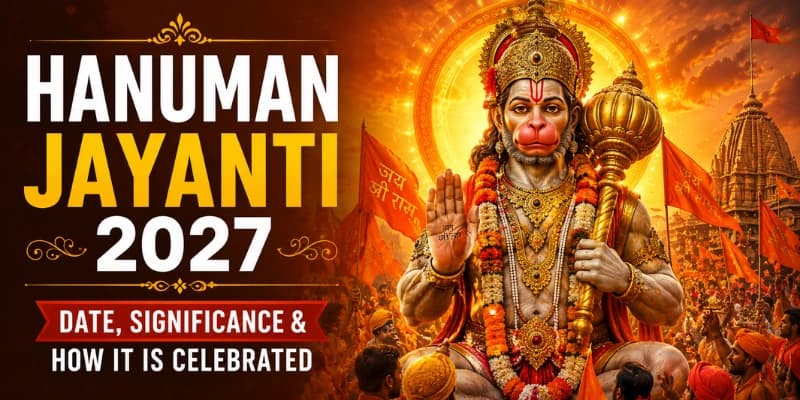
In 2027, Hanuman Jayanti falls on Tuesday, April 20, celebrated across North India on the full moon of Chaitra, the Chaitra Shukla Purnima. By the panchang, the Purnima tithi begins at about 04:51 AM on April 20 and ends at about 03:56 AM on April 21, 2027 and the day honours the birth of Lord Hanuman, the mighty and devoted servant of Lord Rama. Because he is said to have been born at sunrise, the celebrations begin very early and continue through the day. The festival falls in spring, a gentle and beautiful season and a fine time for a pilgrimage; if you wish to spend these days in the sacred land of Krishna, a mathura vrindavan tour package with Experience My India can help you plan the visit.
From the ground (Gurudutt): Hanuman ji is loved everywhere and here in Braj too we hold him dear, for his devotion is the very spirit of this land. On Hanuman Jayanti we rise before the sun, bathe and sing the Hanuman Chalisa; the temples fill with the sound of it. His heart belonged wholly to Ram, so those who wish to walk in his footsteps often add Ayodhya, Ram's own city, to their journey. Whether you observe the day at home or on pilgrimage, chant his name with a simple heart and Bajrangbali will bless you. Jai Shri Ram, Radhe Radhe. See our Mathura Vrindavan tour Package or message WhatsApp +91 7302265809.
Who is Lord Hanuman
Hanuman is among the most beloved deities in all of Hinduism, the very picture of strength joined to humility and devotion. A little about him:
Son of Anjana and Kesari. Hanuman was born to Anjana and Kesari, blessed by Vayu, the wind god, who is often called his celestial father, which is why he is named Pavanaputra, the son of the wind.
The great devotee of Rama. He is the foremost devotee of Lord Rama and a central figure of the Ramayana, whose selfless service, courage and loyalty carried Rama's cause; his devotion is held up as the ideal of bhakti.
Many loving names. He is known by many names, among them Bajrangbali, Maruti, Anjaniputra, Kesarinandan and Mahavir, each recalling his strength, his parentage or his valour.
The significance of Hanuman Jayanti
Hanuman Jayanti, also called Hanuman Janmotsava, celebrates not only Hanuman's birth but everything he stands for. Devotees honour him as the embodiment of devotion, strength and selfless service and pray to him for courage, protection and the removal of obstacles and fear. For many, worshipping Hanuman is a way to draw nearer to Rama, since Hanuman's whole being is turned towards his Lord; to please Hanuman is to please Rama. The day is thus both a birthday and a renewal of faith, a reminder of the boundless power that devotion can awaken in a simple, humble heart.
How Hanuman Jayanti is celebrated
The day is observed with devotion in homes and temples alike. The common observances:
Before sunrise. As Hanuman is said to have been born at dawn, devotees rise early, bathe and begin worship before or at sunrise, when temples open to long queues.
Abhishekam and sindoor. The image of Hanuman is bathed in panchamrita, the mixture of milk, curd, ghee, honey and sugar and adorned with sindoor, the red vermilion sacred to him, along with red flowers and garlands.
Hanuman Chalisa and Sundarkand. Devotees recite the Hanuman Chalisa, often many times over, along with the Sundarkand of the Ramayana and the Bajrang Baan, filling the day with his praise.
Fasting and charity. Many keep a fast, whether a strict nirjala fast without water or a lighter phalahara fast of fruit and milk and give in charity, a practice dear to the occasion.
Prasad and processions. Laddoo and boondi are offered and shared as prasad and many temples hold processions, kirtans and Ramayana recitations through the day.
Regional variations across India
One feature of Hanuman Jayanti is that it is not observed on the same day everywhere; different regions follow their own calendars and traditions. A guide to the main ones:
Region | When it is observed |
North India | Chaitra Purnima, the spring full moon, which is April 20 in 2027 |
Andhra Pradesh and Telangana | A 41-day observance beginning on Chaitra Purnima and ending in Vaishakha |
Karnataka | Margashirsha or Vaishakha Shukla Trayodashi, the thirteenth day |
Tamil Nadu and Kerala | In the month of Margazhi, around December and January |
Odisha | On Pana Sankranti, marking the Odia New Year |
Ayodhya (Hanumangarhi) | Also on Kartik Krishna Chaturdashi, a day before Diwali, by local tradition |
So the April 20, 2027 date is the North Indian Chaitra Purnima observance, the most widely followed; if you keep a regional tradition, check your own panchang for its date.
Observing Hanuman Jayanti in Braj and Ayodhya
Hanuman is worshipped across Braj as everywhere and the region's Hanuman shrines observe the day with early worship and the Chalisa. Since the festival falls in the gentle spring, it is also a pleasant time to be on pilgrimage in the land of Krishna. A few ways to weave the day into a Braj visit:
A spring pilgrimage in Braj. April, before the summer heat, is a fine season for Mathura and Vrindavan; observe Hanuman Jayanti at a local Hanuman shrine, then give your days to the temples of Krishna's land.
Add Ayodhya, the city of Rama. Because Hanuman's heart belongs to Rama, many pilgrims add Ayodhya, Rama's own city, home to the famed Hanumangarhi temple; it pairs beautifully with a Braj journey for those who love both Rama and Krishna.
Temples to visit in Braj. While in the region, the great temples of Krishna await, from the birthplace at Mathura to the beloved shrines of Vrindavan.
For the Ram and Hanuman connection, our mathura vrindavan ayodhya varanasi tour carries pilgrims from Krishna's Braj to Rama's Ayodhya and on to Kashi. In Braj itself, see the krishna janmabhoomi at Mathura and the banke bihari temple and prem mandir vrindavan in Vrindavan; our mathura vrindavan temple timings guide helps with the hours, as several temples close for a few hours at midday.
Tips for observing the day
Rise early and worship before or at sunrise, in keeping with Hanuman's dawn birth.
Offer sindoor, red flowers and laddoo and recite the Hanuman Chalisa and Sundarkand with a calm, devoted heart.
If you fast, choose the form that suits your health, whether nirjala or the gentler phalahara of fruit and milk.
Remember him together with Rama and Sita, for Hanuman's worship is inseparable from his Lord.
If you plan a pilgrimage around the day, book and travel early, as spring is a popular season and temples are busy.
If you would like to spend Hanuman Jayanti or the spring season on pilgrimage, we plan journeys through Krishna's Braj and on to Rama's Ayodhya, with a comfortable vehicle, darshan arranged and a Braj-born guide. A shared day tour starts from around ₹1,499 per person, with darshan free. Our vrindavan tour package covers Vrindavan in a day, our mathura vrindavan tour the twin cities and the braj 84 kos yatra the whole of Braj. Coming from Delhi, our delhi to mathura vrindavan distance taxi cost guide helps and our mathura vrindavan tour itinerary shapes the days; message me on WhatsApp at +91-7302265809. For getting around, see how to commute in vrindavan.
Related guides
Meet Gurudutt — Your Mathura Vrindavan Guide
Not just a tour operator — Gurudutt was born and raised in Braj Bhoomi. He has spent over a decade personally guiding pilgrims through the sacred lanes of Mathura & Vrindavan.

Founder – Experience My India
Gurudutt
Founder · Experience My India