Travel Guide · Festivals & Events · Updated June 2026
Krishna Janmashtami 2026: Date, Tithi, Puja Timings and Complete Festival Guide
By Gurudutt, Experience My India·1 June 2026
Quick Answer
Quick Enquiry
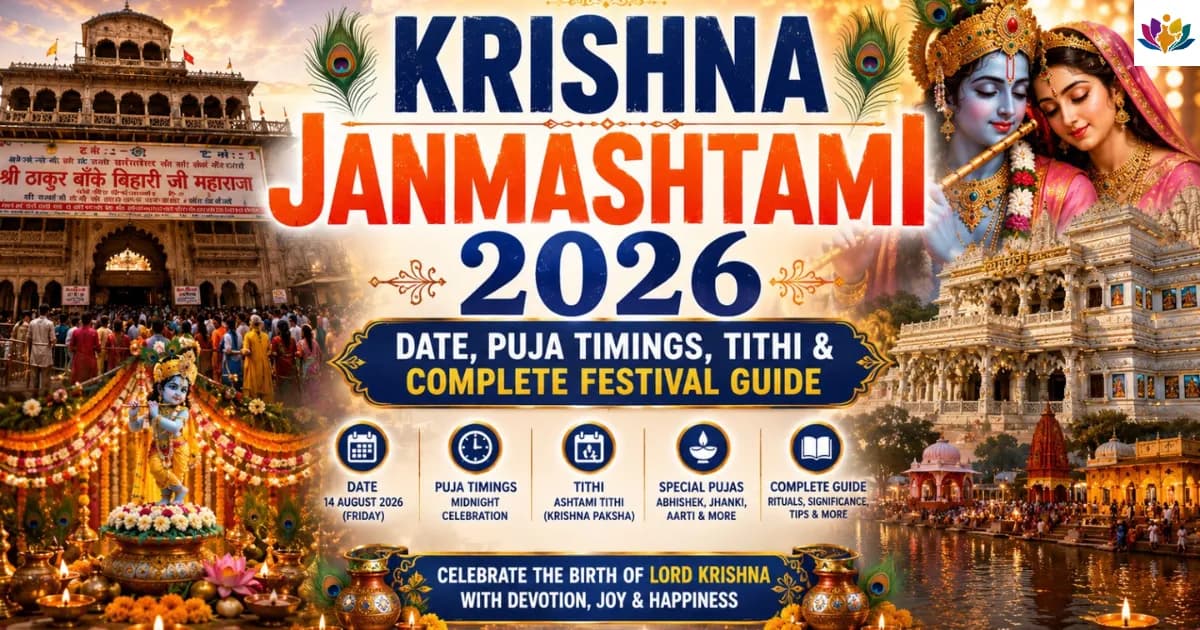
Krishna Janmashtami 2026 marks the 5,253rd birth anniversary of Lord Krishna - and in no place on earth is this moment felt more deeply than in Mathura and Vrindavan, the land where Krishna was born, raised and revealed his divine form. Millions of devotees from across India and the world converge on Braj for the midnight Janmotsav, the most spiritually charged moment of the entire Hindu calendar year. Missing the Nishita Kaal - that 45-minute midnight window - means waiting another year.
Every year, on the eighth night of the dark fortnight of Bhadrapada, the lanes of Mathura and Vrindavan fill past midnight, the temples blaze with light, and at the stroke of twelve a cradle is rocked and a conch is blown to mark the birth of Lord Krishna. This is Janmashtami, and nowhere on earth is it felt more deeply than here, in the land where Krishna was born. Below is everything you need for Krishna Janmashtami 2026: the date, the tithi, the puja timings, the fast, and how the festival actually unfolds in Braj, from someone who has guided pilgrims through it since 2018.
In this guide you will find the official Krishna Janmashtami 2026 date (4 September), the exact Nishita Kaal puja timings, a complete step-by-step Puja Vidhi, fasting rules, the Smarta vs ISKCON date difference explained plainly and a temple-by-temple celebration guide for Mathura and Vrindavan and Book Janmashtami Tour Package.
KEY DATES & TIMINGS AT A GLANCE
Janmashtami 2026 (main / Smarta) | Friday, 4 September 2026 |
ISKCON / Vaishnava observance | Saturday, 5 September 2026 |
Ashtami Tithi begins | 2:25 AM, 4 September |
Ashtami Tithi ends | 12:14 AM, 5 September |
Nishita Kaal puja muhurat | 11:46 PM (4 Sep) to 12:27 AM (5 Sep) |
Rohini Nakshatra | 12:29 AM to 11:04 PM, 4 September |
Parana (break the fast) | after 5:57 AM, 5 September |
Gokul Nandotsav | Saturday, 5 September |
Dahi Handi | Saturday, 5 September |
Why Most Janmashtami Trips to Braj Go Wrong
Mathura-Vrindavan's Janmashtami is different than a trip to any other city. Everything can be planned according to the "3-day window" of the festival - which consists of, 3rd September (the Ashtami Tithi - the day to celebrate "Lord Krishna's Birth"), 4th September (midnight Janmotsav) and 5th September (the Gokul Nandotsav) - and will dictate how many devotees will attend each event; the way the rush of people will come and go; and the way that infrastructure (like streets and temples) will operate during that period - and it does so without reference to Google Maps.
Every year, the same mistakes are committed by people coming for the first time and/or don't have any local knowledge: 1) they arrive on foot to Krishna Janmabhoomi at 11:30pm without realizing that the outer gate closes to new entrants at 10:00pm; 2) they book hotels from 5-8 km away from the temple and then experience delays of 90 minutes to reach the hotel because authorities shut down all cars/trucks within a 3 km radius; 3) they try to visit both Mathura and Vrindavan in the same night and are unable to connect to either; 4) they miss the ISKCON Vaishnava program on the 5th because no one told them about it.
The street width in the older parts of Vrindavan is very small - in some places it's less than 4 metres in width. Approximately 1-1.5 million pilgrims enter the Mathura/Vrindavan corridor on Janmashtami night (and all other significant festivals). None of this is part of a normal tour itinerary.
At Experience My India, every Janmashtami itinerary is built around crowd windows, temple access timings and the midnight Janmotsav sequence - not map distance. Call us at +91-7302265809 before you finalise anything to start with a plan that actually works.
What is Krishna Janmashtami and why is it celebrated?
Krishna Janmashtami celebrates the birth of Lord Krishna, the eighth avatar of Vishnu, who by tradition was born at midnight in a prison cell in Mathura to Devaki and Vasudeva, to end the tyranny of the demon-king Kansa. It falls on the Ashtami (eighth day) of Krishna Paksha in the month of Bhadrapada, which is why the date shifts each year with the lunar calendar. The festival is also known as Gokulashtami, Krishnashtami, Ashtami Rohini and Sree Jayanti.
When is Krishna Janmashtami in 2026?
Krishna Janmashtami 2026 falls on Friday, 4 September 2026. Because Krishna was born when both the Ashtami Tithi and the Rohini Nakshatra were active at midnight, the precise date depends on which the tradition prioritises. Most households (the Smarta tradition) observe it on 4 September, while ISKCON and most Vaishnava temples observe it on 5 September, the day Rohini aligns at sunrise. Both are correct within their own tradition. If you are travelling to Braj, the celebrations effectively span both nights.
Janmashtami Puja Timings 2026 - Nishita Kaal & Muhurat Schedule
The most critical timing to know for Krishna Janmashtami 2026 is the Nishita Kaal - the sacred midnight hour when Lord Krishna is believed to have taken birth in Kansa’s prison, over 5,000 years ago.
Ritual / Period | Auspicious Time Window | What Happens |
Sunrise (Fasting Sankalpa) | 6:10 AM, 4 September | Devotees take vow (Sankalpa) to observe the full-day fast |
Daytime Puja & Bhajan | 8:00 AM - 8:00 PM | Kirtan, scripture recitation, temple darshan, cradle decoration |
Chandrodaya (Moonrise) | 9:00 PM onwards | Considered auspicious to glimpse the moon before midnight |
Evening Aarti & Shringar | 7:00 PM - 11:00 PM | Temples dress the Bal Gopal idol in elaborate jewels and silks |
Nishita Kaal Puja (MAIN) | 12:00 AM - 12:45 AM | Abhishek with Panchamrit; birth celebration; Aarti; conch; bell; Janmotsav |
Janmotsav Bell | Midnight (12:00 AM sharp) | “Nand Gher Anand Bhayo” chant; entire temple erupts in celebration |
Post-Midnight Prasad | 12:45 AM onwards | Distribution of Makhan-Mishri, Panjiri and devotional sweets |
Parana (Fast-Breaking) | Morning of 5 September | After sunrise, once Ashtami and Rohini both conclude |
What is Nishita Kaal? Nishita Kaal is the 45-48 minute midnight window - the exact period within the night when Lord Krishna is scripturally described as having been born. No other moment in the Janmashtami day carries comparable spiritual potency. Performing a full abhishek of the Bal Gopal idol during this window, followed by aarti and the offering of Makhan and Mishri, is the highest puja act of the entire festival.
At Vishram Ghat and Krishna Janmabhoomi Temple in Mathura, the Nishita Kaal celebrations involve thousands of devotees and a full orchestral aarti. Experience My India’s guides position your group at the temple entrance at 11:00 PM to ensure you witness the midnight Janmotsav without fighting the crowd at the gate. Call +91-7302265809 for group Janmashtami darshan coordination.
Janmashtami Puja Vidhi - Step-by-Step Ritual Guide
Whether you are performing Janmashtami puja at home or visiting a temple, the following sequence follows traditional Braj-tradition Vaishnava practice:
Step 1 - Sankalpa (Morning of 4 September)
After sunrise, take a sankalpa (vow) to observe the Janmashtami fast through midnight. Speak the intent aloud: “I observe this fast for Lord Krishna’s Janmotsav.”
Step 2 - Home Mandap Preparation
Set up a clean altar. Place a small Bal Gopal or Ladoo Gopal idol in a decorated cradle (jhula). Surround with fresh flowers - yellow marigold, white jasmine and tulsi leaves. Draw small baby footprints in rangoli or rice flour from the main door to the altar, symbolising Krishna’s arrival.
Step 3 - Daytime Devotion
Spend the day chanting the Hare Krishna mahamantra, reading chapters from the Srimad Bhagavatam (especially the 10th Skandha, which describes Krishna’s birth) and singing bhajans. Do not break the fast.
Step 4 - Panchamrit Preparation
Before midnight, prepare Panchamrit - a sacred blend of:
Milk (raw, full-fat) - 100 ml
Curd (homemade) - 2 tablespoons
Ghee (desi, cow) - 1 tablespoon
Honey - 1 teaspoon
Sugar (mishri/crystal) - 1 teaspoon
Step 5 - Nishita Kaal Abhishek (12:00 AM - 12:45 AM)
At midnight, bathe the Bal Gopal idol with Panchamrit, then with Gangajal or clean water. Dress the idol in fresh silk or cotton garments. Offer Makhan (white butter), Mishri and Panjiri (wheat flour sweet). Light a ghee diya. Perform aarti with a diya, incense, flower, fan and conch.
Step 6 - Janmotsav Celebration
Ring a small bell 108 times. Recite the Nandakumar Ashtakam or chant “Jai Shri Krishna! Nand Gher Anand Bhayo!” Rock the cradle 21 times while singing the cradle song.
Step 7 - Prasad Distribution
Distribute Makhan-Mishri, Panjiri and sweets to family members. This concludes the main midnight ritual.
Step 8 - Parana (5 September morning)
Break the fast after sunrise on 5 September once both Ashtami Tithi and Rohini Nakshatra have concluded. A glass of milk and fruit is the traditional first item.
Experience My India can arrange a trained Braj-tradition pandit to perform the Janmashtami Abhishek at your accommodation or at the ghat. Call +91-7302265809 to book.
Janmashtami Fasting Rules - What to Eat, When to Break
Fast Type | Who Observes | What Is Permitted | When to Break |
Nirjala Vrat (Strict) | Advanced devotees | Nothing - no food, no water | After midnight puja + Ashtami Tithi ends on 5 Sept morning |
Phalahar Vrat (Fruit Fast) | Most devotees | Fruits, milk, sabudana khichdi, kuttu atta roti, panjiri, nuts | After midnight puja; parana on 5 Sept morning |
Sattvic Fast (Moderate) | Families with children/elderly | All above + non-grain items; no onion, no garlic | Morning of 5 September after Rohini and Ashtami conclude |
Ekadashi-style | Devotees who cannot fast fully | One light meal; no grains | After sunrise on 5 September |
During a Phalahar fast: the following foods can be consumed: sweet potatoes (sometimes called yams) such as shakarkandi; samak rice (barnyard millet); sabudana khichri (a dish made from cooking sago and milk); kuttu (buckwheat) preparations; rock salt (sendha namak); fruits, milk, coconut, nuts and panjeeri containing ghee.
The following foods should not be eaten during this period are: all regular grains (such as wheat), non-vegetarian foods, onion, garlic, alcoholic beverages and tobacco products.
The Parana will take place on September 5th, 2026 after sunrise when the Ashtami Tithi ends and both the Rohini Nakshatra and Ashtami end as well. Some devotees who strictly observe the Parana may delay their eating until both the Rohini Nakshatra and Ashtami end.
Is Janmashtami on 4 or 5 September? Smarta vs ISKCON Date Explained
This is among the most commonly searched questions about Krishna Janmashtami 2026 - and the answer depends on which sampradaya tradition you follow.
Tradition | Date | Logic |
Smarta Sampradaya (household Hindus, most of North India) | Friday, 4 September 2026 | Celebrate when Ashtami Tithi prevails at midnight (Nishita Kaal) |
Vaishnava Sampradaya / ISKCON | Saturday, 5 September 2026 | Celebrate when Ashtami Tithi AND Rohini Nakshatra align at sunrise |
Mathura & Vrindavan temples (local tradition) | 4 September 2026 | Follow Smarta tradition; main Janmotsav at midnight on 4-5 Sept |
Gokul Nandotsav | Saturday, 5 September 2026 | Celebrated day after Janmashtami in all traditions |
Udupi, Karnataka (Tholappar tradition) | Regional Panchang - confirm locally | South Indian states may vary by 1 day |
For pilgrims visiting Mathura and Vrindavan: The major temples - Krishna Janmabhoomi, Banke Bihari, Prem Mandir and Dwarkadhish - celebrate the main Janmotsav at midnight on 4 September. The ISKCON Temple Vrindavan holds its primary celebration on 5 September. Experience My India recommends visiting both days if you can - catching the Smarta midnight celebration on 4 September at Janmabhoomi, then ISKCON’s Vaishnava program on 5 September.
Janmashtami 2026 in Mathura & Vrindavan - Temple-by-Temple Guide
No festival in Braj compares to Janmashtami in scale, devotion or noise. Here is what happens, temple by temple, in 2026:
Temple / Site | Location | Janmashtami Program | Best Time to Visit |
Krishna Janmabhoomi Temple | Mathura | Main Janmotsav at midnight; elaborate jhankis; 3-5 million devotees pass through during the festival | Arrive by 10:00 PM on 4 September for midnight access |
Dwarkadhish Temple | Mathura | Special abhishek and shringar; evening aarti elaborately staged | 6:00 PM - 11:00 PM on 4 September |
Vishram Ghat | Mathura | Yamuna aarti; deepa daan; outdoor bhajan | Sunset aarti (7:00 PM) + midnight gathering |
Banke Bihari Temple | Vrindavan | Continuous kirtan; midnight Janmotsav; flower festival | 9:00 PM - 1:00 AM on 4-5 September |
ISKCON Temple Vrindavan | Vrindavan | Vaishnava Janmashtami on 5 September; 24-hour kirtan on 4 Sept | All day 4 Sept + midnight-morning 5 Sept |
Prem Mandir | Vrindavan | Illuminated tableau of Krishna’s birth; fountain show; outdoor bhajan stage | 7:00 PM - 10:00 PM (avoid post-midnight crowd) |
Nidhi Van | Vrindavan | Intimate setting; known for Raas Leela tradition | Daytime 4 September |
Gokul (across Yamuna) | Gokul | Nandotsav celebrations on 5 September; Dahi Handi at noon | Full day of 5 September |
Nandgaon | 56 km from Mathura | Nandotsav; Nanda Baba’s village celebrations; quieter than Vrindavan | 5 September daytime |
Dahi Handi: Gokul Nandotsav (5 September 2026): On the day after Janmashtami, Gokul and Vrindavan celebrate Nanda’s joy at Krishna’s birth. Young men form human pyramids to break a clay pot of curd suspended at height - recreating Krishna’s childhood butter-stealing pranks. This takes place from 10:00 AM to 2:00 PM in Gokul’s central squares.
Chappan Bhog: On Janmashtami, temples offer 56 food items to Lord Krishna - a tradition rooted in the story of young Krishna’s daily diet. At Dwarkadhish Temple in Mathura, the Chappan Bhog is arranged and displayed for darshan from approximately 6:00 PM onwards on 4 September.
Call +91-7302265809 to arrange temple darshan coordination - Experience My India’s team is on the ground in Mathura and Vrindavan throughout the Janmashtami period. View current Vrindavan Mathura temple timings here.
Ground Truth - What Nobody Tells You About Janmashtami in Braj
After guiding pilgrims through Janmashtami in Mathura and Vrindavan every year since 2018, here are the realities other travel blogs do not mention:
Over 5 million devotees pass through Mathura during Janmashtami - and 2026 will be comparable. In 2025, the district administration reported over 5 million devotees in Mathura over the three-day Janmashtami period. On the midnight of Janmashtami itself, 1-1.5 million people are simultaneously present in the Mathura-Vrindavan corridor. If you plan to reach Krishna Janmabhoomi for the midnight Janmotsav without a guide, expect 2-4 hours in queue just to enter the outer gate.
Hotels in Mathura and Vrindavan go from ₹800 to ₹3,500+ per night during Janmashtami. Standard accommodation that costs ₹800-₹1,200 on a regular September night will command ₹2,500-₹4,000 during 3-5 September 2026. Book by 30 June 2026 at the latest. Experience My India has pre-negotiated blocks at partner properties - call +91-7302265809 to check current availability.
Mathura city traffic is halted by authorities in a 3 km radius around Janmabhoomi from 8:00 PM on 4 September. All vehicles - including taxis, autos and tour buses - are stopped at the outer checkpoints. The 1.5-3 km walk into the temple precinct is mandatory on foot. Plan footwear accordingly (no heels, sturdy sandals) and carry minimal belongings in a single small bag.
Banke Bihari Temple in Vrindavan closes for 90-minute intervals during Janmashtami to manage crowd density. This temple does NOT follow a fixed opening pattern during festivals. Arriving at 8:00 PM and finding the gates closed for the next 45 minutes is very common. Experience My India’s local guides know the re-opening windows - this is exactly the kind of ground-level knowledge that makes a guided visit worth it. See
Gokul Nandotsav is dramatically less crowded than Vrindavan on 5 September - and equally devotionally rewarding. Most tourists cluster in Vrindavan and Mathura on 5 September. Gokul, which is 14 km from Mathura across the Yamuna, has the most authentic Nandotsav celebrations with Dahi Handi, processions and local bhajan groups - and you can move freely.
Call +91-7302265809 and speak with Harsh Sharma or our team directly. We will tell you what is happening in Braj on the specific dates of your visit - festival overlaps, temple closures and crowd queue forecasts.
How to Reach Mathura & Vrindavan for Janmashtami 2026
Route | Details | Booking Tip |
By Train | Mathura Junction (MTJ) on Delhi-Mumbai & Delhi-Chennai mainlines. Delhi: 2 hours. Agra: 35 minutes. | Book 90-120 days ahead; September dates fill by June |
By Air | Agra Airport (AGR): 57 km. Delhi IGI: 145 km. Lucknow: 290 km. | Fly to Delhi; take train or taxi to Mathura |
By Road | Delhi-Mathura via NH-19: 145 km (2.5 hours off-peak). Agra-Mathura: 57 km (60 minutes). | Avoid arriving by car on 4 September evening - vehicle restrictions apply 2 km from Janmabhoomi |
From Hyderabad | Train to Agra Cantt or Mathura Junction (18-22 hours) | Book Rajdhani or Duronto 90 days ahead for September |
From Bengaluru | Overnight train via Agra or Delhi | Book by June 2026; Janmashtami September trains are in high demand |
Experience My India provides airport and station pickup from Agra, Delhi and Mathura Junction - included in all Vrindavan Mathura tour packages. Call +91-7302265809 for taxi availability during Janmashtami week.
How is Janmashtami celebrated in Mathura and Vrindavan?
This is the heart of it. Mathura is Krishna's birthplace and Vrindavan his childhood home, so Janmashtami here is not a local festival, it is the festival, and pilgrims arrive from across India and the world.
Shri Krishna Janmabhoomi, Mathura is the epicentre, built around the very prison cell where Krishna is believed to have been born. The midnight Janmotsav here, with abhishek and celebration at the exact birth hour, is the most powerful moment of the night. See our Krishna Janmabhoomi guide.
Banke Bihari Temple, Vrindavan holds its famous Mangala Aarti, performed only this one day in the entire year, drawing enormous crowds. See our Banke Bihari temple guide.
ISKCON Vrindavan celebrates with grand abhishek, kirtan and feasting, observing the festival on 5 September. See our ISKCON Vrindavan guide.
Dwarkadhish Temple, Mathura comes alive with jhankis and decoration.
Gokul Nandotsav on 5 September celebrates Nanda Baba's joy at Krishna's arrival, with great festivity in Gokul.
Harsh Sharma's note: The midnight Janmotsav at Janmabhoomi is the most electric moment of the whole year. As the clock nears twelve the entire complex seems to hold its breath, and at midnight the abhishek begins, the conches sound, and tens of thousands of voices rise together. It moves even those who came only out of curiosity. But here is the honest part most first-timers do not expect: the crush at that exact hour is enormous, the queues are long, and the lanes are packed shoulder to shoulder. So if you are travelling with senior citizens or young children, I gently suggest you skip the midnight darshan and instead go early the next morning, or later the following day, once the crowd has eased. You will still feel the festival deeply, without the strain and the risk of that midnight crush.
What should a visitor expect, and how should you plan?
Expect immense crowds, road and lane restrictions near the temples, long darshan queues, and an atmosphere unlike any other night of the year. The two-day spread (4 September midnight Janmotsav, 5 September Nandotsav) means a well-planned visit can experience both. Arrive with time to spare, travel light, and plan darshan around the crowd, not against it.
A tip from Harsh Sharma: For the midnight celebration, set out early. We reach Mathura by early evening, hours before midnight, because the roads around Janmabhoomi close, the security checks are slow, and the crowd only grows as the night goes on. Once inside, I do not push my guests toward the innermost point at the stroke of twelve, where the crush is heaviest. We take a calmer vantage in the outer courtyard, where you still hear the conches, see the celebration and feel the moment, but can breathe and keep the group together. Agree on a meeting spot in case anyone gets separated. Then, for a close and unhurried darshan, we return early the next morning once the midnight rush has cleared. That way you get both the electricity of the midnight Janmotsav and a peaceful darshan of your own.
A trip built specifically around Janmashtami, with darshan timed, transport and routes handled through the road closures, and both the midnight Janmotsav and the next-day Nandotsav covered, is exactly what our guided Mathura Vrindavan packages are made for. For arrival options from Delhi, see Delhi to Vrindavan Distance: Route, Travel Time & Best Ways to Reach.
Know Before You Plan
Book accommodation by 30 June 2026 - hotels within 1 km of Krishna Janmabhoomi fill completely by July; expect 3x normal pricing if you book in August.
Arrive at Krishna Janmabhoomi by 10:00 PM on 4 September - the outer gate closes to new entrants after this time as crowd density reaches its peak.
All vehicles are stopped 3 km from Janmabhoomi from 8:00 PM on 4 September - the walk-in is 1.5-3 km on foot; wear sturdy flat sandals and carry one small bag only.
The Nishita Kaal window (12:00 AM - 12:45 AM) is the most auspicious moment - plan everything around being inside or at the temple gate by 11:30 PM.
ISKCON Vrindavan celebrates Vaishnava Janmashtami on 5 September - if you can, stay both nights and experience both traditions.
Gokul (14 km from Mathura) on 5 September offers Nandotsav with Dahi Handi and far fewer crowds than Vrindavan - highly recommended for families and senior citizens.
Banke Bihari Temple closes in 90-minute intervals during Janmashtami to manage crowds - a local guide who knows the re-opening windows saves hours of waiting.
All major temple entry is free - anyone charging for temple entry at the gate during Janmashtami is unofficial and not authorised.
Carry minimum 1.5 litres of water per person - September night temperatures in Mathura are warm and the crowd density makes the area feel much hotter.
Experience My India builds every Janmashtami itinerary around the midnight Janmotsav window, crowd patterns and temple re-opening schedules. Call +91-7302265809 - five minutes on the phone prevents a full night going sideways.
Plan Your Janmashtami 2026 with Experience My India
Krishna Janmashtami 2026 on Friday, 4 September is not just another date on the calendar. It is the 5,253rd time humanity will stand at midnight and celebrate the birth of the divine - and in Mathura and Vrindavan, that celebration is unlike anything else in the world. The midnight Janmotsav bell at Krishna Janmabhoomi. The ocean of lamps at Vishram Ghat. The chant of “Nand Gher Anand Bhayo” rippled through Vrindavan at 12:00 AM on a warm September night. These are not experiences you can replicate at home.
The three things that determine whether your Janmashtami is spiritually fulfilling or logistically frustrating: arrive at Krishna Janmabhoomi by 10:00 PM, book accommodation within 1 km of the temple belt by June and have a local guide who knows the crowd windows. If you would rather hand all of that planning to someone who has done it 50,000 times, that is exactly what Experience My India is here for.
Last updated: June 2026
To plan your Janmashtami 2026 darshan, call our Braj-local team at 7302265809. Experience My India has guided over 50,000 pilgrims through Mathura and Vrindavan since 2018, rated 4.5★ by 204 travellers.
Meet Gurudutt — Your Mathura Vrindavan Guide
Not just a tour operator — Gurudutt was born and raised in Braj Bhoomi. He has spent over a decade personally guiding pilgrims through the sacred lanes of Mathura & Vrindavan.
Founder – Experience My India
Gurudutt
Founder · Experience My India