The originals & the replicas - an honest truth
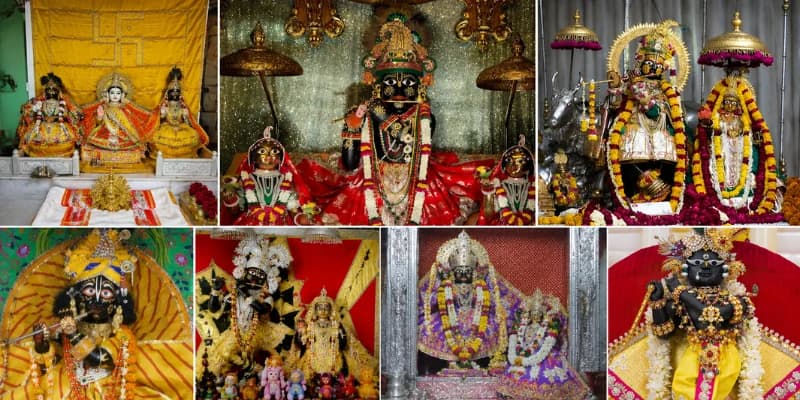
Here is something every pilgrim should understand. In the time of Aurangzeb's iconoclasm (around 1670), the original deities of three of the seven - Madan Mohan, Govind Dev and Gopinath - were carried away to safety in Rajasthan (to Jaipur and Madan Mohan onward to Karauli), where they are worshipped to this day. The temples in Vrindavan now serve pratibhu-murtis - replica deities - honoured with exactly the same love and reverence.
Only one deity among the seven is the original that never left Vrindavan: Radha Raman, the self-manifest form of Gopal Bhatt Goswami. This is not a thing to grieve but to understand: the murti in Vrindavan is no less worshipful for being a pratibhu and the leela-soil beneath these temples is the same sacred ground the Goswamis trod. A born-Brajwasi tells you this plainly, so your darshan is grounded in truth.
Radha Madan Mohan - the attractor
The Radha Madan Mohan temple, on the Dwadashaditya Tila (a hillock by the Yamuna), is reckoned the oldest of the seven, opened around 1580. It is the deity of Sanatana Goswami. The beloved story tells that a salt-merchant from Multan, whose boats were stuck in the Yamuna, was advised by Sanatana to pray to Madan Mohan - and, prospering, he built this temple in gratitude.
"Madan Mohan" means the one who enchants even Madan (Cupid) - the all-attractive Krishna. In the theology of the path, Madan Mohan represents sambandha, our very relationship with Krishna - which is why the pilgrimage of the seven traditionally begins here. The original deity is now in Karauli, Rajasthan.
Radha Govind Dev - the pleasure-giver
The Radha Govind Dev temple is the deity of Rupa Goswami, the foremost of the Six. By the tradition, Krishna himself, as a cowherd boy, led Rupa to the spot on a hillock where a cow daily shed her milk, revealing the deity. The grand red-sandstone temple was built in 1590 by Raja Man Singh of Amber, once seven storeys high - until Aurangzeb razed the top four floors around 1670, leaving the majestic ruin you see today.
"Govind" is the Lord who gives pleasure to the cows, the land and the senses; here he represents abhidheya, the process of devotional service. The original deity is now the famous Govind Dev ji of Jaipur, that city's presiding Lord.
Radha Gopinath - the Lord of the gopis
The Radha Gopinath temple enshrines the deity served by Madhu Pandit Goswami. The deity was found buried beneath the Vamsi Vat banyan, revealed in a dream. Uniquely, here Radha stands to Krishna's left, with her younger sister Ananga Manjari on the right - a darshan found nowhere else among the seven.
"Gopinath" is the Lord of the gopis, the beloved of the cowherd-maidens; he represents prayojana, the ultimate goal - pure love of Krishna. The original deity is now in Jaipur. Together, Madan Mohan, Govind Dev and Gopinath are revered as the three that complete the understanding of the path: relationship, process and goal.
Radha Raman - the self-manifest
The Radha Raman temple, established by Gopal Bhatt Goswami in 1542, holds the most singular deity of the seven. Gopal Bhatt worshipped twelve shaligram-shilas brought from the Gandaki river in Nepal; one night, the tradition says, one of them manifested of its own accord as this exquisite deity of Krishna - the self-manifest (svayam-prakat) Radha Raman.
Alone among the seven, Radha Raman's deity is the original and has never left Vrindavan - devotees hold that he is living. There is no separate idol of Radha; she is present beside him, signified in his very form. The akhand dhuni - an unbroken sacred fire since the deity's appearance - still burns here and Gopal Bhatt's samadhi is within the compound.
Radha Damodar - the Goswamis' seat
The Radha Damodar temple, in the Seva Kunj area, was established by Jiva Goswami in 1542 with a deity given him by his uncle and guru Rupa Goswami. This modest temple is among the most spiritually charged in Vrindavan, for here are the samadhis of the Six Goswamis and Rupa Goswami's bhajan-kuti, where he wrote the great texts of the path.
Here, too, is the precious Giriraj-shila - a stone of Govardhan bearing Krishna's footprints, given by Krishna to Sanatana Goswami; its circumambulation is held equal to the Govardhan parikrama. Srila Prabhupada lived and wrote here from 1959 to 1965. The original deity is in Jaipur (some accounts say it was returned to Vrindavan in 1739 - the tradition varies)
Radha Shyamsundar - born of Radha's heart
The Radha Shyamsundar temple was established by Shyamananda Pandita Goswami - not one of the Six, but a renowned Gaudiya Goswami. Its deity carries one of Vrindavan's sweetest stories: Dukhi Krishnadas, sweeping Seva Kunj in service, found a golden anklet of Radha's; when, after a test, he returned it to her, Radha manifested this deity of Shyamsundar from her own heart and gave it to him.
The temple is modest, with the samadhi of Shyamananda nearby and many of its old patrons were from Odisha (Jagannatha Puri), as the Oriya inscriptions show. Its deity remains in Vrindavan.
The seventh temple - Gokulananda or Radha Vallabh
Now an honest matter, handled as the tradition itself handles it - as varying. The seventh of the Sapt Devalaya differs between lists:
The canonical Gaudiya reckoning gives Radha Gokulananda, established by Lokanatha Goswami, often called "the seventh Goswami." His deity, Radha Vinoda, was discovered at Kishori-kunda; the temple, near Radha Damodar, also holds the samadhis of Lokanatha and Narottama Das Thakur. The original Radha Vinoda is now in Jaipur.
Many popular lists instead give Radha Vallabh, the deity of Hith Harivansh Mahaprabhu - though Radha Vallabh is, strictly, the seat of its own Radha Vallabh Sampradaya, here counted among the seven by long affection.
Some contemporary lists even include Banke Bihari (of the Haridasi tradition) or Jugal Kishore among "the seven Thakurs."
A good Brajwasi names the canonical seventh (Radha Gokulananda) while honouring the variation and does not adjudicate. All are true temples of the Thakur; the "seven" is a frame of love, not a closed list.
The traditional pilgrimage order
There is no compulsory sequence, but many devotees follow the order that mirrors the path itself: begin at Radha Madan Mohan (our relationship with Krishna - sambandha), proceed to Radha Govind Dev (the process of devotional service - abhidheya), then Radha Gopinath (the goal, pure love - prayojana). After these three, the remaining temples - Radha Raman, Radha Damodar, Radha Shyamsundar and the seventh - may be taken in any order. It is a yatra that walks you through the whole journey of bhakti, deity by deity.
The Six Goswamis
Behind the seven temples stand the Six Goswamis of Vrindavan - Rupa, Sanatana, Jiva, Gopal Bhatt, Raghunath Bhatt and Raghunath Das - the towering scholar-saints sent by Chaitanya Mahaprabhu to recover the lost Braj of Krishna's leela, install the deities and compose the scriptures of the Gaudiya path. To them are joined Lokanatha (the "seventh Goswami"), Shyamananda and Madhu Pandit, whose temples complete the Sapt Devalaya.
Their samadhis - above all at Radha Damodar - make Vrindavan a place of pilgrimage to the saints as well as the Lord. See our Braj saints, samadhis & ashrams guide for their lives and resting-places.
An honest note
A born-Brajwasi keeps the facts straight:
The seventh temple varies - canonical lists give Radha Gokulananda (Lokanatha Goswami); popular lists give Radha Vallabh; some include Banke Bihari or Jugal Kishore. I name them all and adjudicate none.
Three deities are replicas (pratibhu-murtis) - Madan Mohan, Govind Dev and Gopinath, whose originals went to Rajasthan; Radha Raman alone is the original that never left. Honour the pratibhus no less.
Build-years and patrons are given variously (Radha Raman and Radha Damodar 1542; Madan Mohan 1580; Govind Dev 1590); and the return of Radha Damodar's deity (1739) is a varying account.
Don't confuse the hillocks - Madan Mohan's Dwadashaditya Tila and the Gomatila of Govind Dev's finding are distinct and Radha Vallabh is its own sampradaya, counted in the seven by affection.
Three sampradayas, three temple-sets
The Sapt Devalaya is one of three great tradition-sets that meet in Braj - a beautiful symmetry:
The Sapt Devalaya - the seven temples of the Gaudiya tradition of Chaitanya Mahaprabhu (this page).
The Divya Desams of Braj - Mathura and Gokul among the 108 abodes of the Tamil Sri Vaishnava tradition.
The Baithakji of Mahaprabhu - the seats of Vallabhacharya in the Pushtimarg tradition.
Three great rivers of Krishna-devotion - Bengal, the Tamil South and the West - all flowing to the one Braj. To know the three is to see how the whole of Vaishnava India loves this single, small, sacred land.
For the pilgrim - visiting the seven
A practical word:
The seven are close together in old Vrindavan - Madan Mohan, Govind Dev, Gopinath, Radha Raman, Radha Damodar and Shyamsundar lie within the historic town, mostly walkable or a short auto apart.
Begin with Madan Mohan, Govind Dev, Gopinath in that order, then the rest as you wish.
Dress modestly, remove footwear before the sanctum and respect the photography rules (often barred at the altar).
A guide who knows the Goswami stories turns a temple-round into a pilgrimage through the whole history of the path.
Festivals of the seven
Festival | What's special | When |
Janmashtami | Krishna's birth - celebrated at every temple of the seven | Bhadrapada |
Radhashtami | Radha's appearance - central to these Radha-Krishna temples | Bhadrapada Shukla Ashtami |
Holi / Phoolon-wali Holi | The Goswami temples keep their own beautiful Holi | Phalguna |
Goswami disappearance-days | Observances at the samadhis (esp. Radha Damodar) | Various |
Kartik / Damodar month | Especially dear at Radha Damodar | Kartik (Oct-Nov) |
Author's tips from Gurudutt - what only a local knows
Start the round at Madan Mohan - the oldest, the "relationship"; then Govind Dev and Gopinath, in that order.
Know what you're seeing at Radha Raman - the one original, self-manifest deity that never left Vrindavan; the others here are honoured replicas.
Don't rush Radha Damodar - the Six Goswamis' samadhis and the Giriraj-shila make it a tirtha in itself.
The seventh "depends who you ask" - canonical Gokulananda, popular Radha Vallabh; both are true.
Walk it, don't drive it - the old-Vrindavan seven are close; the lanes between them are part of the darshan.
When a pilgrim asks me "which are the real seven temples of Vrindavan," I smile - because the answer has a little mystery in it. Six everyone agrees on; the seventh, lovers of Radha Vallabh will name their Lord, while the old Gaudiya books name Gokulananda of Lokanatha Goswami, the seventh Goswami. I tell them both and I tell them the deeper truth: that three of these Thakurs you see are not the originals - those went to Rajasthan when times were cruel - and only Radha Raman never left. None of this lessens the darshan. The soil is the same soil the Goswamis wept upon. To walk these seven is to walk inside the very founding of our Vrindavan. - Gurudutt