_converted.webp&w=1200&q=75)
One of Vrindavan's oldest temples
At the lower end of Vrindavan, where the lanes come down to the Yamuna at Kesi Ghat, stands one of the town's oldest and most historic temples - the Shri Jugal Kishore Temple. Built of the same warm red sandstone as Vrindavan's other great Mughal-era shrines, it is counted among the four temples raised with the permission of Emperor Akbar and it carries a history of some four centuries.
It is a temple of two glories: the divine couple Jugal Kishore within and the sacred Kesi Ghat without - the very spot where, in the leela, Krishna slew a demon and bathed in the holy river. For the pilgrim who loves Vrindavan's deep history and its riverside, it is a treasure - though, as I will tell you honestly, one whose story has a poignant turn. Radhe Radhe.
The four temples of Akbar's permission
When Emperor Akbar visited Vrindavan in 1570, he granted the Gaudiya Vaishnavas permission to build a set of four great temples - and the Jugal Kishore Temple is one of them. The four are traditionally given as:
Govind Dev - the grand seven-storey temple
Madan Mohan - on the hill by the Yamuna
Gopinath - the temple of the gopis' beloved
Jugal Kishore - at Kesi Ghat
All four share the red sandstone, Mughal-Rajput architecture of that golden age of Vrindavan temple-building and all four suffered in the later iconoclasm. Jugal Kishore's spire (shikhar), it is often noted, resembles that of Madan Mohan - so to see one is to glimpse the family likeness of these four ancient sisters.
Jugal Kishore - the divine couple
The deity is Radha and Krishna together as "Jugal Kishore." The word jugal means "pair" or "couple," and kishore means "youthful" - so Jugal Kishore is the eternal youthful divine couple, Radha and Krishna worshipped as one inseparable whole, the very heart of Vrindavan's devotion.
The name itself comes from a leela: in the telling, after Krishna vanished from the gopis and reappeared, Radha and Krishna came to Jugal Ghat on the Yamuna and bathed together there - and from this it is said the Lord here earned the name Jugal Kishore, the divine couple of the sacred bath. To worship Jugal Kishore is to honour Radha and Krishna not separately but as the single, perfect unity of divine love.
Kesi Ghat - the slaying of the horse-demon
The temple stands at Kesi Ghat, one of Vrindavan's most beautiful and sacred riverfronts - and the ghat's name carries its own leela. Here, by tradition, the tyrant Kamsa sent the demon Kesi in the form of a monstrous horse to kill the young Krishna; Krishna fought and slew the horse-demon and then bathed in the Yamuna at this spot, which has been called Kesi Ghat ever since.
Kesi Ghat is today one of the loveliest places in all Vrindavan - its grand stone steps descending to the river, its evening Yamuna aarti famous and moving. (The ghat and its leelas are covered more fully in the Yamuna Ghats & Leela-Sites guide.) The Jugal Kishore Temple rises right beside it, its history and the river's intertwined.
How the deity was found
The deity has a discovery-story dear to devotees. By one account, the sacred image of Jugal Kishore was found by the saint Hariram Vyas, on Magh Shukla Ekadashi (around 1620), at a place called Kishorevan; and King Madhukar Shah of Orchha - a great Bundela patron of Krishna-devotion - built a temple for the deity. This Orchha-Bundela connection matters, for it threads through the temple's later, poignant history: the Bundela kings of Orchha and Panna would become the deity's protectors.
An honest note - the deity at Panna & the locked temple
Now I must tell you the honest, bittersweet truth that many a glossy listing omits. Like Govind Dev, Madan Mohan and Gopinath, the Jugal Kishore Temple suffered in the iconoclasm of Aurangzeb's reign. By the well-documented accounts, the original deity was carried away to safety - to Panna, in Madhya Pradesh (Bundela territory, near Orchha), where, decades later (by one account in 1758), Raja Hindupat Singh Bundela built a new temple for the Lord. To this day, Jugal Kishore Ji is said to grace devotees at Panna.
And so the old red-sandstone temple at Kesi Ghat is, by these accounts, a protected monument under the Archaeological Survey of India (ASI) and may be locked or closed to regular darshan - its deity having long departed. Here the sources differ: some popular listings claim the original deity remained in Vrindavan and give active darshan timings; the scholarly and ASI-based accounts say the deity is at Panna and the old temple is locked. I will not pretend to certainty I don't have. So: revere this as one of Vrindavan's four great ancient temples, come to admire its architecture and the glorious Kesi Ghat - but verify whether it is open for darshan before you go and do not be surprised to find the ancient shrine itself closed.
The architecture & the Govardhan carving
Whether or not you can enter, the temple's exterior is a marvel worth seeing. Built of red sandstone in the Mughal-Rajput style of Vrindavan's golden age, it rises tall enough, it is said, to be seen from across the Yamuna. Its shikhar (spire) echoes that of the Madan Mohan temple, marking it as one of that ancient family of four.
Its most beloved feature is the carving over the main doorway: a beautiful relief of Krishna lifting Mount Govardhan, flanked by peacocks, cows and the sakhis - a little masterpiece of seventeenth-century Braj craftsmanship, with floral and bird motifs adorning the entrance. Even from outside, it rewards the eye and the heart.
The Yamuna aarti at Kesi Ghat
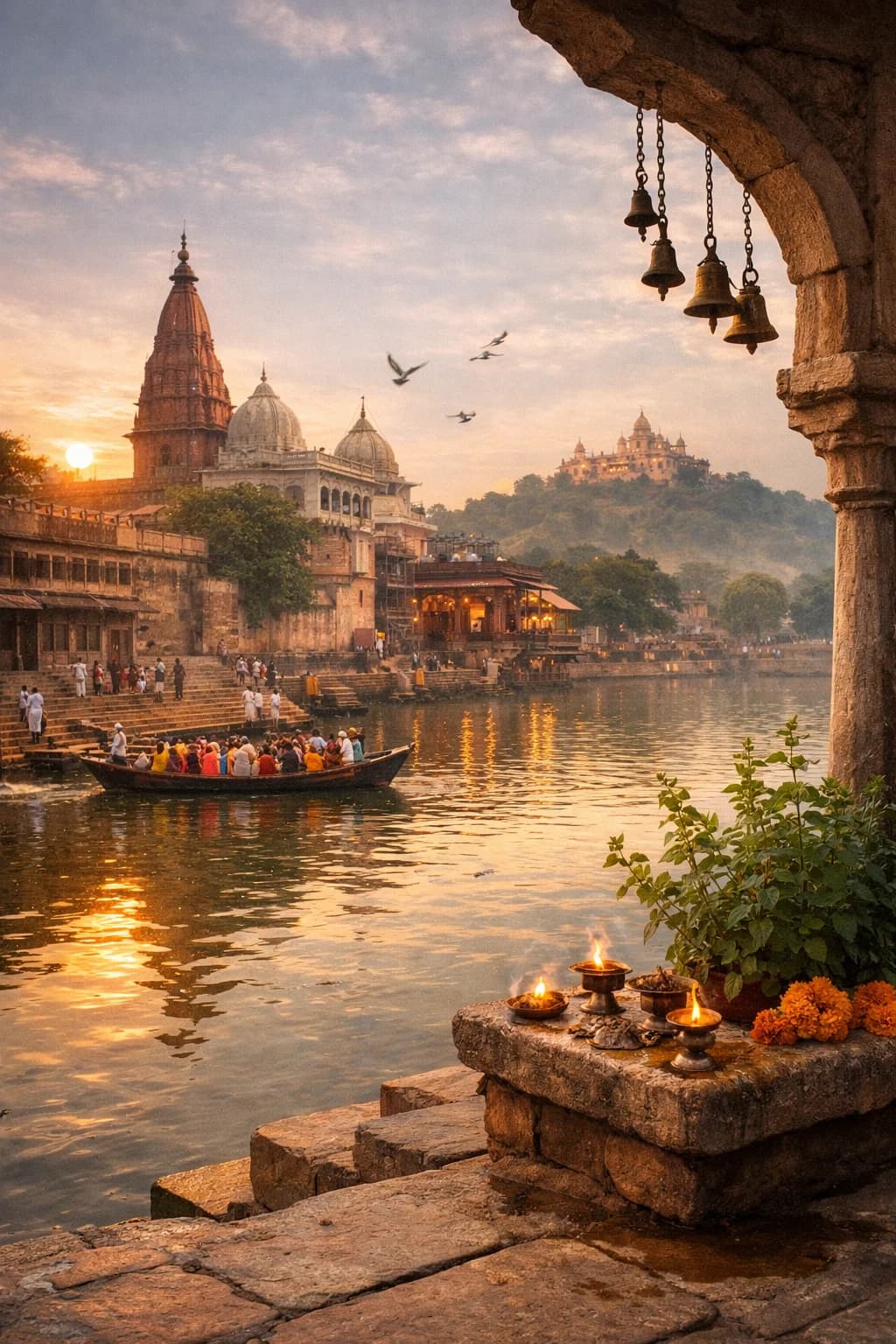
One glory of this spot needs no temple-key: the evening Yamuna aarti at Kesi Ghat. As dusk falls, devotees gather on the grand steps, lamps are lit and floating diyas drift out upon the river while bells and bhajans echo along the water. It is one of the most beautiful and peaceful experiences in all Vrindavan - the holy Yamuna honoured as the mother-goddess she is, beneath the old temple's red walls. Come to Kesi Ghat at sunset and you will receive the blessing of this place whether or not the ancient sanctum is open.
How to visit
A few honest pointers:
Location - at Kesi Ghat, the lower (riverside) end of Vrindavan; reachable on foot through the lanes or by rickshaw and easily combined with the other ghat-side temples.
Verify access first - given the deity's move to Panna and the temple's ASI-protected status, confirm whether it is open for darshan before you go; you may find the ancient shrine closed.
Come for the ghat regardless - even if the temple is shut, Kesi Ghat and its evening Yamuna aarti are unmissable.
Timings - where darshan is offered, verify on the temple timings guide and locally.
Dress modestly - Vrindavan's temples ask for respectful attire; avoid shorts and torn or revealing clothing.
Festivals
Festival | What's special | When (verify the year) |
Kartik Purnima | The great Yamuna-and-ghat festival; Kesi Ghat glows | Kartik full moon |
Janmashtami | Krishna's birth | Bhadrapada Krishna Ashtami |
Radhashtami | Radha's appearance | Bhadrapada Shukla Ashtami |
Holi | Braj's great spring festival | Phalguna (verify) |
The Kartik season, with Kartik Purnima, is especially auspicious at Kesi Ghat, when the riverside and its lamps are at their most beautiful. Festival dates are tithi-based and move yearly, so verify the current year's dates.
Temples to combine nearby
The Jugal Kishore Temple and Kesi Ghat sit among Vrindavan's historic riverside sites:
Kesi Ghat & the Yamuna leela-sites - the ghat itself and its evening aarti
Madan Mohan Temple - its ancient sister, with the resembling spire
Govind Dev ji & Gopinath - the other two of Akbar's four
Radha Vallabh Temple - along the path nearby
Browse all at the Famous Temples of Mathura Vrindavan hub.
Author's tips from Gurudutt - what only a local knows
Verify if it's open first - the deity is by most accounts at Panna and the old temple ASI-protected; a guide or a local call saves a wasted walk.
Come for Kesi Ghat regardless - even if the shrine is shut, the ghat and the evening Yamuna aarti are among Vrindavan's finest sights.
See it with its three sisters - Govind Dev, Madan Mohan and Gopinath are the other three of Akbar's four; together they tell Vrindavan's golden age.
Look up at the doorway - the carving of Krishna lifting Govardhan is a seventeenth-century gem, visible from outside.
Come at sunset, in Kartik - Kesi Ghat at dusk, with floating lamps, is unforgettable.
We have four great old temples from Akbar's time - Govind Dev, Madan Mohan, Gopinath and Jugal Kishore here at Kesi Ghat. And all four share the same sorrow: when the bad days came, their deities were carried away to safety. Our Jugal Kishore Ji went to Panna, far off in Madhya Pradesh and there he stays. So I will be honest with you - this beautiful red temple may be locked, an old monument guarded by the government, its Lord long gone east. But come anyway. Stand at Kesi Ghat at sunset, watch the lamps float on the Yamuna, look up at Krishna lifting the hill carved over that ancient door - and you will feel why we still love this place. - Gurudutt