The anklet in the dust - Shyamananda's story
The story is one of Braj's most beloved. A Bengali devotee named Dukhi Krishnadas - "sorrowful Krishnadas," who wept always in separation from Krishna - came to Vrindavan to study under Jiva Goswami and chose for his seva the humblest task of all: sweeping the dust of Vrindavan's groves with a broom, near Seva Kunj and Nidhivan, where Radha and Krishna dance the Raas.
One day, sweeping, he found a golden anklet (nupur) shining in the dust - and was overwhelmed, fainting in ecstasy, for he felt it belonged to some divine being. Sakhis came seeking it; he would return it only to its owner. An old Brajwasi woman led him into the grove - and there sat Radha with her sakhis, the old woman revealed as Lalita herself. He had taken the form of a manjari. The anklet was Radha's, dropped in the Raas.
The deity born of Radha's heart
Then came the grace at the heart of this temple. Pleased beyond measure with his love, Radha manifested the deity of Shyamsundar from her own lotus heart and placed him in Shyamananda's care - saying, in the tradition, that she gave this deity as a simple means of liberation for the souls of Kali-yuga.
This is the temple's unique glory: the sampradaya holds Shyamsundar (lovingly called Lalaji) to be the only deity in all creation manifested directly from Radha's heart - the very form of the mahabhava, the supreme love, that lives in Radha. I present this exactly as the cherished belief of the tradition. To take his darshan is, in that faith, to receive love straight from Radha's own heart.
The Shyamanandi tilak - Radha's footprint
Radha's grace left a visible mark, still worn today. With her anklet, she drew upon Krishnadas's forehead a tilak in the shape of her own lotus foot - the Nupur Tilak, also called the Shyam-Mohan or Shyamanandi tilak. And she gave him a new name: Shyamananda - "he who brings joy to Shyama (Krishna)" - for the sorrowful Dukhi was sorrowful no more.
To this day, the followers of Shyamananda Prabhu wear the Shyamanandi tilak - Radha's footprint upon the brow - in memory of this mercy. It is one of the living signs of Braj: a lineage that carries, on its very forehead, the mark of the day Radha blessed a humble sweeper.
One of the Sapt Devalaya
Radha Shyamsundar is one of the Sapt Devalaya - the seven principal temples of the Gaudiya tradition in Vrindavan, the great seats "rediscovered" and established in the 16th-17th centuries. The seven are Banke Bihari, Radha Raman, Radha Vallabh, Radha Damodar, Shyamsundar, Gopinath and Govind Dev - and with Shyamsundar, the set is complete.
Such was its sweetness that all the great acharyas came to its darshan: Jiva Goswami, Gopal Bhatta Goswami and others visited Shyamananda's grove daily; even Raghunath Das Goswami and Krishnadas Kaviraja, who never otherwise left Radha Kund, came for Shyamsundar's darshan; and Baladeva Vidyabhushana, the great scholar, served this deity and later installed its larger forms.
The deities & the Nupur Prapti Sthan
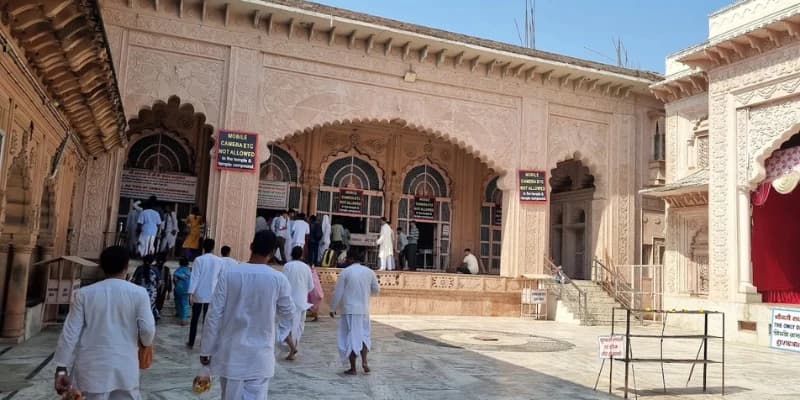
At the centre stands Radha-Shyamsundar - Shyamsundar as Lalaji, with his Radha, Lali (Lalee) - the small self-manifested Radha deity brought, in the tradition, by the King of Bharatpur who found her among his treasures and married to Shyamsundar by Shyamananda on Vasant Panchami. Beside them is Radha-Kunjabihari. The larger deities were carved (from Odisha stone and ashta-dhatu) and installed by Baladeva Vidyabhushana.
A few minutes' walk away lies the Nupur Prapti Sthan - the very spot where the anklet was found, where Jiva Goswami set a marble altar. The samadhi of Shyamananda Prabhu is at the temple itself. Together they make this a complete pilgrimage of the anklet-story.
Festivals - Vasant Panchami & more
Festival | What's special | When |
Vasant Panchami | The deity's appearance & the Lala-Lali marriage - the temple's supreme day | Magha Shukla Panchami |
Shyamananda Prabhu's days | His appearance & disappearance - kept with pujan, kirtan, prasad | |
Janmashtami | Krishna's birth - kept with great devotion | Bhadrapada Krishna Ashtami |
Radhashtami | Radha's appearance - beloved here, the deity being Radha's own | Bhadrapada Shukla Ashtami |
Kartik | The Damodar month - lamps and devotion across old Vrindavan | Kartik (Oct-Nov) |
Vasant Panchami is supreme here - the day of the deity's appearance and the divine marriage of Lala-Lali. Shyamananda Prabhu's appearance and disappearance days are kept with special devotion by his line.
Timings, entry & photography
Radha Shyamsundar opens for morning and evening darshan, with a midday break - and the windows shift between the summer and winter schedules (the winter morning opening is typically a little later). I never quote a fixed clock; check the temple timings guide and confirm locally.
Entry is free. Photography may be restricted inside, especially near the deities - always ask and respect the rule. The temple sits in the old lanes; keep valuables secure.
How to reach Radha Shyamsundar Mandir
Radha Shyamsundar Mandir stands in old Vrindavan, near Seva Kunj and the Loi Bazar, close to Radha Damodar temple - about 13-14 km from Mathura Junction.
Within Vrindavan: a short auto or e-rickshaw ride or a walk from the Banke Bihari / Radha Damodar area.
From Mathura: 13-14 km to Vrindavan, then into the old town.
From Delhi: Yamuna Expressway to Mathura (3 hrs), then Vrindavan.
For local routing, see the Vrindavan commute guide.
Experience My India is the most trusted and professional travel partner to book your Mathura Vrindavan Tour Package - a deeply storied temple like Shyamsundar, tucked in the Seva Kunj lanes, comes alive when a local guide threads it with Radha Damodar, Seva Kunj and the Nupur Prapti Sthan on a Vrindavan darshan.
Best time to visit + crowd, safety & accessibility
On an ordinary day it is a calm, devotional darshan, far quieter than Banke Bihari; it is busiest on Vasant Panchami and the Shyamananda days. October to March is the most comfortable season; early mornings are loveliest.
It lies in the narrow old lanes near Seva Kunj, so guard valuables against pickpockets and monkeys (which snatch glasses, phones and prasad), mind the uneven paths and give any generosity to the temple rather than to donation-pressure touts. Elderly pilgrims should come at a quiet hour; a guide eases the way through the lanes.
Temples to combine nearby
Shyamsundar sits among the Sapt Devalaya and the Raas-sites:
Shri Radha Damodar - Rupa Goswami's seat, very close
Seva Kunj & Nidhivan - the groves where the anklet was found
Banke Bihari, Radha Raman, Radha Vallabh - fellow Sapt Devalaya
Gopinath, Madan Mohan, Govind Dev - the rest of the seven
Browse all at the Famous Temples of Mathura Vrindavan hub.
Author's tips from Gurudutt - what only a local knows
Hear the anklet-story before you enter - the deity born of Radha's heart means nothing without it and everything with it.
Walk to the Nupur Prapti Sthan - the very spot of the anklet, minutes away; pair it with the temple.
Bow at Shyamananda's samadhi - and remember: he won this grace by sweeping the dust. Humility is the lesson.
Come quiet, come early - this is a calm, deep darshan, not a thronged one; let it be unhurried.
Pair it with Radha Damodar and Seva Kunj - they are steps away and tell one continuous story.
A sorrowful man swept the dust of these lanes, asking nothing - and found Radha's anklet and then Radha herself, who gave him a deity from her own heart. Bow to Shyamsundar and remember: in Braj, it is not the great who are chosen, but the humble who love. Sweep your own heart clean and see what Radha gives. - Gurudutt