Travel Guide · Travel Guides · Updated October 2026
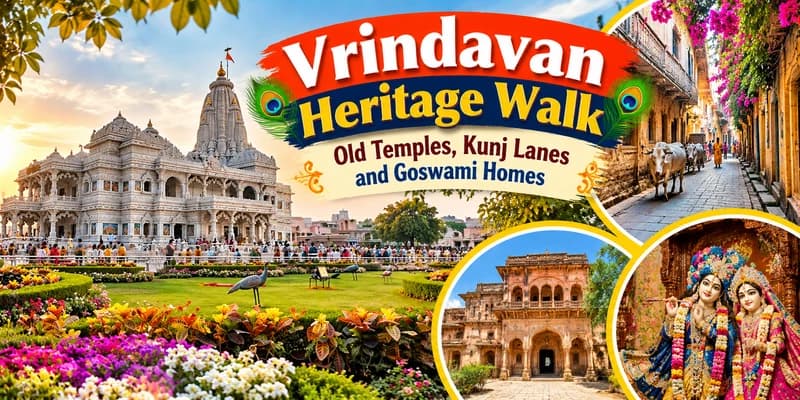
Vrindavan Heritage Walk: Old Temples, Kunj Lanes and Goswami Homes
By Gurudutt, Experience My India·27 October 2026
Quick Answer
Quick Enquiry
This is the Vrindavan I grew up in, the old town, the kunj galis, the Goswami homes where the same families have served the deities for five hundred years. A heritage walk here is nothing like seeing the big modern temples; it is slow, intimate, a step back into the time of the Goswamis who made Vrindavan. I love guiding this walk, the hidden courtyards, the 480-year kitchen flame at Radha Raman, the twisted pillars of Shahji, and timing it around the midday closures so we are never stuck in a locked lane. See our Mathura Vrindavan tour Packages or message WhatsApp +91 7302265809.
The Goswamis and the making of old Vrindavan
To read the old lanes properly, it helps to know who built them and why.
By tradition, Vrindavan as a temple town was shaped in the 16th century by the Six Goswamis, the learned disciples sent by Sri Chaitanya Mahaprabhu to rediscover the lost holy places of Krishna’s pastimes, to build temples on them and to set down the theology of Gaudiya Vaishnavism. Their names, Rupa, Sanatana, Jiva, Gopala Bhatta, Raghunath Das and Raghunath Bhatta Goswami, are woven directly into the temples this walk visits: Jiva Goswami is remembered as the founder of Radha Damodar and Gopala Bhatta Goswami of Radha Raman. Seen this way, the heritage walk is really a walk through the work of these saints.
What makes the old core so unusual is that this inheritance is still alive. The descendants of the Goswamis and the families who have served the deities for generations, continue to live in the traditional homes that line the kunj galis, maintaining the same daily worship their ancestors began. So the lanes are not a preserved museum quarter but a working devotional neighbourhood, with five centuries of unbroken service (sewa) carried on behind its old doorways. That continuity, told here as the living tradition of Braj rather than as documented record, is the thread the whole walk follows and it is what gives the historic temples a depth the big modern shrines cannot match.
The heritage walk itinerary
The walk strings together the foundational temples of old Vrindavan, several among the Sapt Devalaya (Seven Heritage Temples), through the kunj galis.
Shri Radha Damodar Mandir
Established by Srila Jiva Goswami in 1542, this is one of the foundational Sapt Devalaya of Vrindavan and a prime window into the old Goswami residential quarters, with a deeply spiritual, traditional courtyard atmosphere. It is a cornerstone of the walk for anyone drawn to Gaudiya history.
Shri Radha Raman Temple
Built in 1542 by Gopala Bhatta Goswami, the radha raman temple houses a self-manifested (swayambhu) deity of Krishna. Remarkably, its sacred kitchen flame has, by tradition, been kept burning continuously for over 480 years, a glimpse into unbroken ancient culinary and devotional tradition.
Shri Radhavallabh Lal Ji Temple
Dating to 1585, the radha vallabh temple is a protected red-sandstone monument showing a rare, elegant fusion of medieval Hindu and Mughal architecture. Reflecting its Ras Bhakti theology, the sanctum has no physical idol of Radha; her presence is denoted instead by a sacred crown (mukuta).
Shahji Temple
A magnificent 19th-century palace-style temple built by wealthy jewellers from Lucknow, the shahji temple is locally famous as the “Tedhe Khambe Wala Mandir” for its twelve 15-foot spiral marble pillars. It blends European aesthetics with Braj craftsmanship, highlighted by its stunning gold-toned Basanti Kamra (Spring Room) with multi-coloured Belgian glass chandeliers.
Seva Kunj and Nidhivan
The sacred groves of seva kunj and nidhivan, with their twisted, downward-bending Tulsi trees, are bound by deep local mysticism: both enforce an absolute nocturnal lockout on the living belief that the celestial Raas Leela takes place there every night. They are a contemplative close to the walk.
These historic temples are covered more fully in our guide to the historical temples of Mathura and Vrindavan.
Living traditions you encounter on the walk
The old core is loved as much for what still happens inside it as for its old stone.
Beyond the architecture, a heritage walk puts you among traditions that have carried on unbroken for centuries. At Radha Raman, the Samaj Gayan lineage of devotional singing is still strong and its kitchen flame has, by tradition, been kept alight for over 480 years, feeding the deity’s daily bhog. At Radhavallabh, the Ras Bhakti theology is expressed in a sanctum where Radha is present not as an idol but as a sacred crown. Up and down the kunj galis you may hear kirtan drifting from a courtyard, catch the scent of bhog being cooked in a traditional temple kitchen or arrive as the deities are being dressed and offered aarti.
The point is that none of this is staged for visitors; it is simply the daily life of a living devotional town, which is exactly why it moves people so deeply. That also asks something of you as a guest: move quietly, follow each temple’s rules and remember that photography is often restricted or forbidden inside the sanctums, however tempting the scene. Treated with that respect, the living traditions are the richest part of the walk, far more than any single building. As customs and timings differ from temple to temple, confirm what is permitted locally at each one.
Essential practical guidelines
The old core rewards careful planning, as its lanes and temple hours have their own rules.
Logistics and accessibility. The core heritage lanes are highly congested and completely closed to private cars. Park at the peripheral multi-level parking lots and complete the walk on foot or by local e-rickshaw. Paths inside groves like Seva Kunj are rustic and uneven, so wear sensible footing.
Darshan timing guardrail. Historic temples keep traditional slot schedules with rigid midday closures (typically shutting between about 12:00 PM and 4:30 or 5:30 PM). Plan your walking blocks for the early morning or late evening slots so you are never stranded in locked alleyways. Confirm the day’s timings locally. See our vrindavan parikrama guide for the wider lane network.
Monkey safety. The narrow alleys, especially outside Nidhivan and Shahji, have bold, aggressive monkeys. Keep belongings fully secured and avoid wearing visible sunglasses, carrying loose bags or holding your phone in your hand.
Best time and season for the walk
When you go changes the walk completely, both the hour of the day and the time of year.
The single rule that governs the timing is the midday closure. The historic temples keep traditional slot schedules and shut for several hours in the middle of the day, so the only sensible windows for a heritage walk are the early morning and the late afternoon into evening. Mornings are the quietest and coolest, with the lanes just waking and the first aartis under way; evenings are atmospheric, with lamps and kirtan, but busier. Avoid arriving at midday, when you risk wandering locked alleys with nothing open. Always confirm the day’s actual timings locally, as they shift with the season and with festival schedules.
Season matters just as much. The cool, pleasant months of roughly October to March are the most comfortable for walking the congested lanes, which is also the peak pilgrimage season around Kartik and the winter festivals. The summer from about April to June is harsh and best tackled only in the early morning and the monsoon can leave the old lanes slippery underfoot. The great festivals, Holi, Janmashtami and the Kartik season, fill the narrow galis to bursting, which is thrilling but slow and crowded, so if you prefer a calm, contemplative walk, choose an ordinary weekday morning in the cooler months and confirm conditions before you set out.
How the walk fits a wider Vrindavan day
The historic core sits in the heart of town, so it slots naturally into a fuller visit.
The old quarter lies between the Yamuna and the newer parts of Vrindavan, which makes it easy to combine with the rest of the town. Banke Bihari, the most visited temple of all, stands within the same old core, so it folds directly into the walk, while the Yamuna ghats and the evening aarti at Keshi Ghat are a short step down toward the river and the large modern landmarks such as Prem Mandir and the ISKCON temple sit out on the edges of town for later in the day.
A natural rhythm is to walk the historic temples and groves in the cool of the morning, before the midday closures, keep the middle of the day for rest or a modern temple that stays open and return to the old lanes or the ghats in the evening. If you have only half a day, focus on the core temples and the groves; with a full day you can add a stretch of the parikrama path and linger longer in the Goswami quarter. Because queues, lane congestion and temple hours all shift, keep the plan loose and confirm the day’s timings locally rather than packing the hours too tight.
Planning your heritage walk
A heritage walk is best done at a slow, early-morning or evening pace, timed around the midday closures, with comfortable shoes, minimal belongings and water. Half a day lets you take in the core temples and groves without rushing; a fuller day allows the lanes, the Goswami homes and a parikrama stretch too. Because the old core is a maze of congested, car-free lanes with their own timings and the monkey hazard, it is the part of Vrindavan where a local guide helps most. For more on what to see and when, see places to visit in vrindavan, best time to visit and how to reach vrindavan.
Let a Brajwasi walk the old town with you
The historic core is where a Brajwasi guide makes the greatest difference, finding the hidden courtyards and Goswami homes, telling the five-hundred-year stories in the lanes where they happened, timing everything around the strict midday closures and keeping your belongings safe from the monkeys. As Brajwasis, we guide the Vrindavan heritage walk at an unhurried pace, through the kunj galis to Radha Damodar, Radha Raman, Radhavallabh, Shahji, Seva Kunj and Nidhivan. A shared Vrindavan darshan starts from around 1499 rupees per person; see our vrindavan tour package or we design a private heritage walk. Message us on WhatsApp at +91-7302265809 with your dates.
Related guides
Book Your Mathura - Vrindavan Trip Today
📞 +91-7302265809
💬 WhatsApp: +91-7302265809
We Reply in 30 Minutes
Packages start from ₹1,999/ person | Rated 4.5★ / 204+ Reviews
Explore all: Mathura Vrindavan Tour Packages
Jai Shri Krishna
Meet Gurudutt — Your Mathura Vrindavan Guide
Not just a tour operator — Gurudutt was born and raised in Braj Bhoomi. He has spent over a decade personally guiding pilgrims through the sacred lanes of Mathura & Vrindavan.

Founder – Experience My India
Gurudutt
Founder · Experience My India