Travel Guide · Travel Guides · Updated September 2026
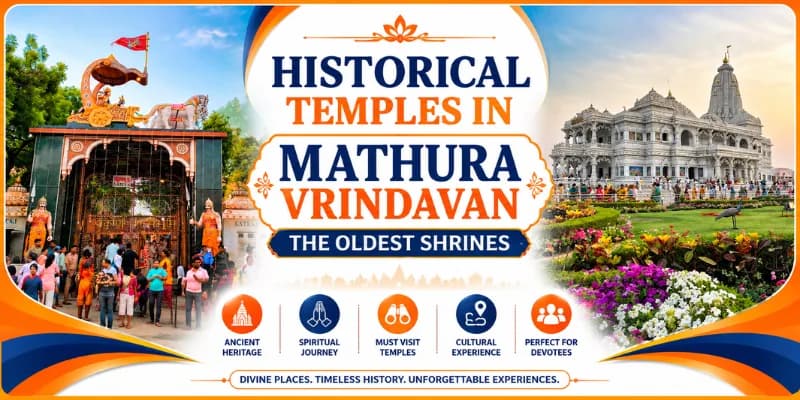
Historical Temples in Mathura Vrindavan: The Oldest Shrines
By Gurudutt, Experience My India·5 September 2026
Quick Answer
Quick Enquiry
The oldest temples at a glance
Temple | Where | Built / era | Note |
Madan Mohan | Vrindavan | About 1580 | The oldest of the Goswami temples |
Radha Raman | Vrindavan | 1542 | Self-manifested deity, sacred fire since |
Radha Damodar | Vrindavan | 1542 | Founded by Jiva Goswami, Giriraj shila |
Govind Dev | Vrindavan | 1590 | Grand red sandstone, once multi-storey |
Gopinath, Shyamsundar, Radha Vallabh | Vrindavan | 16th century | The rest of the seven Goswami temples |
Jugal Kishore | Vrindavan | 1627 | Near Kesi Ghat, among the oldest |
Krishna Janmabhoomi | Mathura | Ancient | The birthplace, of great antiquity |
The four guardian Shiva temples | Mathura | Ancient | Bhuteshwar, Rangeshwar, Gokarneshwar, Pippaleshwar |
Historical temples of Mathura and Vrindavan: an overview
Mathura and Vrindavan hold some of the most ancient and storied temples in all of India and to visit the oldest of them is to walk back through the centuries of Krishna devotion. Mathura, the birthplace of Krishna, is older than almost any living city; Vrindavan, though the town itself was raised up chiefly in the sixteenth century, holds the historic heart of the Gaudiya-Vaishnav revival, its great old temples founded by the disciples of Chaitanya Mahaprabhu. These shrines, of red sandstone and worn marble, are living places of worship still and each carries its own date, its founder and its story. This guide gathers the oldest and most historical of them; and to see them with a guide who knows their history, a mathura vrindavan tour package with Experience My India can weave them into your visit.
From the ground (Gurudutt): Everyone knows Banke Bihari and Prem Mandir, but the old Goswami temples are where the real history lives and I love to take those who care for it. Stand in Madan Mohan on its hill by the Yamuna, the oldest of them or in Radha Raman, where a fire has burned since 1542; you can feel five hundred years of devotion in the stone. These are the roots of Vrindavan. Walk them slowly and the town's whole story opens before you. Radhe Radhe. See our Mathura Vrindavan tour Package or message WhatsApp +91 7302265809.
The seven Goswami temples of Vrindavan
The historic heart of Vrindavan is its seven principal temples, the Sapta Devalaya, founded in the sixteenth century by the Goswamis, the great saints sent by Chaitanya Mahaprabhu to reveal and restore the holy places of Braj. These are the oldest and most revered of the town:
Madan Mohan Temple, about 1580. The oldest of the Goswami temples, built under the guidance of Sanatana Goswami on the Dwadashaditya hill by the Yamuna, of red sandstone in the Nagara style; Sanatana Goswami's bhajan kutir and samadhi are here and its original deity was moved to Jaipur and later Karauli, for safekeeping in the seventeenth century, where it is worshipped still.
Radha Raman Temple, 1542. Established by Gopal Bhatta Goswami, it enshrines a deity of Krishna self-manifested from a shaligram stone, which has never left Vrindavan; a sacred fire, the akhand dhuni, has burned here since its founding and the Goswami families still care for it to this day.
Radha Damodar Temple, 1542. Founded by Jiva Goswami near Seva Kunj, it holds the Giriraj shila, a sacred stone of Govardhan bearing Krishna's footprints, of which four circlings are said to equal one parikrama of Govardhan itself; the samadhis of Rupa Goswami and many Gaudiya saints lie here.
Govind Dev Temple, 1590. Once a magnificent multi-storey temple of red sandstone, among the grandest of its age; its original deity was moved to Jaipur for safekeeping in the seventeenth century, where it is worshipped as Govind Dev Ji, while the historic Vrindavan temple remains a monument of the town's golden age.
Gopinath, Radha Shyamsundar and Radha Vallabh. The remaining Goswami temples: Radha Gopinath, of the line of Madhu Pandit; Radha Shyamsundar, of Shyamananda; and Radha Vallabh, the seat of the Radha Vallabh tradition, each with its own beloved deity and centuries of devotion, completing the seven.
More historic temples of Vrindavan
Beyond the seven, Vrindavan holds other temples of great age and history:
Jugal Kishore Temple, 1627. Also called the Kesi Ghat temple, near the Kesi Ghat on the Yamuna, one of the oldest temples of Vrindavan after the first Goswami shrines, of red sandstone in the old style.
Rangji (Ranganatha) Temple, 1851. The largest temple in Vrindavan, built in the South Indian Dravidian style rare in the north, with a soaring gopuram and a spacious complex; younger than the Goswami temples but a grand historic landmark.
Gopeshwar Mahadev Temple. An ancient temple to Lord Shiva, revered as the one who took the form of a gopi to witness Krishna's raas; held to be very old, reaching back in tradition to the earliest days of Vrindavan.
Nidhivan. The ancient, sacred grove of the nightly Raas belief, with its old trees and the Rang Mahal, sealed after dark; not a built temple but among the most historic and mysterious of Vrindavan's holy sites.
The seva kunj vrindavan and the braj yamuna ghats and leela sites are among the ancient leela sites; and the living tradition of these Goswami temples continues today in the iskcon temple vrindavan, while the beloved banke bihari temple and the modern prem mandir vrindavan stand alongside the historic shrines.
The ancient temples of Mathura
Mathura, far older than Vrindavan as a city, holds shrines of even greater antiquity:
The Krishna Janmabhoomi. The sacred birthplace of Krishna, of immense antiquity, a place of worship rebuilt many times over the ages, at the very heart of Mathura's long story; the garbha griha marks the spot where he was born.
The four guardian Shiva temples. By old tradition, Mathura is guarded at its four quarters by four ancient Shiva temples, Bhuteshwar, Rangeshwar, Gokarneshwar and Pippaleshwar, held to be very old and passed on the traditional Mathura Parikrama.
The Dwarkadhish Temple, 1814. The grandest living temple of the city, younger than the ancient shrines but historic in its own right, honouring Krishna in his royal form as the king of Dwarka, in the Pushtimarg tradition.
See the krishna janmabhoomi and the dwarkadhish temple pages for these Mathura temples in detail.
The Goswami story: Chaitanya Mahaprabhu and the revival of Braj
To understand why Vrindavan's oldest temples date so precisely to the sixteenth century is to know the great story of the revival of Braj. Over the long ages, the exact holy places of Krishna's leelas had been lost to memory and the town of Vrindavan had faded. In the early sixteenth century, Sri Chaitanya Mahaprabhu, the saint of Bengal and the great reviver of Krishna devotion, came to Braj and, through his ecstatic vision, began to reveal its sacred sites. He then sent his foremost disciples, the Six Goswamis, among them Rupa, Sanatana and Jiva Goswami, to settle in Vrindavan, to recover the lost tirthas, to write the scriptures of the tradition and to build the temples. It is these Goswamis who founded Madan Mohan, Radha Raman, Radha Damodar, Govind Dev and the other historic shrines, giving Vrindavan the temples we see today and making it once more the living heart of Krishna bhakti.
How to visit the historical temples
The historic temples are easy to weave into a Vrindavan and Mathura visit:
In Vrindavan's old town. The Goswami temples, Madan Mohan, Radha Raman, Radha Damodar, Gopinath, Radha Shyamsundar and the rest, lie close together in the old town and near the Yamuna, best explored on foot and by e-rickshaw, as cars cannot enter the lanes.
In Mathura. The Krishna Janmabhoomi, the guardian Shiva temples and Dwarkadhish are in the old city of Mathura, about 14 km from Vrindavan; the two are easily seen together over a day or two.
With a guide. Many of the old temples are tucked into the lanes and easy to miss and their histories are little known, so a guide who can find them and tell their stories greatly enriches a heritage visit.
Our how to commute in vrindavan guide covers the e-rickshaws and lanes and for the darshan hours our mathura vrindavan temple timings guide helps, as several temples close for a few hours at midday.
Best time to visit and tips
October to March is the most pleasant season for exploring the old temples and the lanes, with cool, comfortable weather.
See the temples in the morning, when they are calmer and the light on the old sandstone is loveliest; several close for a few hours at midday.
Dress modestly, remove footwear as required and follow each temple's customs on photography, which is often not allowed inside the historic shrines.
Wear comfortable footwear for the old-town lanes and the temple steps and keep your belongings close in the crowds.
A guide is invaluable for the historic temples, many of which are hidden in the lanes and rich in stories a first-time visitor would never find alone.
We guide pilgrims and history lovers through the oldest temples of Mathura and Vrindavan, finding the hidden Goswami shrines and telling their five-hundred-year stories, with a comfortable vehicle, the darshan and the e-rickshaw arranged and a Braj-born guide. A shared day tour starts from around ₹1,499 per person, with darshan free. Our mathura vrindavan tour covers Mathura and Vrindavan, our vrindavan tour package Vrindavan in a day and the braj 84 kos yatra the whole of Braj. To plan, see our mathura vrindavan tour itinerary; message me on WhatsApp at +91-7302265809 to plan a heritage visit.
Related guides
Meet Gurudutt — Your Mathura Vrindavan Guide
Not just a tour operator — Gurudutt was born and raised in Braj Bhoomi. He has spent over a decade personally guiding pilgrims through the sacred lanes of Mathura & Vrindavan.
Founder – Experience My India
Gurudutt
Founder · Experience My India