Travel Guide · Travel Guides · Updated October 2026
Best Photo Spots in Vrindavan
By Gurudutt, Experience My India·20 October 2026
Quick Answer
Quick Enquiry
I love taking photo-minded guests around Vrindavan, because when you know where to point your camera, it is one of the most beautiful towns in India. The secret is simple: shoot the open, permitted places, Prem Mandir glowing at dusk, the Yamuna at Keshi Ghat at sunrise, the twisted pillars of Shahji, the old red-sandstone towers and keep the camera away entirely inside the strict temples and the sacred groves. And please, guard your phone from the monkeys in the lanes; I have lost count of the visitors who learned that lesson the hard way. Respect the rules, chase the light and Vrindavan will give you photographs you will treasure. See our Mathura Vrindavan tour Packages or message WhatsApp +91 7302265809.
Photographing Vrindavan: the lay of the land
Vrindavan is a visual paradise, full of devotion, ancient heritage and architectural marvels, but because it is an active pilgrimage hub, the one thing you must understand before raising a camera is that the rules vary wildly from place to place. Some temples openly welcome cameras in their open areas, while others strictly ban phones and equipment altogether to preserve sanctity and prevent chaos in their crowds. So a good photo trip here is really a matter of knowing which is which and this guide maps both the best spots and the strict no-go zones.
Before you set out, keep one critical piece of local advice front of mind: never show off your phone or take careless selfies in the open lanes, because Vrindavan’s notoriously aggressive monkeys will snatch a phone straight out of your hand in broad daylight, especially in the crowded old-town areas. This single habit, keeping your device secured and out of sight in the lanes, prevents the most common mishap visiting photographers have. With that understood and with respect for every temple’s rules, Vrindavan rewards a camera richly, so let us look at exactly where to shoot.
The best photo spots in Vrindavan
These are the places where photography is welcome and the results are most rewarding. Rules can change, so confirm at each gate and always keep clear of the inner sanctums.
Prem Mandir
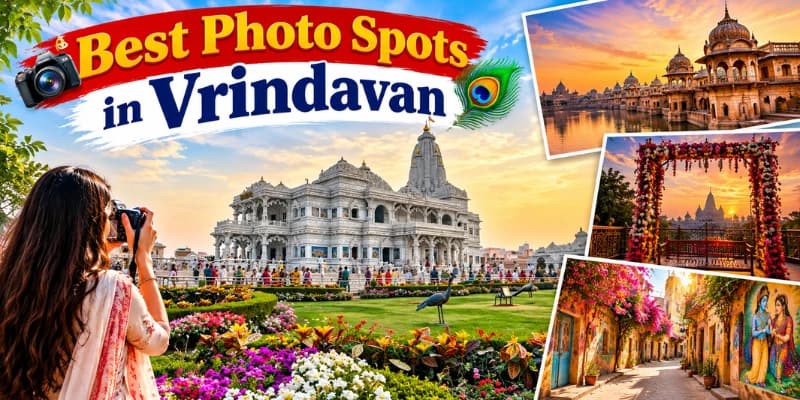
The showpiece. By day, the jaw-dropping exterior of gleaming white Italian marble is framed by landscaped gardens; after dark, the whole temple transforms under a dynamic multi-coloured light display with a synchronised musical fountain show. Photography is openly permitted across the lawns, walkways and outer fountains of prem mandir, though strictly prohibited and heavily monitored once you step past the inner-sanctum doors. Best time: late afternoon, from about 4:30 PM, to catch both the sunset light on the marble and the evening illuminations.
Keshi Ghat (Yamuna riverfront)
The most atmospheric open spot. At keshi ghat you can shoot golden-hour reflections of the grand stone steps mirroring the old terracotta towers, pilgrim life by the water, silhouettes of traditional wooden boats against a misty sunrise and the drama of the brass lamps at the daily evening Maha Aarti. Photography is openly permitted, as it is an open riverfront public space. Best time: sunrise for misty, serene, calm-lit frames or sunset to document the aarti.
Shahji Temple
A heritage-photography favourite, away from the most intense crowds. This 19th-century marvel fuses Greek, Mughal and Hindu styles and its signature is the twelve twisting, 15-foot marble columns that give it the local name “Tedhe Khambe wala Mandir”. During special festivals you may also capture the hidden Basanti Kamra (Spring Room), a royal yellow durbar hall of Belgian glass chandeliers and gold plating. Photography is generally permitted in the outer courtyard and architectural spaces of shahji temple. Best time: morning, roughly 8:30 AM to 12:30 PM, when sunlight filters elegantly into the courtyards.
Shri Radha Madan Mohan Ji Mandir
For history and views. Built around 1580, this is one of the oldest surviving temple structures in Vrindavan, perched on an elevated hillock (Aditya Tila) and its distinctly elongated red-sandstone tower makes a rugged, historic subject. Walk the perimeter for panoramic views of the old quarter and the winding Yamuna below. Photography is restricted inside the inner sanctum, but capturing the rugged exterior architecture and the valley views from the hillock is widely accepted. Best time: early morning, both for the light and to beat the heat on the short uphill walk.
More photogenic corners
Beyond the headline spots, much of Vrindavan’s charm for a camera is in its everyday texture and these subjects are mostly in open, unrestricted areas. The old kunj lanes of the historic core are full of colour and life: carved wooden doors, faded frescoes, flower sellers, sadhus in saffron and the narrow alleys themselves, though remember these are exactly the monkey-prone areas where you must guard your phone. The temple exteriors across the town, particularly the red-sandstone heritage architecture of the oldest temples, reward anyone who loves detail and form.
The markets, especially around Loi Bazar, offer vivid street and life photography, from garlands and sweets to the bustle of pilgrims, again with care for your device. And the general atmosphere, the morning mist, the evening lamplight, the crowds flowing toward the temples, the cows in the lanes, gives Vrindavan a mood that photographs beautifully when you look for it. The guiding principle across all of these is the same one that keeps you welcome everywhere: shoot the architecture, the river, the light, the lanes and the life, the beauty around the worship, rather than the deities and rituals themselves. For more of what to see, our places to visit in vrindavan guide is a useful companion.
Places where photography is banned
Just as important as knowing where to shoot is knowing where not to, so you do not plan a photo stop at a temple that will turn your camera away. Respect these strict bans completely.
ISKCON Vrindavan. The clean marble courtyards look photogenic, but a strict photography, video and selfie ban is actively enforced inside the entire temple hall and inner premises to preserve spiritual decorum. Shoot only the outer garden areas, not the hall.
Nidhivan and Seva Kunj. These mystical, sacred groves strongly restrict or discourage photography and reel-making, to protect their heritage sanctity and the local folklore around them. Treat nidhivan and seva kunj as places to witness quietly, not to film.
Banke Bihari and Radhavallabh temples. Photography is strictly prohibited inside the main sanctuaries of the banke bihari temple and the radha vallabh temple, due to intense crowd volumes and traditional mandates. At Banke Bihari in particular, phones are best kept away entirely.
The universal rule underlying all of these is the one that applies everywhere in Vrindavan: never photograph the deities, the altars or any aarti in progress, regardless of a temple’s other rules. When in doubt, keep the camera away, take the darshan with your heart and save your photography for the open, permitted spots.
Best times and light
Timing the light turns a good Vrindavan photo into a memorable one and the town has two clear golden windows. Sunrise is magical at Keshi Ghat and along the Yamuna, soft, misty, serene, with calm reflections, boats and early pilgrims and it is also the coolest, quietest time for the heritage temples like Radha Madan Mohan and Shahji before the crowds and heat build. Late afternoon into evening is the other prime window: the sunset light on Prem Mandir’s white marble, followed by its dramatic illuminations and fountain show from dusk and the lamps of the Keshi Ghat Maha Aarti at nightfall.
Midday is best avoided for serious shooting, the light is harsh and flat, the heat is tiring and most temples close for the deities’ rest in the early afternoon anyway, so use that time to rest and plan. Seasonally, the cool, clear months from October to March give the most comfortable and photogenic conditions, with winter mornings especially atmospheric at the ghats; the summer is hot and hazy and the monsoon brings moody skies but muddy lanes. Plan your shoots around the two golden hours and the cool season and confirm temple timings on the day; see our best time to visit guide for the fuller picture.
Gear and the monkey hazard
A few practical points on equipment and safety complete the picture. On gear: a smartphone is the most practical camera for Vrindavan, tolerated in the open, permitted areas and easy to keep discreet. Serious DSLR or mirrorless cameras, tripods and selfie sticks, by contrast, are restricted or banned at most active temples, so reserve them for the genuinely open spots like Keshi Ghat, the Prem Mandir grounds and the heritage exteriors and seek permission in advance for anything more ambitious. Carry a cloth for dust and keep spare batteries and storage, as the best light comes at the start and end of the day.
The monkey hazard deserves repeating because it is the most common way a photographer’s trip goes wrong. The macaques in the old lanes, especially around Banke Bihari, Nidhivan and Loi Bazar, specifically target raised phones and glasses and a phone held up for a photo is a prime target. Keep your device on a strap or in a zipped pocket, do not stand in these lanes shooting with it exposed and only bring it out in safer, open areas. If a monkey does grab it, do not chase or fight, let a local help you offer a food item so it drops the device. The simplest safeguard is to do your serious shooting at the open, safer spots and keep the phone away in the monkey lanes.
Planning a photo trip and how a Brajwasi can help
A little planning gets you the best of Vrindavan’s light without any friction. Build your day around the two golden windows: an early start at Keshi Ghat and the heritage temples, a midday rest while the temples close and an evening at Prem Mandir for the sunset and illuminations. Carry a phone for the permitted spots, leave the heavy gear for the open areas only, keep your device secured in the monkey lanes and simply enjoy the strict temples as pure darshan with the camera away. Confirm each temple’s current photography rule at the gate, as they tighten from time to time. For arrival and planning, see how to reach vrindavan.
Let a Brajwasi find you the best light
Knowing exactly where photography is allowed, which hour gives the best light and how to avoid the monkeys, crowds and touts is where a local truly helps a photographer. As Brajwasis, we can guide photo-loving guests to the most beautiful, permitted spots at precisely the right times, the misty Keshi Ghat sunrise, the Prem Mandir fountains at dusk, the Shahji pillars and the hilltop heritage views, while keeping you clear of the strict-temple rules and the monkey-prone lanes, so you come away with wonderful images and a smooth visit. A shared Vrindavan darshan starts from around 1499 rupees per person; see our vrindavan tour package or we design a private, photo-friendly itinerary around the light. Message us on WhatsApp at +91-7302265809 with your dates.
Related guides
Book Your Mathura - Vrindavan Trip Today
📞 +91-7302265809
💬 WhatsApp: +91-7302265809
We Reply in 30 Minutes
Packages start from ₹1,999/ person | Rated 4.5★ / 204+ Reviews
Explore all: Mathura Vrindavan Tour Packages
Jai Shri Krishna
Meet Gurudutt — Your Mathura Vrindavan Guide
Not just a tour operator — Gurudutt was born and raised in Braj Bhoomi. He has spent over a decade personally guiding pilgrims through the sacred lanes of Mathura & Vrindavan.
Founder – Experience My India
Gurudutt
Founder · Experience My India