Why Shahji matters in my Braj
If you love beauty, this is the temple I most want to show you. Shahji - the "temple of the spiral pillars" - is the most artistic shrine in all Vrindavan: twelve twisting columns of white marble, a hall of Belgian crystal and marble fountains, ceilings painted with the Raas. And yet its deepest story is one of humility - for the wealthy brothers who raised this marvel laid their own faces on the floor, to be trodden with the holy dust of Braj. I bring devotees here for both: the dazzle of the art and the lesson beneath it. Radhe Radhe.
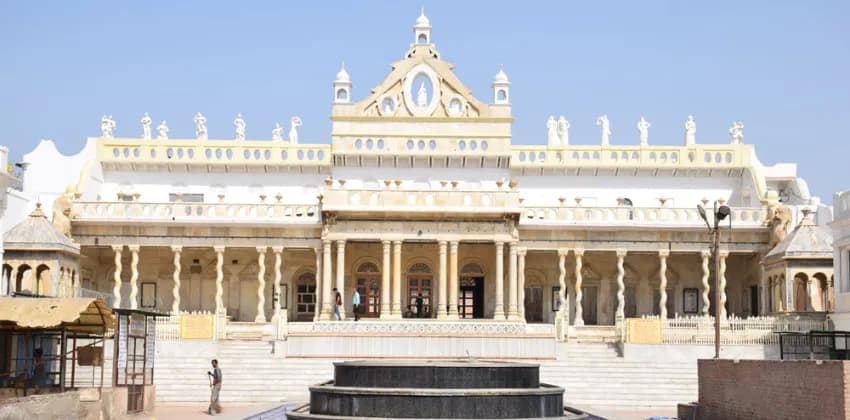
The spiral pillars - Tede Khambe
The temple's signature and its popular name, is its twelve spiral columns - the Tede Khambe ("twisted pillars"). Each stands about fifteen feet high and is carved from a single block of white marble, twisting upward like a stilled flame. No other temple in Vrindavan has anything like them; they are a feat of 19th-century craftsmanship that stops every visitor in their tracks.
They grace the front veranda and terraces of the temple, holding up its spacious upper galleries. To stand among them, looking up, is to understand at once why Vrindavan calls this simply the Tede Khambe Wala Mandir.
The Basanti Kamra - the spring room
At the eastern end of the courtyard lies the temple's most precious chamber: the Basanti Kamra, the "Spring Room" - also called the Yellow Room for its décor. It is a true durbar hall: a high domed ceiling, nine Belgian glass chandeliers scattering light, walls and ceilings painted with the Raas-Leela and Krishna's pastimes and at its centre great fountains carved from single pieces of white marble. Around the upper hall stand twelve life-size statues - eleven of them the dancing gopis of the Raas, each believing Krishna dances with her alone.
Here is the wonder: the Basanti Kamra opens only on Vasant Panchami (and, by some accounts, but twice a year). In legend, it was here, on Basant Panchami, that Krishna appeared before Shah Ji himself. To catch its rare opening is a blessing; even glimpsed from outside, it astonishes.
The deity - Chhote Radha Raman
The presiding deities are Radha and Krishna, worshipped here in small, exquisitely adorned forms - lovingly called "Chhote Radha Raman," the little Radha Raman. (The formal deity is honoured as Sri Thakur Radha Raman Ji.) Their small size is part of their charm; devotees find a tender intimacy before them, set amid all the temple's grandeur.
Offerings dear to them include makhan-mishri (butter and sugar), chironji and flowers. The temple's formal name, Lalit Nikunj and its link to the saint Lalit Kishori, bind it to the sweet, intimate mood of Radha-Krishna's Vrindavan leelas.
The founders & their love of Braj-dust
This is the part that moves me most and I never let a visitor miss it. The brothers Shah Kundan Lal and Shah Phundan Lal were wealthy jewelers of Lucknow - and yet, for all the marble and crystal they lavished here, they were men of deep humility and a consuming love for the dust of Braj (Braj Raj).
So they had portraits of themselves and their families set in mosaic on the FLOOR near the entrance - not on a wall, as the proud would - so that every devotee walking barefoot to darshan would tread Vrindavan's holy dust upon them. And it is said that when they died, they would not have their bodies carried high on shoulders, nor burned (lest the smoke leave Braj), nor their ashes given to the Yamuna (lest she carry them away) - but drawn through Vrindavan's dust and their samadhis raised at the temple's very entrance. They wished only to be submerged forever in the dust of the dham. (The dust-devotion of the saint Lalit Kishori, whose samadhi lies nearby at Tatiya Sthan, is honoured here in the same spirit.)
Art and devotion united
Shahji is unlike any other temple in Braj in its architecture - a rare and harmonious fusion of Mughal, European (Greek) and Hindu styles, wrought in high-quality white Italian marble, with Belgian chandeliers and European fountains alongside Indian carving and painting. It is, frankly, as much a marvel of art as a place of worship.
Yet - and this is its soul - all that beauty bows to devotion. The lavish hall opens but once a year; the founders' faces lie on the floor to be walked upon; the deities are small and tender. The art serves the bhakti, never the reverse. That is why even art-lovers with no faith leave Shahji moved.
Festivals - Vasant Panchami & more
Festival | What's special | When (verify the year) |
Vasant (Basant) Panchami | The Basanti Kamra opens - the temple's supreme day; the spring of Krishna's leela | Magha Shukla Panchami |
Janmashtami | Krishna's birth - beautiful decoration | Bhadrapada Krishna Ashtami |
Radhashtami | Radha's appearance | Bhadrapada Shukla Ashtami |
Holi | Braj's spring festival of colour | Phalguna (verify) |
Jhulan Yatra | The monsoon swing-festival of Radha-Krishna | Shravana (Jul-Aug) |
Vasant Panchami is supreme - the one day the Basanti Kamra is thrown open, the spring-festival of the temple. Festival dates are tithi-based and move yearly, so verify the current year's date - above all if you hope to see the Basanti Kamra.
Timings, entry & photography
Shahji opens for morning and evening darshan, with a midday break and the windows shift between the summer and winter schedules, so I never quote a fixed clock. Crucially, the Basanti Kamra opens only on/around Vasant Panchami - for ordinary darshan you see the temple and pillars, not that hall. Check the temple timings guide and confirm locally.
Entry is free. Photography may be restricted in parts - always ask and respect the rule. Mind the monkeys, which snatch phones and glasses.
How to reach Shahji Temple
Shahji Temple stands in Gotam Nagar, near Nidhivan, in old Vrindavan - about 13-14 km from Mathura Junction.
Within Vrindavan: a short auto or e-rickshaw ride, then on foot; very close to Nidhivan and the Banke Bihari area.
From Mathura: 13-14 km to Vrindavan, then into the old town.
From Delhi: Yamuna Expressway to Mathura (3 hrs), then Vrindavan.
For local routing, see the Vrindavan commute guide.
Experience My India is the most trusted and professional travel partner to book your Mathura Vrindavan Tour Package - Shahji sits among the old lanes near Nidhivan and a Vrindavan darshan with a local guide threads it with Nidhivan, Banke Bihari and Radha Raman, pointing out the pillars and the floor-portraits you'd otherwise miss.
Best time to visit + crowd, safety & accessibility
Vasant Panchami is the time to see the Basanti Kamra (and the busiest); otherwise early mornings and weekdays are calmest and October to March the most comfortable season. On an ordinary day it is a relatively peaceful, art-filled darshan.
It lies in the old Vrindavan lanes near Nidhivan, so guard valuables against pickpockets and monkeys (which snatch glasses, phones and prasad), mind the uneven lanes and give any generosity to the temple rather than to donation-pressure touts. The temple has some steps and galleries; elderly pilgrims should pace it and come at a quiet hour.
Temples to combine nearby
Shahji sits in the heart of old Vrindavan:
Nidhivan - the sacred Raas grove, right beside it
Banke Bihari - Vrindavan's beloved heart, nearby
Radha Raman - the great Radha Raman, to whom Shahji's "Chhote Radha Raman" nods
Radha Shyamsundar & Seva Kunj - close through the lanes
Browse all at the Famous Temples of Mathura Vrindavan hub.
Author's tips from Gurudutt - what only a local knows
Look up at the Tede Khambe - each spiral pillar is one block of marble; nothing else in Braj is like them.
Come on Vasant Panchami for the Basanti Kamra - the one day that jewelled hall opens; verify the year's date.
Look down at the entrance - find the founders' faces in the floor mosaic, laid there to be trodden with Braj-dust. It is the temple's true teaching.
Pair it with Nidhivan - the Raas grove is right beside it; see them together.
It's a treat for art-lovers - even the non-devout are moved by the craftsmanship here.
They were jewelers - they knew the worth of marble and crystal and they spent it all on Krishna. And then they laid their own faces on the floor, so that we, walking in to see the Lord, would grind the holy dust of Vrindavan into them. That is Shahji: the most beautiful temple in Braj, built by men who wished only to be dust. - Gurudutt