Travel Guide · Travel Guides · Updated June 2026
What to Carry for a Vrindavan Temple Trip
By Gurudutt, Experience My India·4 June 2026
Quick Answer
Quick Enquiry
Every year, thousands of pilgrims arrive in Vrindavan for their temple trip carrying exactly the wrong things - and leaving behind exactly the wrong things too. They bring large backpacks that cannot enter the cloak room queue fast enough, mobile phones that get confiscated at Krishna Janmabhoomi and leather sandals that must be removed outside every temple. They forget cash in small denominations, a scarf for head covering and a cloth bag for shoes. What they carry - or do not carry - shapes the entire experience.
I am Gurudutt, born and raised in Braj Bhoomi and founder of Experience My India. Since 2018, I have guided 50,000+ pilgrims through the temples of Vrindavan and Mathura. Before every single tour, my team gives each pilgrim a carry briefing. This guide is that briefing written down in full.
By the end of this post, you will know exactly what to pack, what to leave at the hotel, what each temple bans, how much cash to carry and how to pack differently for summer versus winter. You will also find Experience My India's guided tour packages so you can hand all of this planning to someone who does it every day.
Why What You Carry Matters on a Vrindavan Temple Trip
Vrindavan is not a museum circuit. It is a living pilgrimage town where every major temple has its own entry rules, security checks and practical requirements. A wrong item in your bag - a DSLR camera, a large backpack, a mobile phone - can cost you 30 to 60 minutes at a security counter before you even step inside. The wrong footwear can leave you limping through 4 km of narrow lanes. Forgetting small-denomination cash can mean missing an offering, a prasad or an e-rickshaw fare.
Vrindavan's temple lanes are, in places, less than 4 metres wide. Monkeys are active near Banke Bihari Temple and Nidhivan. Shoe counters outside most major temples add 15–20 minutes to every visit. None of this appears on a standard travel packing guide.
Experience My India builds every Mathura around these ground realities. If you are planning independently, this checklist is what our guides hand to every pilgrim before departure. Call +91-7302265809 if you want the guided version of this experience.
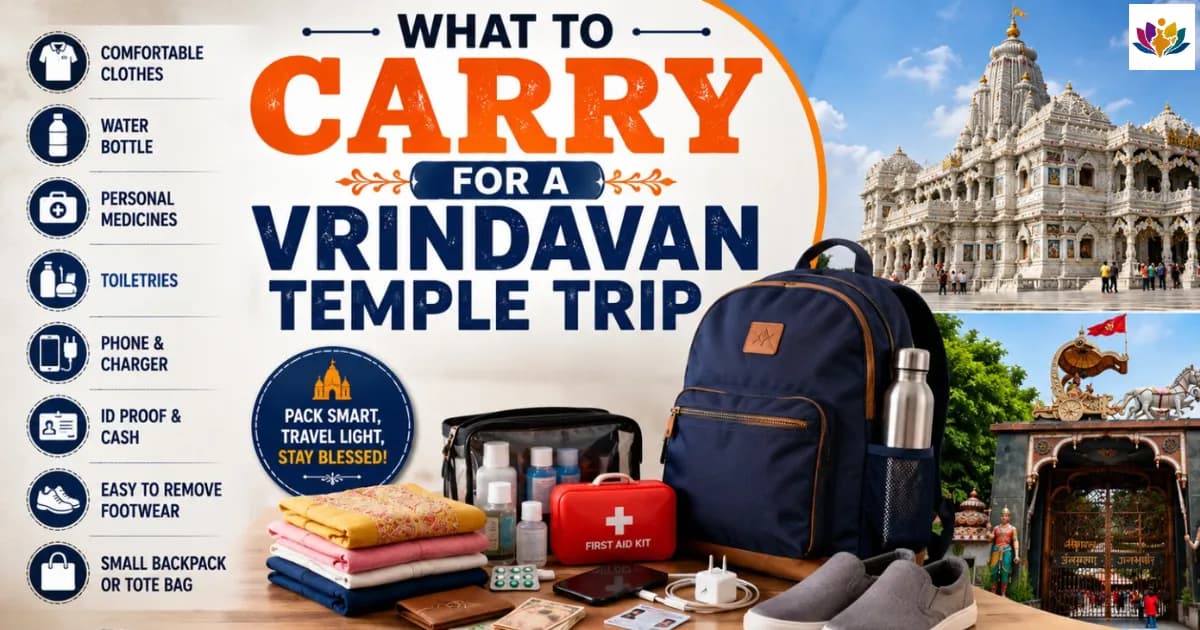
The Master Carry Checklist for a Vrindavan Temple Trip
This is the complete, item-by-item carry list for a Vrindavan temple visit, built from 8 years and 50,000+ pilgrim experiences.
Clothing & Accessories
Item | Quantity | Notes |
Cotton kurta (men) or salwar kameez (women) | 1 per day | Covers shoulders and knees - required at all major temples |
Dupatta or scarf | 1 | Head covering for women at Radha Raman, Dwarkadhish; also useful against sun |
Innerwear + undergarments | 1 per day | Cotton preferred for heat |
Light cotton socks | 1 pair per day | Protects feet on hot stone floors in summer |
Easy slip-on footwear (flat sandals or jootis) | 1 pair | Must remove at every temple; slip-ons save 3–5 minutes per visit |
Backup dupatta or stole | 1 | Available outside temples for ₹50–₹100 but carry one to save time |
Bags & Carriers
Item | Notes |
Small cloth bag (max 30×25 cm) | For carrying shoes at each temple; also passes most cloak room rules |
Day bag (small, no metal frame) | Must fit in cloak room locker; large backpacks are turned away |
Do NOT bring | Trolley bags, rucksacks, laptop bags - these cannot enter temple premises |
Documents & Payments
Item | Notes |
Photo ID (Aadhaar, Voter ID, Passport) | Mandatory at Krishna Janmabhoomi security check |
Cash in ₹10, ₹20, ₹50 notes | For e-rickshaws, prasad, donations, shoe counters, local food |
UPI app (PhonePe, GPay) | Accepted at ISKCON gift shop, Prem Mandir entry - but carry cash as backup |
Printed tour booking confirmation | If booked with Experience My India - keep accessible, not buried in bag |
Health & Practical Essentials
Item | Notes |
Water bottle (600 ml–1 litre) | Refill points available at ISKCON and Prem Mandir |
Sunscreen SPF 50+ | For summer visits - stone lanes reflect heat; apply before leaving hotel |
Hand sanitiser (100 ml) | After shoe counter, prasad distribution queues |
Any personal medication | Carry in original packaging |
Light cotton handkerchief or face cover | For dust in lanes, incense smoke sensitivity |
Small first aid: plasters × 3–4 | For blister prevention on cobbled lanes |
Folding hand fan | Summer only - available locally for ₹30–₹50 but carry one |
What to Wear - Dress Code Temple by Temple
Vrindavan's dress code is not uniform across all temples. Each major temple has its own policy and enforcement varies. Here is the complete temple-by-temple dress guide, based on what Experience My India's pilgrims have encountered on the ground:
Temple | Men - Required | Women - Required | Strictly Prohibited |
Banke Bihari | Kurta/full trousers + shirt | Salwar kameez, saree or churidar with dupatta | Shorts, sleeveless, torn jeans, night suits |
ISKCON Vrindavan | Full trousers + shirt or kurta | Salwar kameez or saree | Shorts, sleeveless, revealing clothing |
Prem Mandir | Full trousers or kurta | Salwar kameez or saree | Shorts, sleeveless inside sanctum |
Radha Raman | Dhoti or kurta preferred | Saree or salwar with head covering | Shorts, sleeveless |
Krishna Janmabhoomi (Mathura) | Full trousers + shirt | Salwar kameez or saree | Shorts, sleeveless; leather items restricted near sanctum |
Dwarkadhish (Mathura) | Kurta or dhoti + kurta | Saree or salwar with head covering | Shorts, sleeveless |
The practical rule: Cover shoulders, cover knees, carry a scarf. This passes the dress check at every temple in Vrindavan and Mathura without exception.
Cotton clothing is the practical choice for summer visits - temperatures in Vrindavan reach 42–44°C in May and June. Synthetic fabric becomes uncomfortable within an hour of walking the lanes. Experience My India's guides brief every pilgrim on dress code 24 hours before the visit. Call +91-7302265809 if you have any doubt about a specific item.
If you arrive in Vrindavan dressed incorrectly, inexpensive traditional clothing is available from shops outside Banke Bihari and near the ISKCON gate - kurtas from ₹150, dupattas from ₹80. Budget ₹200–₹400 if you need to purchase on the day.
What NOT to Carry Into Vrindavan Temples
This is the most important section of this guide. The items below have caused actual pilgrims to lose 30–90 minutes at temple entry - or be turned away entirely.
Item | Why Not to Carry | Which Temple Enforces |
DSLR / mirrorless camera | Strictly prohibited inside the temple | Banke Bihari, Krishna Janmabhoomi |
Mobile phone | Must be deposited at security counter before entry | Krishna Janmabhoomi (Mathura) |
Selfie stick / tripod | Confiscated at entry | Banke Bihari, ISKCON |
Large backpack (laptop bag, rucksack) | Too large for cloak room lockers; entry denied | All major temples |
Leather shoes or leather belt (inside sanctum) | Some temples restrict leather near the deity | Radha Raman, Banke Bihari (informal) |
Outside food or sealed water bottles | Not permitted inside the sanctum | ISKCON, Prem Mandir, Janmabhoomi |
Tobacco, alcohol | Strictly prohibited in all Braj temples | All temples |
Flowers bought from outside | Accepted only if offered to the official prasad counter | Banke Bihari |
Photography rules, temple by temple:
Banke Bihari: Photography and video completely prohibited inside the temple - including on a mobile phone. Temple staff are stationed specifically to enforce this. Violations result in removal.
Krishna Janmabhoomi: All electronics including mobile phones must be deposited at the security counter before entry. The cloak room is free but queues form quickly between 8:00 AM and 11:00 AM.
ISKCON: Photography permitted in garden areas and exterior. Restricted during aarti inside the sanctum.
Prem Mandir: Photography allowed outdoors. Not permitted inside the main deity sanctum.
Radha Raman: No specific photography ban but photography during aarti is considered disrespectful and is discouraged by the pujari.
Experience My India's guides do a 2-minute pre-entry briefing at every temple - including which pocket to keep your phone in and which bag to put through the security check. This saves the average pilgrim 20–30 minutes of confusion per temple. Our guided Vrindavan darshan tour Packages start from ₹1,999 - call +91-7302265809.
How Much Cash to Carry for a Vrindavan Trip
Cash in Vrindavan matters more than most pilgrims expect. UPI is accepted in limited places. The vast majority of temple-related transactions - e-rickshaws, shoe counters, prasad, donations, local food, clothing shops - require physical cash in small denominations.
Expense | Typical Cost | Notes |
E-rickshaw (one way, within Vrindavan) | ₹20–₹50 per person | Shared; private auto costs ₹100–₹200 per trip |
Shoe counter fee | ₹10–₹20 | Some are free, some charge - carry ₹20 notes |
Prasad at Banke Bihari | ₹20–₹100 | Depends on what you purchase |
Prasad at ISKCON | Free (distributed at temple) | Buy flowers at gate for ₹20–₹50 |
Local thali meal near temple | ₹80–₹150 per person | Pure veg; widely available near Loi Bazaar |
Tulsi mala / chandan set | ₹50–₹300 | Souvenir shops near Banke Bihari Road |
Mathura Peda (per 250 gm) | ₹80–₹150 | Near Holi Gate, Mathura |
Emergency dupatta or kurta | ₹80–₹400 | If dress code check catches you unprepared |
Donation / mannat at temple | As desired | Carry ₹10 and ₹50 coins if possible |
Recommended cash to carry per day:
Single pilgrim (1 day): ₹800–₹1,200
Family of 4 (1 day): ₹2,500–₹3,500
If buying souvenirs or prasad in bulk: Add ₹1,000–₹2,000
ATMs are available near Mathura Junction and on the main Vrindavan road near Parikrama Marg. Inside old Vrindavan lanes near Banke Bihari, ATMs are limited - withdraw before you enter the temple zone.
The Same Day Vrindavan Tour by Experience My India includes all transport and guide fee from ₹1,999 per person, so you only need personal cash for prasad, food and any shopping.
Season-wise Packing - Summer vs Winter vs Festival Season
Your Vrindavan temple trip packing list should change based on when you visit. Here is what to add or swap for each season:
Item | Summer (Apr–Jun) | Winter (Oct–Mar) | Festival Season (Janmashtami/Holi) |
Clothing layers | 1 cotton kurta per day - light | 2 layers: kurta + light jacket for evenings | Cotton kurta - festivals run hot even in winter |
Sun protection | Sunscreen SPF 50+, cap or hat | Optional - pleasant weather | Sunscreen if outdoor events |
Water | 1 litre bottle minimum | 500 ml bottle sufficient | 1 litre+ - festival crowds are tiring |
Footwear | Cotton socks under jootis - stone lanes reach 55°C at midday | Warm socks - stone floors cold before 8 AM | Slip-ons only - festival crowds make lacing impractical |
Crowd management | Visit before 10 AM or after 5 PM | Full day flexibility | Arrive 2 hours before aarti - queues are 90–180 min at Banke Bihari during Janmashtami |
Monkey precaution | Active near Banke Bihari and Nidhivan | Less active in cold | Active - food in hand attracts monkeys |
Cash buffer | Add ₹200 for water, cold drinks, electrolyte | Standard amount | Add ₹500 extra - festival stalls and impulse purchases |
Summer-specific note: Vrindavan in May–June has temperatures of 42–44°C. Stone lanes and open courtyards amplify heat significantly. Carry an ORS sachet or electrolyte powder if you are visiting with elderly family members. The 4-Day Mathura Vrindavan Tour Package by Experience My India from ₹7,999 builds midday rest time into the itinerary specifically for summer visits.
Festival-specific note: During Janmashtami (August) and Holi (March), Vrindavan's lanes see footfall of 2–5 lakh pilgrims per day. Keep your bag minimal - a single small cloth bag is all you should carry on festival days. Do not wear white on Holi unless you intend to participate in colour play. Experience My India adjusts all packing briefs seasonally - call +91-7302265809 for the current season's specific advice.
Ground Truth - What Nobody Tells You Before You Pack
After guiding 50,000+ pilgrims through Vrindavan since 2018, here are the packing realities that most travel blogs skip entirely:
1. Slip-on footwear is not a preference - it is a time-saving tool. Every major temple requires shoe removal. At 5 temples per day, that is 10 shoe removal-and-wear cycles. Lace-up shoes cost you 5–10 minutes per temple. Over a full day, that is 50–100 minutes lost to footwear. Carry flat kolhapuri sandals or slip-on jootis exclusively.
2. Carry ₹10 and ₹20 notes specifically. Shoe counters, e-rickshaw fares and small prasad purchases all run at ₹10–₹30. Vendors near Banke Bihari frequently cannot break ₹500 notes - and you will waste 10 minutes waiting for change at the worst possible moment (just before an aarti begins).
3. Monkeys near Banke Bihari and Nidhivan are opportunistic. They will take food, glasses and open bags from inattentive pilgrims. Do not carry biscuits, fruits or food in your hand or in an open bag near these temples. A closed zipper cloth bag is sufficient protection. This is not a generic warning - it is a specific operational reality that Experience My India guides address in every pre-temple briefing.
4. A backpack that worked in Rishikesh may not work in Vrindavan. Rishikesh temples allow bags freely. Vrindavan's major temples have bag size limits - anything larger than a small day bag (roughly 20×30 cm) goes to the cloak room. A 40-litre rucksack means a 20-minute cloak room queue before you even enter the temple. Leave large bags at the hotel.
5. Your phone needs a decision before each temple, not at the gate. Krishna Janmabhoomi requires depositing your mobile phone at security. Banke Bihari prohibits its use inside. ISKCON restricts it during aarti. Having a plan - whether to leave it at the hotel or in the guide's bag - before you arrive at the temple gate saves the frantic decision under crowd pressure. Experience My India's guides hold a designated secure bag for all pilgrim valuables at each temple entry.
Call +91-7302265809 and speak with Gurudutt directly. He will send you a personalised carry checklist based on your exact travel dates, group size and the temples on your itinerary.
Plan Your Vrindavan Temple Trip with Experience My India
A successful Vrindavan temple trip comes down to three things: the right clothing, the right bag and knowing which item goes where before you reach the gate. The checklist in this guide is what Experience My India's team hands to every pilgrim before every tour. Follow it and you eliminate 90% of the avoidable delays, entry refusals and wasted time that first-time visitors encounter.
If you would rather have someone manage all of it - the carry briefing, the temple sequencing, the darshan flow, the transport - that is exactly what Experience My India is built for.
Guided tour packages start from ₹1,999. Our rating is 4.5★ from 204+ pilgrims.
📲 WhatsApp us now - send a message to +91-7302265809.
We will reply with a tailored plan - including a personalised carry checklist for your specific temples and dates - within the hour.
Explore all Mathura Vrindavan Tours
Jai Shri Krishna 🙏
Meet Gurudutt — Your Mathura Vrindavan Guide
Not just a tour operator — Gurudutt was born and raised in Braj Bhoomi. He has spent over a decade personally guiding pilgrims through the sacred lanes of Mathura & Vrindavan.

Founder – Experience My India
Gurudutt
Founder · Experience My India