Travel Guide · Pilgrimage & Yatra · Updated June 2026
Vrindavan Parikrama 2026: Route, Distance, Timings, Places & Complete Guide
By Gurudutt, Experience My India·14 June 2026
Quick Answer
Quick Enquiry
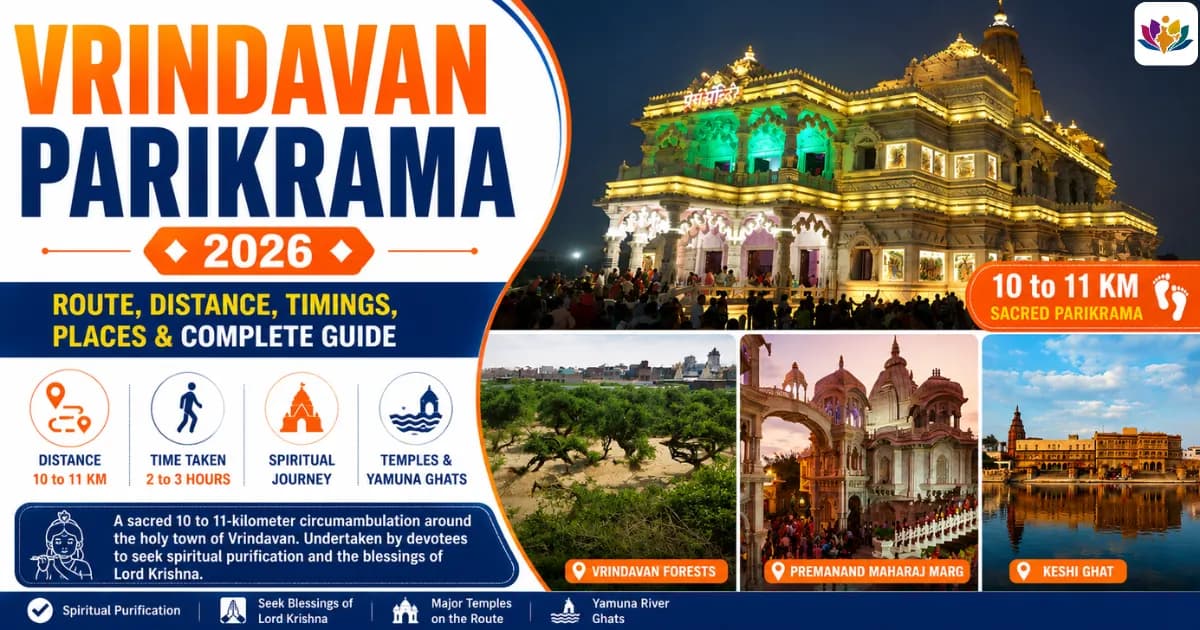
Vrindavan Parikrama is not simply a walk. It is one of the oldest continuous devotional practices in the Braj tradition - a circumambulation of the entire town of Vrindavan that devotees have performed since the 16th century. Unlike visiting a single temple, the parikrama takes you around the outer boundary of Vrindavan, touching its most sacred sites, its ancient ghats and the forest groves associated with Krishna's pastimes, in a single continuous act of devotion.
I am Gurudutt, born and raised in Braj Bhoomi and the founder of Experience My India. Since 2018, I have guided 50,000+ pilgrims through the Vrindavan Parikrama - on Ekadashi mornings when thousands of devotees walk together chanting the Maha Mantra and on quiet Tuesday mornings when our groups complete it almost alone. Every detail in this guide is from direct experience.
By the end of this guide you will know the exact route with stop-by-stop distances, the correct starting time for each season, what "84 Kos Parikrama" actually means versus the town parikrama, the best days to walk, how senior citizens can complete the parikrama by e-rickshaw and the practical customs around barefoot walking and what to carry.
What Is Vrindavan Parikrama and Why It Matters
Parikrama - circumambulation - is one of the most fundamental devotional practices in Hinduism and the Vaishnav tradition. The act of walking around a sacred place in a clockwise direction, with the sacred site to your right, is considered an act of reverence and a means of receiving the blessings associated with every site you pass.
Vrindavan Parikrama circumambulates the entire town of Vrindavan - the forest-city where Krishna spent his childhood. The path follows the outer boundary of the original Vrindavan forest, passing all the major temples established by the Six Goswamis in the 16th century, the Yamuna river ghats, the sacred groves and the ancient stone ghats.
The parikrama is different from visiting temples in a random sequence because it follows the sacred geography of Vrindavan in order - the same route that Vaishnav saints have walked for centuries. The path passes sites mentioned in the Bhagavata Purana and the Gaudiya Vaishnav texts, making each step a continuation of a tradition that predates most of the temples themselves.
Experience My India includes Vrindavan Parikrama as a dedicated morning experience in all 2-day and longer Vrindavan tour packages. WhatsApp +91-7302265809 to add it to your itinerary.
Vrindavan Parikrama Route - Stop by Stop
The most commonly followed Vrindavan Parikrama route starts and ends near ISKCON Temple (Sri Krishna Balaram Mandir) in the Raman Reti area and follows a clockwise direction through the town. This is the route Experience My India uses for all guided parikramas.
The complete route sequence:
Start: ISKCON Temple (Raman Reti area) ↓
Madan Mohan Temple - One of the oldest temples in Vrindavan, established in the 16th century. The red sandstone shikhara is one of the most distinctive in Braj. The temple sits on a hillock - brief upward path of 50-60 metres.
Kaliya Ghata - The ghat where Krishna danced on the head of the serpent Kaliya in the Yamuna. A relatively quiet ghat with old stone architecture. The Kaliya Naag rock is pointed out here.
Keshi Ghat - The primary Yamuna ghat of Vrindavan. Named after the demon Keshi whom Krishna defeated here. Built by Queen Laxmi Devi of Bharatpur in the 17th century - one of the few original ghats still intact.
Imli Tala - The ancient tamarind tree under which Krishna is said to have sat and played the flute. The tree is hundreds of years old; the site is marked by a small temple.
Nidhivan - The enclosed forest grove of 16,000 twisted plants, believed to be gopis who participate in Krishna's Raas Leela nightly. Entry is free; the grove closes before sunset.
Seva Kunj - Immediately adjacent to Nidhivan. The sacred grove where Krishna decorated Radha's hair. Quieter than Nidhivan; open during morning hours.
Banke Bihari Temple area - The parikrama passes through the approach lanes near Banke Bihari Temple. The temple itself is slightly off the main parikrama path.
Sringara Vat - A sacred tree marking the spot where Krishna tied Radha's braid in a playful act. One of the smaller but devotionally significant stops on the route.
Return to ISKCON Temple
Vrindavan Parikrama Distance and Time
Mode | Distance | Time | Notes |
Walking (full route) | 10-11 km | 2-3 hours | Standard pace with brief stops at major sites |
Walking (Ekadashi - slower, more crowds) | 10-11 km | 3-4 hours | Larger crowd, more chanting stops |
E-rickshaw (senior citizen option) | 10-11 km | 1.5-2 hours | With stops at key sites - cab follows route |
Running / fast walk | 10-11 km | 1-1.5 hours | Unusual - this is a devotional walk, not a fitness circuit |
The 10-11 km distance is the standard Vrindavan town parikrama. This is different from the 84 Kos Parikrama (see dedicated section below) which covers the entire outer Braj circuit of approximately 270 km.
Experience My India walks the parikrama at a devotional pace - stopping for 10-15 minutes at each major site for context and reflection, not rushing past them. Total time with this approach: 3-3.5 hours. WhatsApp +91-7302265809 to join a guided parikrama.
Complete Stop-by-Stop Route Table
Stop | Distance from Previous Stop | Cumulative Distance | Key Significance |
ISKCON Temple (start) | - | 0 km | Starting point - most organised approach |
Madan Mohan Temple | 1.8 km | 1.8 km | Oldest active temple in Vrindavan - 16th century |
Kaliya Ghata | 0.7 km | 2.5 km | Yamuna ghat - site of Kaliya serpent episode |
Keshi Ghat | 0.9 km | 3.4 km | Primary Yamuna ghat - 17th century sandstone |
Imli Tala | 0.8 km | 4.2 km | Ancient tamarind tree - Krishna's flute-playing site |
Nidhivan | 0.6 km | 4.8 km | 16,000-plant grove - Raas Leela site |
Seva Kunj | 0.3 km | 5.1 km | Sacred grove - Radha's shringar site |
Banke Bihari lanes | 0.7 km | 5.8 km | Pass through old city lanes |
Sringara Vat | 0.5 km | 6.3 km | Sacred fig tree - Radha-Krishna pastime |
Loi Bazaar / old city section | 1.2 km | 7.5 km | Market lanes - Vrindavan's commercial heart |
Return approach to ISKCON | 2.5 km | 10-11 km | Completes the circuit |
Note: Distances between stops are approximate - the exact parikrama path varies slightly depending on the guide and current road conditions. The total circuit consistently measures 10-11 km.
Want a guided Vrindavan Parikrama? Experience My India leads guided parikramas as part of all 2-day Vrindavan tour packages - stop-by-stop context at every site, correct barefoot customs, Ekadashi timing managed. From ₹3,499 per person. View 2 Days Vrindavan Tour
Vrindavan Parikrama Timings - When to Start
The time you begin the parikrama determines both the temperature and the crowd experience.
Start Time | Season | Crowd Level | Temperature | Verdict |
4:00-5:00 AM | Oct-March | Very low | 12-20°C | ✅ Most peaceful - darkness fades during walk |
5:30-6:30 AM | Oct-March | Low | 14-22°C | ✅ Recommended - morning light, manageable |
7:00-8:00 AM | Oct-March | Moderate | 18-26°C | ✅ Good - temples opening, lively atmosphere |
6:00 AM | April-June | Very low | 28-32°C | ⚠️ Start no later - complete by 8:30 AM before heat |
4:30-5:30 AM | Ekadashi | High (thousands) | Variable | ✅ Best Ekadashi timing - join the main crowd |
9:00 AM+ (any season) | Any | Moderate-high | 30-45°C | ❌ Avoid - heat and crowds combine |
Practical timing guide by season:
October to March: Start between 5:30 AM and 7:00 AM. The walk is comfortable throughout and morning darshan at roadside temples is active.
April to June: Start no later than 6:00 AM. The route passes open stone surfaces that become extremely hot underfoot by 9:00 AM - critical for barefoot walkers.
July to September (monsoon): Start between 6:00 AM and 7:00 AM. Some path sections become waterlogged - non-barefoot sections may be muddy.
Ekadashi: Start at 4:30-5:00 AM to walk with the main gathering of pilgrims chanting the Maha Mantra.
Experience My India plans all parikrama starts at the optimal time for the specific season and date. WhatsApp +91-7302265809.
Best Days for Vrindavan Parikrama - Ekadashi and Festival Calendar
Day / Occasion | Crowd Level | Atmosphere | Verdict |
Ekadashi (twice monthly) | Very high | Thousands chanting Maha Mantra together | ✅ Most spiritually charged - book ahead |
Purnima (full moon) | High | Moonlit parikrama - deeply atmospheric | ✅ Recommended |
Kartik Month (Oct-Nov) | Very high | Most significant month for Vaishnavs | ✅ Peak spiritual season |
Janmashtami (Aug/Sept) | Extremely high | Hundreds of thousands in Vrindavan | ⚠️ Parikrama possible but very crowded |
Regular Tuesday | Very low | Almost private parikrama | ✅ Best for quiet personal parikrama |
Regular Monday morning | Low | Some pilgrims, very peaceful | ✅ Good for senior citizen groups |
Saturday / Sunday | Moderate-high | Weekend visitors from Delhi NCR | ⚠️ Manageable - start by 5:30 AM |
Ekadashi parikrama - what it actually looks like: On Ekadashi, the Vrindavan Parikrama draws 5,000-15,000 devotees walking together chanting the Hare Krishna Maha Mantra. The collective chanting creates an atmosphere that regular-day parikramas cannot replicate. Kirtana groups with drums and kartals punctuate the route. For first-time parikrama walkers, an Ekadashi is the recommended first experience despite the crowd.
Experience My India checks the Braj Panchang for Ekadashi dates for your specific travel month. WhatsApp +91-7302265809 and mention Ekadashi parikrama specifically when enquiring.
Vrindavan 84 Kos Parikrama vs Vrindavan Town Parikrama - The Difference
This is one of the most commonly confused topics among pilgrims planning a Vrindavan visit. These are two completely different parikramas.
Feature | Vrindavan Town Parikrama | 84 Kos Parikrama |
Distance | 10-11 km | 270 km (84 kos = 270 km) |
Area covered | Vrindavan town boundary | Entire outer Braj circuit |
Time to complete | 2-3 hours (walking) | 5-7 days (walking) / 2-3 days (by vehicle) |
Route | Vrindavan's perimeter | Entire Braj Mandal - all 12 forests |
Key stops | Madan Mohan, Keshi Ghat, Nidhivan, Seva Kunj | Vrindavan + Govardhan + Barsana + Nandgaon + all outer Braj |
Starting point | ISKCON Temple, Vrindavan | Mathura / Vrindavan |
Frequency | Any day - Ekadashi most auspicious | Kartik Month - most auspicious |
Best for | First-time pilgrims, day visitors | Dedicated Braj pilgrims with 5+ days |
The 84 Kos Parikrama covers the outer boundary of the entire Braj Mandal - the sacred region associated with all of Krishna's pastimes. "84 kos" refers to 84 kos (a traditional unit of measurement), approximately 270 km. This is a multi-day pilgrimage done during Kartik Month (October-November) when tens of thousands of devotees walk the complete outer Braj circuit.
Experience My India offers the 84 Kos Parikrama tour - cab follows the group, key stops are visited on foot, elderly pilgrims are transported between sites. WhatsApp +91-7302265809 for details on the 84 Kos Parikrama vehicle-support package.
Customs and Practical Rules - Barefoot, Clothing, What to Carry
Barefoot tradition: The Vrindavan Parikrama is traditionally done barefoot - the entire Vrindavan town is considered sacred ground and removing footwear is an act of reverence. The path passes through stone lanes, ghats and forested areas. In October-March, the stone is cool and comfortable. In April-June, stones heat significantly by 8:30-9:00 AM - completing the walk before this window is essential for barefoot walkers.
Footwear storage: Several facilities exist at or near the ISKCON Temple starting point for storing footwear (nominal fee ₹20-₹50). Experience My India's guides carry a designated footwear bag for each group member - shoes collected at the start, returned at the conclusion.
What to wear:
Cotton kurta or comfortable loose-fitting Indian attire
Women: salwar kameez or comfortable churidar - covering shoulders and knees
Light clothing - the walk generates body heat
No leather clothing or belts on the parikrama route (some traditions observe this)
What to carry:
A small water bottle (500 ml minimum - not food, not large bags)
Any specific prasad or flowers for offering at key stops
A small bag that can be carried hands-free (crossbody or small backpack)
No mobile phone photography inside Nidhivan (respect the atmosphere)
Chanting: Many pilgrims chant the Hare Krishna Maha Mantra or the Radhe Radhe chant throughout the walk. On Ekadashi, collective chanting is continuous. Individual chanting with japa beads is common and adds to the devotional quality of the walk.
Senior Citizen and Differently-Abled Parikrama Options
Vrindavan Parikrama is fully accessible for elderly and mobility-limited pilgrims - with the right planning.
E-rickshaw / cab-assisted parikrama: Experience My India arranges a cab or e-rickshaw that follows the parikrama route. Elderly pilgrims walk short sections (200-300 metres) at the key stops - Keshi Ghat, Madan Mohan, Nidhivan, Seva Kunj - and are transported between stops. This approach covers every major spiritual site without requiring the full 10-11 km walking distance.
Approach | Walking Distance | Riding Distance | Time |
Full walking parikrama | 10-11 km | 0 | 2-3 hours |
Partial walking (senior option) | 1.5-2 km at key stops | 8-9 km | 2-2.5 hours |
Full e-rickshaw (very limited mobility) | 200-300 m total | 10 km | 1.5-2 hours |
Cost of e-rickshaw for parikrama route: Full route hire: ₹150-₹250 for a shared e-rickshaw / ₹300-₹500 for a private e-rickshaw for a 2-hour parikrama circuit. Experience My India includes this in all senior citizen Vrindavan packages. WhatsApp +91-7302265809 with your specific requirements.
Stone path note: The main parikrama path is paved stone for most of the route - flat, manageable for most elderly visitors. The approach to Madan Mohan Temple involves a 50-60 metre upward path on stone - this is the most physically demanding section. Experience My India guides always give elderly visitors the option to view Madan Mohan from the base while the others ascend.
Ground Truth - What Nobody Tells You About Vrindavan Parikrama
1. Ekadashi parikrama with 10,000+ pilgrims is a completely different experience from a regular Tuesday morning walk. Both are "Vrindavan Parikrama" but the experience is as different as a quiet temple at 8 AM versus a festival day at noon. On Ekadashi, the collective devotion, chanting, prasad distribution along the route and the sheer energy of thousands of pilgrims walking together creates something that a solo or small-group parikrama cannot replicate. Experience My India recommends first-time pilgrims do their first parikrama on an Ekadashi.
2. The stone path between Nidhivan and Banke Bihari lanes becomes extremely narrow in sections - 1 to 2 metres wide. For groups larger than 6, this section requires single-file movement. On Ekadashi or festival weekends, this lane can be shoulder-to-shoulder for 200-300 metres. Elderly pilgrims in large groups should have a guide managing pace and position here. Experience My India always has a guide at the front and rear of any group larger than 4.
3. Barefoot walking after 8:30 AM in summer (April-June) becomes genuinely painful within 20 minutes. The stone and brick path absorbs significant heat. Experienced Braj walkers start at 4:30-5:30 AM specifically to complete the walk before stone temperatures rise. The alternative - carrying slippers and wearing them outside strictly sacred points - is widely practised and entirely acceptable; Experience My India briefs every pilgrim on this practically.
4. The complete parikrama crosses through Loi Bazaar - the busiest market lane in Vrindavan. This section is not a peaceful forest path or a quiet ghat. The parikrama route passes through Vrindavan's main commercial area, which is active with vendors, e-rickshaws and local traffic from 8:00 AM onwards. On Ekadashi mornings at 5:00 AM, it is empty and atmospheric. On a Saturday afternoon, it is chaotic. Starting time determines which version you experience.
5. The Sringara Vat stop is frequently skipped by commercial tour groups - it should not be. Sringara Vat is a sacred tree with a small shrine that marks the spot where Krishna is said to have tied Radha's braid in a loving act during the Raas Leela. It is one of the few stops on the parikrama with a direct connection to the Radha-Krishna relationship - not just a temple building but a natural site. Experience My India always stops at Sringara Vat with context.
Ready to Walk the Vrindavan Parikrama with Experience My India?
WhatsApp us and receive your personalised Vrindavan Parikrama guide within 30 minutes - Ekadashi date check, starting time, route brief, barefoot customs and e-rickshaw option if needed - all prepared before you arrive. Packages from ₹1,999 per person.
WhatsApp +91-7302265809 - Book Now
Jai Shri Krishna 🙏
Meet Gurudutt — Your Mathura Vrindavan Guide
Not just a tour operator — Gurudutt was born and raised in Braj Bhoomi. He has spent over a decade personally guiding pilgrims through the sacred lanes of Mathura & Vrindavan.
Founder – Experience My India
Gurudutt
Founder · Experience My India


_converted.webp&w=1920&q=75)
_converted.webp&w=1920&q=75)