Travel Guide · Temple Guides · Updated October 2026
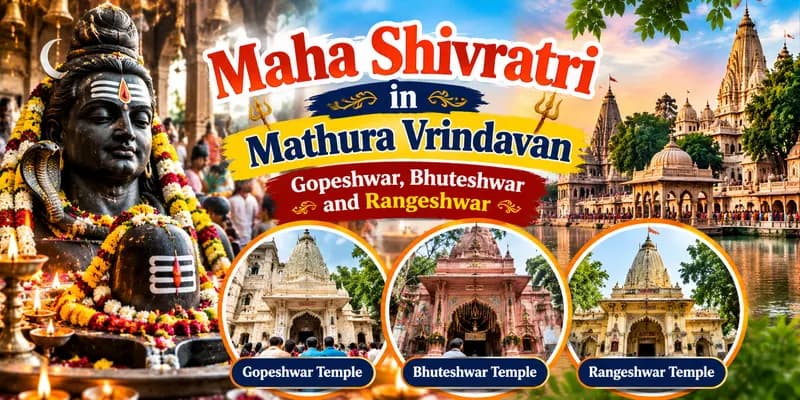
Maha Shivratri in Mathura Vrindavan: Gopeshwar, Bhuteshwar and Rangeshwar
By Gurudutt, Experience My India·31 October 2026
Quick Answer
Quick Enquiry
People are often surprised to learn how important Shiva is in Krishna’s own land, but we Brajwasis know it well: Shiva guards Braj, standing watch over Krishna’s playground as its Kotwal. On Maha Shivratri the Shiva temples stay open all night and the whole town is awake with bells, bhajans and the offering of milk and bel leaves. My favourite is Gopeshwar in Vrindavan, where by our tradition Shiva took the form of a gopi to witness the Raas and the Lingam is dressed as Mahadev by day and as a gopi by night. If you come for Shivratri, plan for a night, not a day, pace yourself and let me map the temple circuit for you so you are not lost in the crowds at 1 AM. See our Mathura Vrindavan tour Packages or message WhatsApp +91 7302265809.
Maha Shivratri in Braj: Shiva, the guardian of Krishna’s land
It can seem a surprise that Maha Shivratri, Lord Shiva’s great night, is so important in Mathura and Vrindavan, the land of Krishna. But in the Braj tradition there is no contradiction: while Krishna is the beloved Lord of Braj, Shiva is revered as its eternal guardian, the Kshetrapala or Kotwal who protects the sacred region and its sites. By tradition, ancient Shiva shrines stand as the guardians of the directions and quarters of the holy land, watching over Krishna’s playground. So in Braj, devotion to Krishna and devotion to Shiva are woven together and several of the Shiva temples are themselves tied directly to the Krishna story.
This is why Maha Shivratri in Mathura and Vrindavan is celebrated with such feeling and why it centres on visiting these powerful, ancient Shiva temples. On the night of Shivratri the shrines stay open through the night for continuous worship, the four Prahar pujas (the four watches of the night), Rudrabhishek (the ritual bathing of the Lingam) and night-long vigils (Ratri Jagaran), with devotees offering milk, water and bel (belpatra) leaves. Three temples in particular are legendary, each with its own extraordinary story and together they make the ideal Shivratri circuit of Braj, which the sections below cover in turn.
The 2027 date and muhurat timings
In 2027, Maha Shivratri falls on Saturday 6 March. By the Hindu lunar calendar, the Chaturdashi tithi begins at about 12:03 PM on 6 March 2027 and concludes at about 1:46 PM on 7 March 2027. The most important worship is at night and the highly auspicious midnight window, the Nishita Kaal puja, is roughly 12:07 AM to 12:57 AM on 7 March 2027.
For those keeping the observance, the key frames for the night of 6 to 7 March 2027 are: the Chaturdashi tithi beginning (about 12:03 PM on 6 March); the Nishita Kaal midnight puja window (about 12:07 AM to 12:57 AM); and the Shivratri Parana, the breaking of the fast, on 7 March from about 06:40 AM to 01:46 PM. Many devotees keep a night-long vigil and perform worship through the four Prahars (watches) of the night. Because the festival follows the lunar calendar, the date and the precise muhurat timings are set by the panchang and can vary slightly between calendars, so treat 6 March 2027 and these timings as expected and reconfirm nearer the time. The temple opening hours below are likewise approximate and are extended for the festival, so confirm them locally too.
Gopeshwar Mahadev, Vrindavan: the Shiva who became a gopi
The most beloved of Vrindavan’s Shiva temples, gopeshwar mahadev stands near Vamshi Vat on the banks of the Yamuna. It is considered one of the oldest shrines in Vrindavan, with its Lingam, by tradition, installed by Vajranabha, the great-grandson of Lord Krishna.
Its significance beautifully unites Shaivism and Vaishnavism. By the cherished lore, Lord Shiva longed to witness Krishna’s divine cosmic dance, the Maha Raas Leela, but no male was permitted within the arena except Krishna himself. So, after bathing in the Yamuna, Shiva was granted Sakhi Bhava, the inner mood of a gopi and entered the Raas in the form of a cowherd maiden. Krishna welcomed him as Gopeshwar, the Lord of the Gopis and made him the eternal gatekeeper of the Raas. To honour this, the deity is worshipped in its masculine form as a Shiva Lingam by day, but every evening is lovingly dressed in a colourful saree, shringar (makeup), jewellery and a nose ring and worshipped as a gopi by night. Devotees come here to pray for Gopi Bhava, the mood of selfless, loving devotion. These are devotional legends and traditions held dear by the faithful.
On Maha Shivratri, Gopeshwar stays open through the night to accommodate the thousands who come for continuous Rudrabhishek and the four nocturnal Prahar pujas. Its regular hours are approximately early morning (around 4:00 AM) to around noon and about 5:00 PM to 9:00 PM, though these are indicative, so confirm locally and they are extended into an all-night opening for the festival. The temple’s riverside setting near Vamshi Vat, among the yamuna ghats and leela sites, makes a Shivratri visit here especially atmospheric.
Bhuteshwar Mahadev, Mathura: the Kotwal of the city
In Mathura stands bhuteshwar mahadev, one of the city’s most important and ancient Shiva temples, located near the Bhuteshwar crossroads, within reach of the krishna janmabhoomi complex and roughly 3 km from Mathura Junction railway station. It houses a Swayambhu (self-manifested) Shiva Lingam.
By tradition, its founding is traced to Shatrughna, the younger brother of Lord Rama, who established Mathura after slaying a demon (in the tradition, Lavanasura). Bhuteshwar Mahadev is revered as the Kotwal, the supreme divine guardian and protector, of Mathura, standing among the shrines that guard the city from harm. It is also closely tied, in tradition, to the nearby Katyayani (Mata) Shakti Peeth, as the Bhairava shrine that safeguards it and the complex is associated with ancient sites of the sacred geography. Pilgrims on the traditional Vraja yatra visit this shrine to honour the city’s guardian alongside their Krishna darshan. These historical and devotional traditions are recounted as the temple’s own and held dear by the faithful.
On Maha Shivratri, Bhuteshwar opens early (around 4:00 AM on 6 March 2027) and stays open through the night into the morning of 7 March, for night-long vigils, special Rudrabhishek and prayers, with a continuous influx of devotees offering milk, belpatra (bael leaves) and by the customary tradition at Shiva shrines, bhaang. Its regular hours are approximately 5:00 AM to 1:00 PM and 4:30 PM to 10:30 PM, which are indicative and extended for the festival, so confirm locally.
Rangeshwar Mahadev, Mathura: the witness to Kansa’s defeat
The third of the great Shiva temples is Rangeshwar Mahadev, a historic stone temple in the southern sector of Mathura, along the Holi Gate and Tank Chauraha road. By local lore it is extraordinarily ancient and the Shivlinga here is famously said to be the very one that King Kansa, Krishna’s tyrant maternal uncle and a devout Shaivite, worshipped daily. Rangeshwar is revered as the Kshetrapal, the divine guardian of the southern quarter of Mathura.
Its story is deeply intertwined with the Kansa Vadh, the slaying of Kansa. By tradition, Kansa built his grand wrestling arena (the Rangashala) right by this temple, conspiring to trap and kill the young Krishna and Balarama and offered great prayers at this Lingam before the contest, seeking victory. Instead, as the Srimad Bhagavata recounts, Krishna broke Shiva’s heavy bow at the gate, defeated the tyrant’s wrestlers and ultimately slew Kansa, on the day of Shivratri by this tradition. Lord Shiva, watching the triumph of righteousness from his shrine, was overjoyed and danced in ecstasy; and because he bore witness to and rejoiced at the events of the Ranga (the arena), he came to be known forever as Rangeshwar, the Lord of the Arena. These are devotional legends and scriptural traditions held dear by the faithful.
On Maha Shivratri, Rangeshwar hosts major celebrations and runs special extended hours through the night on 6 March 2027, focused on the midnight Nishita Kaal puja (around 12:07 AM to 12:57 AM), with discrete aartis performed to honour Shiva’s joy at the liberation of Mathura. Its regular hours are approximately 5:00 AM to around noon and about 4:00 or 5:00 PM to 8:00 or 9:00 PM, with aartis through the day; these are indicative and extended for the festival, so confirm locally.
Doing the Shivratri temple circuit and practical planning
Maha Shivratri in Braj is a night festival, so plan around the night rather than the day. The ideal is a circuit of the three temples, Gopeshwar in Vrindavan and Bhuteshwar and Rangeshwar in Mathura, timed around the night watches and the midnight Nishita Kaal puja. Because the two towns are about an hour apart, see our mathura to vrindavan distance guide, a common approach is to base your evening in one town and its temple and plan transport carefully if you wish to combine both.
A few practical points for the night:
Plan for the night and pace yourself. With all-night opening, the four Prahar pujas and the midnight Nishita Kaal window, this is a late night or an all-nighter. Rest beforehand, pace your energy and be realistic about how many temples you can do well.
Expect large crowds and long queues. These temples draw thousands on Shivratri, with long lines for darshan and abhishek, so arrive early for each, keep your group together and be patient. The elderly, young children and anyone unwell should take special care in the crush and consider a shorter, calmer plan.
Offerings. Devotees traditionally offer water, milk and belpatra (bael leaves) to the Lingam; follow each temple’s arrangements for the abhishek and offerings, which are often streamlined into managed queues on the busy night.
Dress and essentials. Dress modestly and warmly, as early March nights are cool, carry water, keep valuables secure (and mind the monkeys in Vrindavan) and wear comfortable footwear for queueing and walking.
It is free. Darshan is free, so be cautious of anyone selling paid “VIP” access or quick-darshan shortcuts on the night.
For temple hours generally see our mathura vrindavan temple timings and must attend aarti guides, for arrival see how to reach vrindavan and for a base see where to stay in vrindavan. Confirm all timings nearer the time.
Planning your Maha Shivratri and how a Brajwasi can help
A night festival across two towns and three temples genuinely rewards planning. Confirm the live date (6 March 2027) and the Nishita Kaal and temple timings nearer the event, decide a realistic circuit (one town and temple or a careful Mathura-and-Vrindavan combination), rest beforehand for the late night, plan transport between the temples and set your expectations for big crowds and long queues met with patience. Many visitors also pair the Shivratri temples with the regular Krishna darshans by day.
Let a Brajwasi plan the night for you
An all-night, multi-temple festival with huge queues is exactly where a local makes the difference. As Brajwasis, we can confirm the live date and the Nishita Kaal and temple timings, map a realistic circuit of Gopeshwar, Bhuteshwar and Rangeshwar around the night watches, arrange transport between Vrindavan and Mathura and a place to rest, guide you through the crowds and the abhishek queues as smoothly as the night allows and keep you clear of touts, so your focus stays on the worship. A shared Mathura and Vrindavan darshan starts from around 1499 rupees per person; see our mathura vrindavan tour or we design a private Shivratri visit. Message us on WhatsApp at +91-7302265809 with your plans.
Related guides
Book Your Mathura - Vrindavan Trip Today
📞 +91-7302265809
💬 WhatsApp: +91-7302265809
We Reply in 30 Minutes
Packages start from ₹1,999/ person | Rated 4.5★ / 204+ Reviews
Explore all: Mathura Vrindavan Tour Packages
Jai Shri Krishna
Meet Gurudutt — Your Mathura Vrindavan Guide
Not just a tour operator — Gurudutt was born and raised in Braj Bhoomi. He has spent over a decade personally guiding pilgrims through the sacred lanes of Mathura & Vrindavan.
Founder – Experience My India
Gurudutt
Founder · Experience My India