Travel Guide · Festivals & Events · Updated October 2026
Widow Holi in Vrindavan: History and How to Witness It with Respect
By Gurudutt, Experience My India·20 October 2026
Quick Answer
Quick Enquiry
What Widow Holi is and the 2027 dates
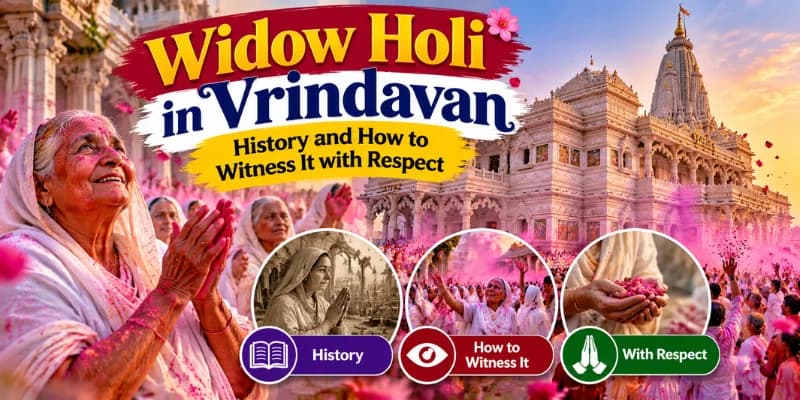
Widow Holi is a comparatively new tradition, begun in 2013, in which the widows of Vrindavan openly celebrate Holi, something orthodox custom denied them for centuries. The celebration prioritises fresh flower petals (marigolds and roses) and minimal, skin-friendly organic gulal over harsh synthetic colour and it carries enormous emotional weight as an act of joy and liberation.
For 2027, Widow Holi is expected on Friday, 19 March, a few days ahead of the main festivities: Holika Dahan on Sunday, 21 March and the main Rangwali Holi on Monday, 22 March 2027, with the Barsana Lathmar Holi earlier, around 16 March. Dates for the widows’ event are set by the organisers and usually fall a few days before the main Holi, so treat 19 March as the expected day and confirm the final programme locally before you plan around it. The primary gathering is in the courtyard of the gopinath temple and at the Meera Sahabhagini Ashram in Vrindavan. See our Mathura Vrindavan tour Packages or message WhatsApp +91 7302265809.
History and significance
Why this event matters and why it is so much more than a photo opportunity.
For centuries, orthodox social custom forced Hindu widows into a life of strict asceticism, isolation and renunciation. Mandated to wear only white, they were ostracised from community celebrations and festivals, their very presence traditionally considered a bad omen. Thousands of abandoned or destitute widows migrated to Vrindavan, so many that the town came to be called the City of Widows, to spend their remaining days in prayer.
That regressive tradition was fundamentally challenged in 2012, when the Supreme Court of India intervened over the plight of Vrindavan’s widows and directed the social-reform NGO Sulabh International, founded by Dr Bindeshwar Pathak, to oversee their welfare. In 2013, the NGO initiated the first large-scale Widow Holi. For the first time in centuries, hundreds of widows threw off the taboo to sing, dance and play with colour. Today the event stands as a global symbol of social reform, inclusion and reclaimed dignity and that history is exactly why it deserves to be witnessed with care.
The meaning behind the colour
To understand why Widow Holi moves people so deeply, it helps to grasp what colour itself signifies here. For a traditional Hindu widow, the loss of colour was not a small thing; it was the outward sign of a whole life of enforced withdrawal. White dress, bare wrists, no vermilion, no festivals: these marked her as someone set apart from ordinary joy. To take colour away was, in effect, to take away a share of belonging. So when these women lift handfuls of gulal and let marigold petals rain down, they are not simply playing a game, they are reclaiming the very thing that exclusion had stripped from them.
That is why the sight of white sarees blooming into pink and gold carries such weight and why it should never be reduced to a striking photograph. Each woman in that courtyard has her own long history of grief and survival and the laughter you see is hard-won. For many it is also a gesture of solidarity: a shared, public refusal of a taboo that kept them small. Holding this meaning in mind changes how a visitor stands in the courtyard, from spectator to witness and it is the single most important thing to carry into the day. The colour is joyful, but it is joy with a long shadow behind it and that is precisely what makes it sacred.
How to witness it with respect
Because of its deep emotional and social weight, this event asks visitors to be mindful witnesses rather than casual tourists. Please hold to these.
Do not treat it as a spectacle
This is a highly emotional, therapeutic act of joy and liberation for women who have faced a lifetime of trauma and isolation. Maintain a quiet, reverent demeanour, especially when entering temple spaces and let the celebration belong to the women at its heart.
Use gentle, herbal colours only
The celebration prioritises fresh flower petals (marigolds and roses) and minimal, skin-friendly organic gulal. Do not bring or throw harsh synthetic dyes, water balloons or wet colours, which can harm elderly skin and break the spirit of the day.
Seek consent before photography
The sight of white sarees covered in bright pink and yellow gulal draws photographers from around the world, but pushing a camera or phone into the face of an elderly participant is intrusive and unkind. Always wait for a nod or a smile before any close-up portrait and lower your camera the moment it is not welcome.
Dress modestly
As in all holy places in Braj, dress conservatively, modest Indian attire or loose clothing that covers your shoulders and knees. Choose something you do not mind getting stained by stray powder.
Respect private spaces
The public event is in the Gopinath Temple courtyard. Do not enter the ashram living quarters or the seating zones reserved for the elderly residents unless the organisers explicitly invite you. Their home is not a venue.
What to expect on the day
Picture the setting so you arrive prepared. The celebration unfolds in and around the Gopinath Temple courtyard, an old, atmospheric space that fills steadily through the morning. Volunteers and organisers set out baskets of marigold and rose petals and trays of soft herbal gulal and the mood builds gradually from quiet gathering and bhajan-singing into open colour-play, song and dance. The women themselves lead the rhythm of the day; there is no ticket, no stage and no fixed script, which is part of its grace. Expect warmth, tears and real joy in equal measure.
Expect crowds too, including a large number of photographers and film crews drawn by the striking images, which is exactly why restraint matters so much. Arriving early helps you find a respectful spot before the courtyard is packed and it gives you time to greet the organisers and understand where visitors may and may not stand. The lanes around the temple are narrow and often closed to cars during the Holi season, so plan to walk or take an e-rickshaw the last stretch. Bring only gentle colour, keep your belongings light and be ready to simply pause and take it in rather than document every moment. The most memorable part for most guests is not a photograph at all, but standing quietly in that courtyard as the colour flies and understanding what it means to the women throwing it.
Where it happens and the wider Braj Holi
The heart of Widow Holi is the historic courtyard of the Gopinath Temple, with gatherings also at the Meera Sahabhagini Ashram, both in Vrindavan. If you are coming for it, you are arriving in the middle of the most spectacular Holi season in India, so plan to see more of Braj around it: the famous Barsana Lathmar Holi (expected around 16 March 2027), the flower-petal Phoolon Wali Holi at the barsana radha rani temple and Banke Bihari and the main Rangwali Holi on 22 March. Temple hours shift a lot during the festival, so see our mathura vrindavan temple timings guide and confirm the day’s programme locally and our mathura vrindavan tour itinerary to plan the wider trip.
Beyond Holi: supporting the widows year round
Widow Holi is one radiant day, but the women at its heart live their whole year in the ashrams and care homes of Vrindavan and the most meaningful response to the celebration is to care about them beyond it. If the day moves you, let that feeling become something lasting rather than a single photograph. The steady needs are the ordinary ones: food, clean housing, healthcare for an ageing community, help securing identity documents and pensions, and for younger and able-bodied women, literacy and a trade that can restore independence.
The honest way to help is through verified organisations that do this work on the ground, rather than through cash handed to individuals, which can perpetuate begging. Before giving to any group, check its registration and track record and donate through its official channels. Simply spreading accurate, respectful awareness of the widows’ story and treating the women as citizens with dignity rather than as a cause to be pitied, is itself a contribution. Seen this way, Widow Holi is not an isolated spectacle but a window into a community that deserves support all year and the visitor who carries that understanding home has truly understood the day.
Witness Widow Holi with care
This is a moment to be a good guest and that is exactly where a local who knows the courtyard, the organisers and the right timing makes all the difference. As a Brajwasi who hosts guests through the Holi season, I can help you witness this with dignity: arriving at the right time, dressed and supplied with gentle herbal colour, photographing only with consent and keeping clear of the residents’ private spaces, while also showing you the wider Braj Holi (Barsana, Nandgaon, Phoolon Wali Holi and the main day). Attending is free. We design respectful, private Braj Holi experiences around it. Message us on WhatsApp at +91-7302265809 with your dates and we will arrange it thoughtfully.
Related guides
Book Your Mathura - Vrindavan Trip Today
📞 +91-7302265809
💬 WhatsApp: +91-7302265809
We Reply in 30 Minutes
Packages start from ₹1,999/ person | Rated 4.5★ / 204+ Reviews
Explore all: Mathura Vrindavan Tour Packages
Jai Shri Krishna
Meet Gurudutt — Your Mathura Vrindavan Guide
Not just a tour operator — Gurudutt was born and raised in Braj Bhoomi. He has spent over a decade personally guiding pilgrims through the sacred lanes of Mathura & Vrindavan.
Founder – Experience My India
Gurudutt
Founder · Experience My India