Travel Guide · Travel Guides · Updated September 2026
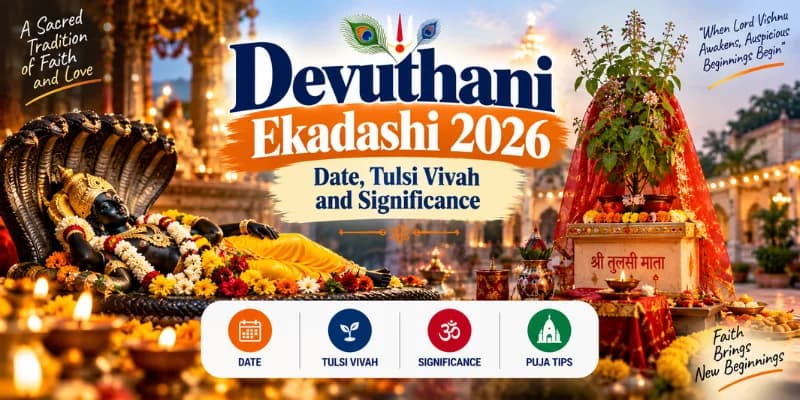
Devuthani Ekadashi 2026: Date, Tulsi Vivah and Significance
By Gurudutt, Experience My India·9 September 2026
Quick Answer
Quick Enquiry
Devuthani Ekadashi 2026 at a glance
Detail | Information (confirm with local panchang) |
Main fasting day | Friday, November 20, 2026 |
Ekadashi Tithi begins | November 20, 2026, at 07:15 AM |
Ekadashi Tithi ends | November 21, 2026, at 06:31 AM |
Gauna / Vaishnava observance | Saturday, November 21, 2026 |
Parana (fast break) time | November 21, 2026, between 01:11 PM and 03:18 PM |
Marks | Vishnu's awakening, the end of Chaturmas and Tulsi Vivah |
When is Devuthani Ekadashi in 2026
Devuthani Ekadashi in 2026 falls on Friday, November 20, the eleventh day of the bright fortnight of the month of Kartik. The Ekadashi tithi begins early on November 20 and ends early on November 21 and by some traditions, the Gauna or Vaishnava observance, it is kept on Saturday, November 21, with the fast broken at the parana time that day. It is one of the most auspicious Ekadashis of the year, for it is the day Lord Vishnu wakes from his cosmic sleep. As tithi timings shift a little by place and panchang, confirm the exact times locally; and to spend the day in the temples of Krishna's own land, a mathura vrindavan tour package with Experience My India can bring you to Braj.
From the ground (Gurudutt): Devuthani Ekadashi is a joyful day in Braj, for it is when we wake the Lord. In the homes and temples we call to him, Utho Deva, baithho Deva, rise up, O Lord, with conches and bells and songs and the long, quiet Chaturmas is over. That same evening the tulsi is married to the Lord and here in Vrindavan, the very town of Tulsi, that is a wedding the whole town keeps. The marriage season opens and Braj fills with joy. Come and see it. Radhe Radhe. See our Mathura Vrindavan tour Package or message WhatsApp +91 7302265809.
What is Devuthani Ekadashi
Devuthani Ekadashi, also called Dev Uthani Ekadashi, Devutthana Ekadashi, Prabodhini Ekadashi or Deothan, is the Ekadashi on which the gods and above all Lord Vishnu, awaken:
The waking of the Lord. The name means the Ekadashi of the gods' awakening; on this day Lord Vishnu is believed to rise from his four-month yoganidra, his cosmic sleep and devotees ceremonially wake him with songs, conches and bells.
The end of Chaturmas. It marks the end of Chaturmas, the four holy months from Devshayani Ekadashi, when Vishnu slept, a period of restraint in which no auspicious ceremonies were held; with his waking, the world returns to its full round of celebrations.
One of the year's great Ekadashis. Falling in the holy month of Kartik, Devuthani Ekadashi is among the most beloved and auspicious of all the Ekadashis, kept with fasting and devotion across India.
The significance: Vishnu awakens and Chaturmas ends
The awakening of Vishnu carries a deep and joyful meaning:
Auspicious beginnings reopen. With the Lord awake, the calendar reopens for weddings, housewarmings and all the sacred ceremonies, the manglik karya, that were set aside during Chaturmas; the great wedding season of the year begins from this day.
A return to fullness. The long restraint of Chaturmas gives way to celebration and homes and temples fill again with music, ritual and joy, in the presence of the waking Lord.
A day of great merit. To fast and worship on Devuthani Ekadashi and to take part in the waking of the Lord, is held to bring great merit and blessing, washing away sins and drawing the devotee near to Vishnu.
Tulsi Vivah: the marriage of Tulsi and Vishnu
Bound closely to Devuthani Ekadashi is Tulsi Vivah, one of the loveliest of Hindu ceremonies:
The marriage of the sacred plant. Tulsi Vivah is the ceremonial marriage of the sacred Tulsi plant, revered as the goddess Vrinda, to Lord Vishnu in his Saligram or shaligram, form; it is performed on or around the evening of Devuthani Ekadashi.
A true wedding. The tulsi plant is dressed as a bride and married to the Lord with all the rites of a Hindu wedding, the tying of the sacred thread, the seven steps and the blessings, a joyful and moving ceremony kept in homes and temples alike.
The opening of the wedding season. As the first and most auspicious marriage of the season, Tulsi Vivah opens the months of weddings that follow the end of Chaturmas and is dear to every devotee of Vishnu and Krishna.
Devuthani Ekadashi and Tulsi Vivah in Vrindavan
Nowhere is this day dearer than in Vrindavan, the land of Krishna, who is Vishnu himself:
The town of Tulsi. Vrindavan takes its very name from Vrinda, the sacred Tulsi and the tulsi groves of Krishna; so Tulsi Vivah, the marriage of Tulsi to the Lord, is celebrated here with a special love and meaning.
The waking of Krishna. In the temples of Braj, Krishna, who is Vishnu, is ceremonially woken on Devuthani Ekadashi with conches, bells and songs and the whole of Braj rejoices at the end of Chaturmas.
A beautiful time to visit. With the awakening, the Tulsi Vivah and the opening of the festive season, Devuthani Ekadashi is a joyful and beautiful time to be in Vrindavan, the temples alive with celebration.
The tulsi and the leela groves are honoured at seva kunj vrindavan and across the temples and the awakening is kept at the banke bihari temple, prem mandir vrindavan and the iskcon temple vrindavan.
How it is observed
Devuthani Ekadashi is kept with fasting, worship and the joyful waking of the Lord:
The Ekadashi fast. Devotees keep the Ekadashi fast, many taking only fruit and milk or nothing at all and break it at the parana time on the following day, the time given above for 2026.
Waking the Lord. In the evening or at dawn, the Lord is ceremonially woken with the calling of Utho Deva, with conches, bells, clapping and songs; his feet are often drawn in rangoli and sugarcane, fruits and sweets are offered.
The Tulsi Vivah ceremony. The tulsi plant is decorated as a bride and married to the Lord's Saligram form with the full wedding rites, in homes and temples, on or around this evening.
Charity and devotion. The day is kept with charity, the lighting of lamps and the reading of the Vishnu and Ekadashi stories; it is a day of both fasting and rejoicing.
For the darshan hours at the temples during the festival, our mathura vrindavan temple timings guide helps, though hours often change on festival days, so confirm locally.
Visiting Braj at this time and tips
Devuthani Ekadashi and Tulsi Vivah, in mid-November, fall in the pleasant, cool season, a lovely time to be in Braj.
Confirm the tithi and parana times with your local panchang, as they shift a little by place and note the Nov 20 and Nov 21 observances.
Expect the temples to be busy and beautifully decorated for the awakening and Tulsi Vivah; arrive early for a calmer darshan.
If you keep the fast, plan your parana, the fast-breaking, for the time given on November 21, after the Ekadashi tithi ends.
Book accommodation ahead, as the festival and the opening of the wedding season bring many visitors to Braj.
We bring pilgrims to Vrindavan and Braj for Devuthani Ekadashi and Tulsi Vivah, with a comfortable vehicle, the temple darshan and the e-rickshaw arranged and a Braj-born guide who knows the festival. A shared day tour starts from around ₹1,499 per person, with darshan free. Our vrindavan tour package covers Vrindavan in a day, our mathura vrindavan tour the twin cities and the braj 84 kos yatra the whole of Braj; our mathura vrindavan tour itinerary and how to commute in vrindavan guides help you plan and the krishna janmabhoomi and the braj yamuna ghats and leela sites are dear stops. Message me on WhatsApp at +91-7302265809.
Related guides
Meet Gurudutt — Your Mathura Vrindavan Guide
Not just a tour operator — Gurudutt was born and raised in Braj Bhoomi. He has spent over a decade personally guiding pilgrims through the sacred lanes of Mathura & Vrindavan.

Founder – Experience My India
Gurudutt
Founder · Experience My India