Travel Guide · Festivals & Events · Updated October 2026
Tulsi Vivah in Vrindavan: Where to See the Ceremony
By Gurudutt, Experience My India·31 October 2026
Quick Answer
Quick Enquiry
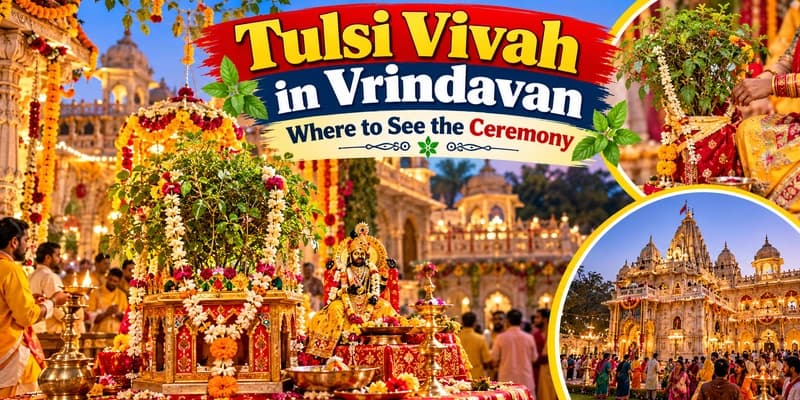
Vrindavan literally means the forest of Vrinda, the Tulsi, so Tulsi Vivah here is not just a festival, it is the town celebrating its own name. On this day, the whole town becomes a wedding pavilion: the Tulsi is dressed as a bride, there are flowers, conch shells, wedding music and the marriage is performed at twilight. I love taking guests from Seva Kunj, where the Tulsi groves are lit up, to the temples with their beautiful jhankis. My simple tip is to come for the evening, because the wedding muhurat is right after sunset and that twilight hour, with the lamps and the music, is when it is most magical. See our Mathura Vrindavan tour Packages or message WhatsApp +91 7302265809.
What Tulsi Vivah in Vrindavan is
Tulsi Vivah is the ceremonial marriage of Tulsi Devi, the goddess form of the sacred Tulsi (holy basil) plant, to Lord Vishnu, worshipped in his Krishna or Shaligram form. It is observed across India, but Vrindavan holds it especially dear, because the town derives its very name from Vrinda, a name of the Tulsi and is historically recognised as the dense holy forest of Tulsi, the Vrinda-van. So when Vrindavan celebrates Tulsi Vivah, it is in a real sense honouring its own identity and origin.
On this day the whole town transforms into a widespread wedding pavilion. The Tulsi plant is dressed as a bride, temples set up beautiful wedding tableaus (jhankis) with heavy flower decorations, conch shells and traditional wedding music and the divine marriage is performed, traditionally at twilight. It is a joyful, tender festival, at once a wedding, a celebration of the awakening of the Lord from his cosmic sleep and the opening of the auspicious wedding season. For devotees it is also a deeply personal occasion, many perform the Kanyadaan, the giving away of Tulsi Mata as the bride, as an act of devotion believed to bring marital harmony and spiritual blessing.
The 2027 date and ceremony muhurat
In 2027, Tulsi Vivah is observed on Thursday 11 November, on the tithi of Kartik Shukla Dwadashi (the twelfth lunar day of the bright fortnight of Kartik). The grand wedding rituals traditionally take place during Pradosh Kaal or Godhuli Kaal, the auspicious twilight hour right after sunset, which is the muhurat for the divine marriage, so the main ceremony is an evening event.
Importantly, while Dwadashi is the primary day, the celebrations and temple tableaus in Vrindavan span a window: they begin around Devutthana (Prabodhini) Ekadashi on 10 November 2027, the day the Lord is believed to awaken from his four-month cosmic sleep and continue right up to Kartik Purnima on 14 November 2027. So a visit anywhere in this window can catch Tulsi Vivah celebrations, with the main wedding on the 11th. Because the festival follows the Hindu lunar calendar, the date and the precise muhurat are set by the panchang and can vary slightly between calendars and temples, so treat 11 November 2027 and the window here as expected and reconfirm nearer the time. The festival falls in the holy month of Kartik; see our kartik month guide for the wider season.
Where to see the ceremony in Vrindavan
Because Vrindavan is the forest of Tulsi, the whole town takes part, but a few places are especially iconic for the festival. Aim to be at the temples for the evening, around the twilight muhurat.
Seva Kunj (Nikunj Van)
Considered the core sacred grove where, by tradition, the eternal leela of Krishna unfolds, seva kunj is a beautiful place to experience Tulsi Vivah. The Tulsi trees here are beautifully illuminated and worship is offered directly to the sacred groves, connecting the festival to the very roots of Vrindavan as the forest of Vrinda.
Sri Banke Bihari Temple
At Banke Bihari, the primary deity is adorned in special festive attire to celebrate the awakening of the Lord from his four-month cosmic sleep (Chaturmas). Devotees gather in large numbers for the evening aarti and the distribution of special Kartik prasad. Given the temple’s popularity, expect big crowds and see our must attend aarti guide.
ISKCON Vrindavan (Sri Sri Krishna Balaram Mandir)
Known for large community celebrations, iskcon vrindavan hosts a spectacular visual wedding layout in which the Tulsi plant is dressed meticulously as a bride, accompanied by enthusiastic Vaishnava congregational kirtan. It is a wonderful place to experience the festival’s joy and music.
Radha Raman Temple
radha raman temple, known for its precise, centuries-old traditions, features a beautifully curated marriage tableau (jhanki) depicting the divine wedding, with heavy flower decorations, conch shells and traditional wedding music, in an intimate, deeply traditional setting.
Prem Mandir
The grand prem mandir also features a beautifully curated wedding tableau and its scale, gardens and famous evening illuminations make it a visually stunning place to take in the festival; see our prem mandir light show guide for its evening display.
A lovely plan is to pair Seva Kunj and one or two of these temples over an evening, allowing time for crowds. For more of the town, see our places to visit in vrindavan guide.
The legend of Vrinda and Jalandhar
The festival rests on a powerful legend, recounted in scriptures such as the Padma Purana and cherished in tradition. By this account, a pious woman named Vrinda was married to the demon king Jalandhar. Her absolute devotion and purity as a wife made her husband invincible, so powerful that even the gods could not defeat him, which threatened the cosmic order.
To restore that order, Lord Vishnu is said to have disguised himself as Jalandhar and by this means Vrinda’s vow of devotion was broken, which led to the demon’s defeat. Realising the deception, a heartbroken Vrinda cursed Vishnu to turn into a black stone, which, in the tradition, manifests today as the sacred Shaligram, the revered fossil-stone form of Vishnu. Yet, moved by her pure heart, Vishnu blessed her, proclaiming that her soul would transform into the holy Tulsi plant and he promised to marry her each year in this form, declaring that no offering to him would ever be complete without a Tulsi leaf. This is the origin of Tulsi Vivah, of the sanctity of the Tulsi plant and of the Tulsi leaf’s essential place in Vishnu worship. These are devotional legends and scriptural traditions held dear by the faithful.
Chaturmas, the wedding season and the Kanyadaan
Tulsi Vivah carries meanings beyond the legend and they are worth understanding. First, it marks the end of Chaturmas, the four-month period beginning in the monsoon during which, by tradition, Lord Vishnu is in cosmic sleep (yoga-nidra) and auspicious ceremonies such as weddings are paused. Tulsi Vivah, falling just after Devutthana Ekadashi (the awakening of the Lord), officially breaks this quiet period and serves as the holy green light that opens the auspicious Hindu wedding season across India. This is why so many weddings begin in the days and weeks after it.
Second, it is rooted in Madhurya Bhav, the devotional mood of worshipping the divine as the ultimate beloved, which is at the heart of Braj’s whole tradition of Radha-Krishna devotion, so the wedding of Tulsi and Vishnu resonates deeply here. And third, there is the personal act of the Kanyadaan: devotees who perform the Kanyadaan, the ritual giving away of Tulsi Mata as the bride, are believed to be blessed with marital harmony and spiritual prosperity, which is why many families observe Tulsi Vivah with the care and joy of a family wedding. Together these give the festival its unique blend of the cosmic, the devotional and the intimately personal.
Practical planning for Tulsi Vivah
A few practical points help you make the most of the festival.
Come for the evening. The wedding muhurat is at twilight, right after sunset (Pradosh or Godhuli Kaal), so the main ceremony and the most beautiful atmosphere, with lamps, flowers and wedding music, are in the evening. Plan to be at the temples then.
Use the wider window. If you cannot be there on Dwadashi itself (11 November 2027), the celebrations and tableaus span roughly 10 to 14 November, so you can still catch the festival, though the main wedding is on the 11th.
Plan a temple route. Pair Seva Kunj with one or two temples (Banke Bihari, ISKCON, Radha Raman or Prem Mandir), rather than rushing all of them and allow time for crowds and the walk between them.
Expect crowds and dress modestly. Popular temples, Banke Bihari above all, get very busy, so arrive early for the evening, keep your group together and valuables secure (also against the monkeys) and dress modestly for the temples.
November weather. The weather is pleasant autumn-into-winter, cool in the evenings, so carry a light layer. Darshan is free, so be cautious of anyone selling paid “access.”
For arrival see how to reach vrindavan, for a base see where to stay in vrindavan and for temple hours see our mathura vrindavan temple timings guide. Confirm the date and timings nearer the time.
Planning your Tulsi Vivah visit and how a Brajwasi can help
Tulsi Vivah rewards a little planning, since the main ceremony is an evening, twilight event spread across several beautiful venues. Confirm the live date (11 November 2027) and the ceremony timings nearer the event, plan an evening route that pairs Seva Kunj with one or two temples, arrive early for the crowds and set your expectations for a joyful, busy, deeply devotional evening. Many visitors time a Kartik-season trip to include Tulsi Vivah, pairing it with the wider Kartik observances and the town’s temples.
Let a Brajwasi plan the evening for you
With an evening twilight ceremony across several venues and big crowds at the popular temples, local help makes the festival flow. As Brajwasis, we can confirm the live date and timings, plan the best evening temple route for the jhankis and the wedding muhurat, guide you from Seva Kunj’s lit groves to the temple tableaus smoothly, arrange a well-placed stay and transport and keep you clear of touts. A shared Vrindavan darshan starts from around 1499 rupees per person; see our vrindavan tour package or we design a private visit around Tulsi Vivah and the Kartik season. Message us on WhatsApp at +91-7302265809 with your plans.
Related guides
We had a wonderful experience on our same-day Mathura Vrindavan tour. We wanted to visit the main temples without feeling rushed, and the team planned the day very thoughtfully. The pickup was smooth, the vehicle was comfortable, and the driver was polite and familiar with the local routes. We visited the important places in Mathura and Vrindavan and still had time to enjoy the peaceful atmosphere. The coordination was good throughout the trip. It was a lovely experience for our family, and we would happily recommend this package.
Book Your Mathura - Vrindavan Trip Today
📞 +91-7302265809
💬 WhatsApp: +91-7302265809
We Reply in 30 Minutes
Packages start from ₹1,999/ person | Rated 4.5★ / 204+ Reviews
Explore all: Mathura Vrindavan Tour Packages
Jai Shri Krishna
Meet Gurudutt — Your Mathura Vrindavan Guide
Not just a tour operator — Gurudutt was born and raised in Braj Bhoomi. He has spent over a decade personally guiding pilgrims through the sacred lanes of Mathura & Vrindavan.
Founder – Experience My India
Gurudutt
Founder · Experience My India