Travel Guide · Festivals & Events · Updated October 2026
Radha Raman Prakatya Utsav: The Appearance Day Darshan
By Gurudutt, Experience My India·31 October 2026
Quick Answer
Quick Enquiry
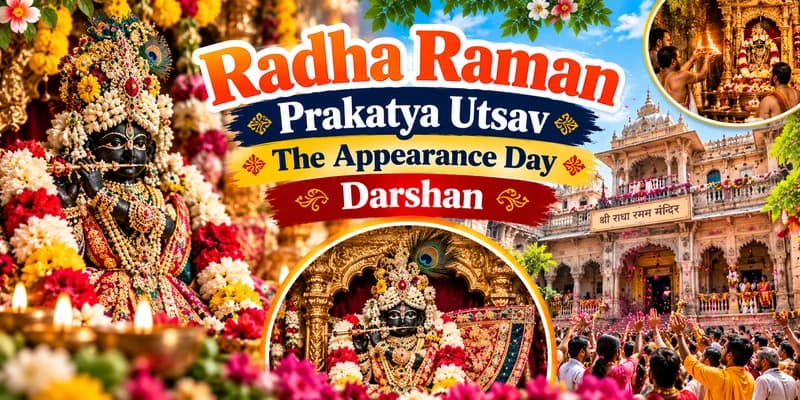
Radha Raman is one of the most precious deities in all of Vrindavan and His appearance day is deeply special to us. What makes Him so dear is that He is Swayambhu, self-manifested from a sacred stone for the love of Gopal Bhatta Goswami and that He has never once left Vrindavan in all these centuries. On the Prakatya Utsav you can witness the grand Maha-Abhishek in the morning, when Thakur ji is bathed with rivers of milk, honey and curd and it is unforgettable. The lanes are narrow and the crowd is large, so come early for the abhishek and let me guide you through the old galis so you do not miss the moment. See our Mathura Vrindavan tour Packages or message WhatsApp +91 7302265809.
What the Radha Raman Prakatya Utsav is
Prakatya means appearance or manifestation and the Radha Raman Prakatya Utsav (also called the Prakatya Mahotsav) celebrates the day the beloved deity of Shri Radha Raman Lal Ji appeared or self-manifested, in Vrindavan. It is the appearance day of the deity himself, observed each year on the full-moon day of Vaishakha and it is one of the most important and joyful occasions at the historic Radha Raman temple.
Unlike a temple’s founding anniversary, this is the celebration of a deity believed to have self-manifested through the pure devotion of a great saint, which gives the day its special wonder. The festival centres on the temple, where the day’s rituals, above all the grand morning Maha-Abhishek, draw devotees in large numbers. It is at once a profound devotional occasion, honouring a living, self-manifested form of the Lord and a beautiful, atmospheric festival in one of Vrindavan’s most treasured and traditional temples, deep in the old lanes of the holy town.
The 2027 date and tithi
In 2027, the Radha Raman Prakatya Utsav is celebrated on Thursday 20 May. It falls on Vaishakh Purnima, the full-moon day of the Hindu month of Vaishakha and by the panchang the Purnima tithi begins at about 04:02 PM on 19 May 2027 and ends at about 04:28 PM on 20 May 2027, which is why the festival is observed on the 20th. The year 2027 marks the 485th appearance anniversary of Lord Radha Raman, counting from the manifestation in 1542 CE.
Because the festival follows the Hindu lunar calendar, the date and the precise tithi timings are set by the panchang and can vary slightly between calendars, so treat 20 May 2027 as the expected date and reconfirm nearer the time. The day’s special ritual timings also shift dynamically around the ceremonies (detailed below) and are set by the temple close to the event, so confirm the schedule locally. Note that late May in Braj is very hot, so plan your visit around the cooler early-morning hours, which is also when the day’s supreme event, the Maha-Abhishek, takes place.
The history: Gopal Bhatta Goswami and the self-manifestation
The story of Radha Raman’s appearance is one of the most beloved in the Gaudiya Vaishnava tradition. In 1542 CE, Srila Gopal Bhatta Goswami, one of the legendary Six Goswamis of Vrindavan and a direct disciple of Chaitanya Mahaprabhu, travelled to the Kali-Gandaki river in Nepal, where he obtained twelve sacred Shaligram Shilas, the holy stones revered as forms of Lord Vishnu.
Gopal Bhatta Goswami lovingly worshipped these stones every day. Yet he deeply longed to be able to dress, ornament and serve a deity form of the Lord, with limbs and features, as other devotees served their deities. By the tradition, on the full-moon night of Vaishakha, in response to his pure devotion, one of the stones, the Damodara Shila, miraculously self-manifested (Swayambhu) into the exquisitely beautiful, roughly twelve-inch-tall form of Lord Krishna, with a captivating smile. This self-manifested deity became known as Radha Raman. This is why the appearance is celebrated each year on Vaishakh Purnima and why Radha Raman is revered as a Swayambhu deity, appearing of his own accord for the love of his devotee. These are devotional traditions and sacred history held dear by the faithful.
What makes Radha Raman unique
Few deities anywhere carry as many extraordinary distinctions as Radha Raman and understanding them deepens the appearance-day visit.
The joint form of Radha and Krishna. Although only Krishna’s delicate form, with its magical smile, is physically visible, Gaudiya Vaishnava tradition holds that the deity embodies both Radha and Krishna bound together in a single form. The name “Radha Raman” beautifully means “the one who gives joy (ramana) to Radha.”
No separate Radha idol. Because Radha is held to be fundamentally present within him, there is no separate idol of Radha Rani in the sanctum. Instead, a sacred object, by tradition a crown is placed to the left of the deity (some accounts describe a Gomati Chakra, in keeping with the Hari Bhakti Vilas), to symbolically honour her eternal presence beside him.
The deity that never left Vrindavan. Radha Raman is exceptionally distinct as one of the very few original Vrindavan deities that was never hidden or moved for safekeeping, for example to Jaipur, during the upheavals of the medieval period, when many of Vrindavan’s deities were relocated. Radha Raman has remained in Vrindavan without interruption since his appearance.
The unbroken eternal flame. The sacred fire in the temple kitchen is said to have burned continuously for nearly five hundred years, since Gopal Bhatta Goswami first lit it and all the temple prasad is still prepared over this eternal flame.
These distinctions, recounted as the temple’s own tradition and history, are part of why Radha Raman is so treasured and why his appearance day is celebrated with such devotion. The temple is also one of Vrindavan’s great historical temples.
The Appearance Day: the grand Maha-Abhishek
The supreme event of the Prakatya Utsav is the grand Maha-Abhishek, the ceremonial bathing of the deity, which takes place in the morning hours and is the heart of the whole festival. Devotees gather early to catch a glimpse of Radha Raman being bathed with over a hundred litres of milk, honey, curd (yogurt), ghee, sacred water and other auspicious substances, in a magnificent and deeply moving ritual.
Around this central event, the day’s timings alter dynamically to accommodate the rituals: special early-morning ceremonies begin before sunrise, with the Mangal Aarti typically early (around 4:00 AM in summer) and the doors remain active through extended daytime and late-evening sessions, rather than following the ordinary schedule. The atmosphere through the day is festive and devotional, with the deity beautifully adorned and the temple full of song and celebration of his appearance. Because the Maha-Abhishek is in the morning and is the event most devotees come for and because late May is hot, the early morning is the time to aim for. Confirm the day’s exact ritual schedule with the temple nearer the time, as it is set close to the event.
Darshan timings and practical planning
On ordinary days the temple follows standard viewing windows, with a long afternoon closing for the deity’s rest and bhog. As an approximate guide (the temple sets its own hours and different sources vary slightly, so confirm locally):
Summer (roughly April to October): Mangal Aarti early morning (around 4:00 AM); morning darshan from the early hours through to around 1:00 PM; a long afternoon closing; and evening darshan from around 4:30 PM to about 9:15 PM.
Winter (roughly November to March): Mangal Aarti around 5:30 AM; morning darshan through to around 1:00 PM; afternoon closing; and evening darshan from around 4:00 PM to about 9:00 PM.
Please treat all of these as indicative, as the temple sets and adjusts its own timings and on the Prakatya Utsav the schedule changes around the rituals, so always confirm the current timings locally. A few practical points:
Come early for the Maha-Abhishek. The morning ceremonial bath is the day’s highlight and draws the biggest gathering, so arrive early in the day for the best experience.
Mind the old lanes and the crowd. The temple is tucked deep in Vrindavan’s narrow old lanes near Nidhivan and Keshi Ghat, so vehicle access is limited and you will walk in; keep your group together, secure your valuables (and mind the monkeys) and be patient in the crowd.
Prepare for the May heat. Late May is very hot, so carry water, dress modestly and lightly and favour the cooler early morning and evening.
It is free. Entry and darshan are free, with no tickets or VIP passes at the temple, so ignore anyone selling paid “access.”
For temple hours generally see our mathura vrindavan temple timings and must attend aarti guides, for arrival see how to reach vrindavan and for a base see where to stay in vrindavan. Confirm the date and timings nearer the time.
Planning your Appearance Day visit and how a Brajwasi can help
The Prakatya Utsav rewards an early start and a little local knowledge, since the Maha-Abhishek is a morning event in a temple deep in the old lanes, with a large crowd and May heat. Confirm the live date (20 May 2027) and the day’s ritual timings nearer the event, plan to arrive early for the morning abhishek, prepare for the heat and the walk through the narrow galis and pair your visit with the nearby Vrindavan sites. Many visitors also like to learn Radha Raman’s remarkable story before they go, which makes the darshan all the more meaningful.
Let a Brajwasi guide you to the darshan
A morning ceremony in a crowded temple deep in Vrindavan’s old lanes is exactly where a local helps. As Brajwasis, we can confirm the live date and the day’s ritual timings, guide you early through the narrow galis near Nidhivan and Keshi Ghat to catch the Maha-Abhishek, tell you the deity’s story so the darshan means more, arrange a well-placed stay and transport to the edge of the lanes and keep you clear of touts. A shared Vrindavan darshan starts from around 1499 rupees per person; see our vrindavan tour package or we design a private visit around the Prakatya Utsav. Message us on WhatsApp at +91-7302265809 with your plans.
Related guides
Book Your Mathura - Vrindavan Trip Today
📞 +91-7302265809
💬 WhatsApp: +91-7302265809
We Reply in 30 Minutes
Packages start from ₹1,999/ person | Rated 4.5★ / 204+ Reviews
Explore all: Mathura Vrindavan Tour Packages
Jai Shri Krishna
Meet Gurudutt — Your Mathura Vrindavan Guide
Not just a tour operator — Gurudutt was born and raised in Braj Bhoomi. He has spent over a decade personally guiding pilgrims through the sacred lanes of Mathura & Vrindavan.
Founder – Experience My India
Gurudutt
Founder · Experience My India