Travel Guide · Travel Guides · Updated October 2026
Keoladeo National Park from Mathura: A Winter Birding Day Trip
By Gurudutt, Experience My India·29 October 2026
Quick Answer
Quick Enquiry
Not everyone who comes to Braj is only here for temples and Keoladeo is my favourite answer for nature lovers. Just over into Rajasthan, barely an hour from Mathura, it is one of the world’s great bird parks. In winter the wetlands fill with birds that have flown all the way from Siberia, it is magical. I always tell guests two things: come in winter, when the migrants are here and hire one of the park’s cycle-rickshaw naturalists, they spot birds you would walk straight past. See our Mathura Vrindavan tour Packages or message WhatsApp +91 7302265809.
Why Keoladeo is world-famous
Keoladeo is not just a local park; it is a biodiversity powerhouse with legendary conservation status.
UNESCO World Heritage Site. Recognised by UNESCO in December 1985 for the outstanding universal value of its wetland ecosystem.
Ramsar wetland. Designated a Wetland of International Importance under the Ramsar Convention.
A node on the Central Asian Flyway. It is a critical staging point on this great migratory route; every winter, thousands of migratory waterfowl fly thousands of miles from Siberia, Russia and Central Asia to feed and roost in these largely man-made wetlands.
Massive biodiversity. It hosts over 375 bird species, including painted storks, sarus cranes, herons and rare raptors, alongside mammals and reptiles such as nilgai, spotted deer and pythons.
This global importance, so close to Mathura, is what makes Keoladeo such a rewarding addition for travellers who want nature alongside Braj’s pilgrimage.
A short history of the wetland
Keoladeo’s wetlands are not entirely natural and that story is part of what makes the park so remarkable. By the accounts usually given, the area was a natural depression that flooded in the monsoon and in the nineteenth century the rulers of the princely state of Bharatpur developed and shaped it, raising small dykes (bunds) and channelling water from a nearby irrigation system so that the shallow lakes held water through much of the year. For decades it was managed as a royal duck-shooting reserve and old hunting records describe very large shoots by colonial and royal parties, a history the park’s older signboards still recall.
After Independence the shooting gradually ended, the area was protected and by tradition it was declared a national park in the early 1980s, with grazing of domestic cattle phased out. It had already served as a bird sanctuary from the middle of the twentieth century. UNESCO inscribed it as a World Heritage Site in 1985 and it is listed as a Ramsar wetland of international importance. The wetland’s survival now depends on a careful and sometimes difficult, balance of water management, since the lakes need a reliable monsoon or a managed water supply each year to fill properly; in dry years the park can look very different. This is why we always suggest you check recent reports on water levels and bird numbers and confirm the current situation locally, before planning a winter visit.
Understanding this background helps you read the landscape: the straight bunds you ride along, the regulated sluice gates and the mosaic of shallow pools and woodland are the result of long human management as much as of nature, which is exactly why ornithologists find the park so interesting and why it carries such conservation weight.
Best time to visit and timings
Keoladeo is, above all, a winter destination. The migratory season runs roughly November to February, when the wetlands fill with birds that have flown in from the north and this is overwhelmingly the best time to come. Outside winter, far fewer birds are present and the park is much quieter, so if birdlife is your aim, plan for the cold months.
Detail | Information (confirm locally) |
Winter hours | About 7:00 AM to 5:30 PM (peak winter, roughly November to February) |
Outside winter | Opens as early as 6:00 AM |
Best strategy | Arrive right at opening for crisp light and maximum bird activity before the day’s crowds |
Best season | Winter migratory season, roughly November to February |
Hours and the exact migratory window vary year to year with the season and weather, so confirm locally before planning. Entry and any camera fees apply at the gate; check the current rates on arrival. For the wider comfortable season across Braj, see best time to visit.
How to reach Keoladeo from Mathura
The park sits in Bharatpur district, Rajasthan, right on the Uttar Pradesh-Rajasthan border, which makes it very reachable from Mathura for a single day.
By road. Take State Highway 33 (SH33), which connects Mathura directly to Bharatpur; the drive is about 1 to 1.5 hours by car or taxi. This is the most flexible option for an early start. See our places to visit near mathura guide for other day-trip ideas on this side.
By train. Frequent short-distance trains run between Mathura Junction and Bharatpur Junction, which is about 3 km from the park gate, with autos for the last stretch. See our mathura trains guide for rail options into the region.
By air. The nearest major airport is Delhi, from which you would travel on to Mathura or Bharatpur by road or rail.
For arrival into the wider Braj region, see how to reach vrindavan.
Inside the park: transport, guides and eco-rules
Park transport. Personal motorised vehicles are strictly banned beyond the main parking lot. You explore the flat, roughly 6 km paved trail by hiring an authorised cycle-rickshaw, renting a bicycle or taking an electric vehicle. The flat terrain makes it easy for most visitors.
Hire a rickshaw-guide. The park’s cycle-rickshaw pullers double as highly trained naturalists; they carry bird logbooks, can spot perfectly camouflaged owls and pythons and often bring spotting scopes. Hiring one hugely improves what you see, it is money well spent and supports the local naturalists.
Eco-rules. Single-use plastics are completely forbidden, so carry a reusable water bottle. Bring binoculars (8x42 or 10x42 are ideal) to appreciate the nesting colonies and dress for cold early mornings in winter.
The birds and wildlife you can hope to see
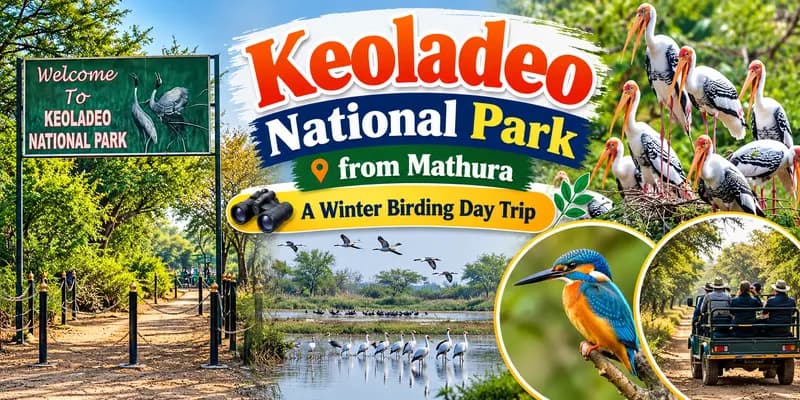
The headline draw is the winter congregation of waterbirds. By the park’s own reckoning it records well over 375 species across the year and on a good winter morning a patient visitor with a naturalist can log dozens. Among the most loved sights are the great nesting colonies of painted storks, which breed in noisy, crowded treetop rookeries over the water, along with open-billed storks, spoonbills, cormorants, darters and several species of egret and heron. On the open pools you may see bar-headed geese (which cross the Himalaya on migration), northern pintails, shovelers, teals, pochards and many other ducks that have flown down from Central Asia.
The park was historically famous as a wintering ground for the critically endangered Siberian crane, though by tradition these great white cranes have not been reliably recorded here for many years and travellers should not expect to see them; it is a loss the older naturalists still talk about with real sadness. What you can still hope for are the tall, graceful sarus cranes (among the world’s tallest flying birds, associated in local lore with lifelong pairs), kingfishers, bee-eaters and a fine range of raptors including eagles, harriers and owls roosting quietly in the trees, which the rickshaw-naturalists are expert at picking out.
Beyond birds, the park holds mammals and reptiles: nilgai (the large blue bull antelope), spotted deer, wild boar, jackals, mongooses and basking near the water in the warmer hours, rock pythons, which the guides often know exactly where to find. Remember that wildlife is never guaranteed and numbers vary with the season, the water and the particular winter, so come with open, patient expectations rather than a checklist and treat every sighting as a gift rather than a certainty.
Birding and photography tips
A little preparation turns a pleasant walk into a memorable morning. Arrive at opening, when the light is soft and the birds are most active and move slowly and quietly; the single biggest mistake visitors make is rushing. Good binoculars (8x42 or 10x42) make an enormous difference and if you own a spotting scope it is worth bringing, though the rickshaw-naturalists usually carry one. For photography, a telephoto lens of 300mm or longer is ideal for the nesting colonies and distant waterfowl and the low morning and late-afternoon sun gives the warmest light; a beanbag or monopod helps steady long lenses from a slow-moving rickshaw.
Dress in quiet, muted colours rather than bright white or red, which can startle birds and layer up, because winter mornings here are genuinely cold before the sun gains strength. Carry a reusable water bottle (single-use plastic is banned), a hat and sunscreen for later and a small notebook or a bird-identification app if you like to keep a list. Patience is everything: sit still by a pool for a while and the birds that scattered at your arrival will return and carry on around you.
Finally, let the naturalist set the pace. These guides know where the owls roost, which tree the pythons favour and where a particular rarity was seen that week and a gentle, unhurried circuit with one of them will show you far more than covering the whole trail at speed. Keep noise down, never try to flush a bird for a better photograph and give the nesting colonies a respectful distance so the breeding birds are not disturbed.
Planning your day trip
Keoladeo deserves a full morning at least, arrive at opening, spend three to four hours on the trail with a rickshaw-naturalist and you will see a great deal. Because it sits just over the Rajasthan border near Deeg and Bharatpur, it pairs well with a wider cultural sweep: the Deeg water palace, Bharatpur’s Lohagarh Fort or the Braj and Agra circuits. Pack layers for the cold morning, binoculars, water and sun protection. For a Braj add-on, it fits a deeper regional itinerary, see our braj chaurasi kos yatra and Rajasthan-side notes in the govardhan parikrama guide.
Let a Brajwasi plan your birding day
Keoladeo is an easy, rewarding break from the temple circuit and we are glad to plan it for nature-minded travellers. As Brajwasis, we arrange comfortable transport from Mathura or Vrindavan, time your visit for the winter migratory season and the early-morning window, help you hire the park’s naturalist rickshaw-guides and can combine the park with Deeg, Bharatpur or Agra. We extend our braj tour package into these further sites; a shared Braj day starts from around 1499 rupees per person or we design a private plan. Message us on WhatsApp at +91-7302265809 with your dates.
Related guides
Book Your Mathura - Vrindavan Trip Today
📞 +91-7302265809
💬 WhatsApp: +91-7302265809
We Reply in 30 Minutes
Packages start from ₹1,999/ person | Rated 4.5★ / 204+ Reviews
Explore all: Mathura Vrindavan Tour Packages
Jai Shri Krishna
Meet Gurudutt — Your Mathura Vrindavan Guide
Not just a tour operator — Gurudutt was born and raised in Braj Bhoomi. He has spent over a decade personally guiding pilgrims through the sacred lanes of Mathura & Vrindavan.

Founder – Experience My India
Gurudutt
Founder · Experience My India