The four classical sampradayas
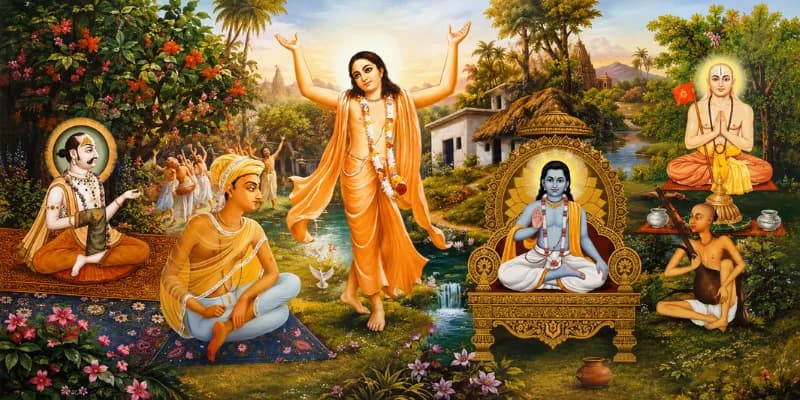
The tradition speaks of four bona-fide Vaishnava sampradayas (the Chatuh Sampradaya), each said to descend from a divine source and headed by a great acharya:
The Sri Sampradaya (from Sri/Lakshmi), headed by Ramanuja - philosophy Vishishtadvaita (qualified non-dualism).
The Brahma Sampradaya (from Brahma), headed by Madhva - philosophy Dvaita (dualism); the Gaudiya tradition affiliates with this line as the Brahma-Madhva-Gaudiya.
The Rudra Sampradaya (from Rudra/Shiva), headed by Vishnuswami, later carried by Vallabhacharya - philosophy Shuddhadvaita (pure non-dualism).
The Kumara Sampradaya (from the four Kumaras, Brahma's sons), headed by Nimbarka - philosophy Dvaitadvaita (natural difference-and-oneness).
From these four classical roots - and flowering into new, Braj-born traditions - come the living sampradayas you meet in Mathura-Vrindavan today.
Gaudiya - the tradition of Chaitanya
The Gaudiya Sampradaya, founded by Chaitanya Mahaprabhu in early-sixteenth-century Bengal, is the tradition whose heart is Vrindavan. Mahaprabhu sent the Six Goswamis to recover Braj's lost leela-sites and build its temples; their legacy is the Sapt Devalaya, the seven Goswami temples that founded the modern holy city. Its philosophy is Achintya-bhedabheda - the "inconceivable oneness-and-difference" of the soul and God - and its mood is the parakiya (paramour) love and the sweetness of separation (vipralambha).
It is the most widespread tradition in Vrindavan and its modern global expression, ISKCON, stands within it. See the Six Goswamis & saints guide for its founding saints.
Pushtimarg - the path of grace
The Pushtimarg (Vallabh Sampradaya), founded by Shri Vallabhacharya (1479-1531) within the Rudra line, was born at Gokul - where the Brahma Sambandha was first given. Its philosophy is Shuddhadvaita (pure non-dualism); its path is grace (pushti) through loving service (seva), open to householders; its supreme deity is Shrinathji (now at Nathdwara). Its sacred sites in Braj are the Baithakji - the seats where Mahaprabhu sat - and its worship the elaborate haveli seva.
You meet it at Gokul, at the Dwarkadhish temple in Mathura (a Pushtimarg haveli) and around Govardhan and Jatipura. Its Ashtachhap poets - Surdas chief among them - gave Braj some of its sweetest devotional song.
Nimbarka - the ancient Radha-Krishna lineage
The Nimbarka Sampradaya, of the Kumara line, is among the earliest traditions to establish the worship of Radha and Krishna together as the Supreme. Its founder, Nimbarkacharya, is held by the tradition to have been born near Govardhan and its centers have long lain in the Mathura-Vrindavan region (as well as Rajasthan and Bengal). Its philosophy is Dvaitadvaita (svabhavika-bhedabheda, "natural difference-and-oneness") and it worships the divine couple in the swakiya (wedded) and union (sambhoga) mood.
For its antiquity and its early devotion to Radha, the Nimbarka tradition holds an honoured place in Braj's spiritual history. (An honest word: Nimbarka's date is debated by scholars, given variously from the early to the medieval centuries - the tradition itself reckons him very ancient.)
Radha Vallabh - Radha as the Supreme
The Radha Vallabh Sampradaya is Braj-born - founded in 1535 at Vrindavan by Hith Harivansh Mahaprabhu (1502-1552). It is distinctive even among Krishna-traditions: here Radha herself is the Supreme Being and Krishna is described as her most intimate servant. The tradition prefers pure devotion (bhakti) over philosophy, declining theological commentary and resisted affiliation with the four classical sampradayas. Its scriptures are in Braj Bhasha - above all the Hita Chaurasi, the eighty-four verses of Harivansh.
Its temple is the Radha Vallabh temple, where - beautifully - there is no idol of Radha: a crown beside Krishna signifies her presence, for the Lord is never separate from her. It is among the most rasik (relish-filled) of all Braj's traditions.
Haridasi - the way of the sakhi
The Haridasi Sampradaya (the Sakhi Sampradaya) is also Braj-born - founded by the great musician-saint Swami Haridas, revered as an incarnation of Lalita Sakhi. Its devotees worship the divine couple in the sakhi-bhava - the mood of the maidservants (sakhis and manjaris) of Radha, serving the eternal love of Radha and Krishna in the groves. Swami Haridas, by tradition the guru of the legendary musician Tansen, manifested the deity of Banke Bihari at Nidhivan.
You meet this tradition at the Banke Bihari temple - Vrindavan's most beloved - and at Nidhivan, where Swami Haridas did his bhajan. Its devotion flows above all through music.
Sri Vaishnava - the Tamil tradition in Braj
The Sri Sampradaya - the Tamil Sri Vaishnava tradition of Ramanujacharya - brings the devotion of the South to Braj. Its philosophy is Vishishtadvaita (qualified non-dualism) and its great scripture is the Divya Prabandham of the Alvar saints. Two of Braj's holiest sites, Mathura and Gokul, are among the 108 Divya Desams sung by the Alvars.
Its living heart in Braj is the magnificent Dravidian-style Rangji temple in Vrindavan, where the Divya Prabandham is recited and the Brahmotsav kept in South-Indian splendour. It is the bridge that brings the Tamil South into Krishna's northern land.
The moods of love
Here is a beautiful key to the traditions: they differ above all in the mood (bhava) of love with which they approach the divine couple.
The Gaudiya tradition cherishes the parakiya (paramour) love and the ache of separation - the gopis' longing.
The Nimbarka tradition worships in the swakiya (wedded) mood and the joy of union.
The Radha Vallabh and Haridasi traditions serve in the sakhi/manjari bhava - as Radha's own handmaidens, relishing her love.
The Sri Vaishnava tradition approaches the Lord in reverence and surrender (the mood of Lakshmi and the devotee-servant).
Same Braj, same Radha and Krishna - beheld through different windows of love. To know the moods is to understand why each temple feels so different.
Why Braj is where they all meet
It is no accident that every great tradition of Krishna-devotion roots itself here. Braj is the land of the leela - where Krishna was born, grew, played and loved. So the Tamil South sang of it (the Divya Desams); the Bengal of Chaitanya rebuilt it (the Sapt Devalaya); the West of Vallabhacharya was born here (the Baithaks at Gokul); and Braj's own soil gave rise to the Radha Vallabh and Haridasi traditions. Three temple-sets we have charted - the Sapt Devalaya, the Divya Desams and the Baithaks - are the three great sampradayas made visible in stone. Braj belongs to the whole of devotional India.
An honest note
A born-Brajwasi keeps the record fair:
The four-fold classification of sampradayas is a traditional framing; some Braj-born traditions, notably Radha Vallabh and Haridasi, resisted affiliation with it and stand on their own.
The dates of the older acharyas - Nimbarka especially and even Ramanuja - are given variously; I note them as debated rather than fix a single year.
The sampradayas differ and sometimes dispute one another on points of theology - whether Radha or Krishna is supreme, which mood is highest and more. I present each tradition's own understanding with respect and do not adjudicate between them. Each is a true and beautiful path of love; Braj is large enough for them all.
For the pilgrim - experiencing the traditions
You can feel the difference between the sampradayas simply by visiting their temples:
At Banke Bihari (Haridasi), the curtain opens and closes, music everywhere - the sakhi's playful love.
At Radha Vallabh, the crown beside Krishna where Radha's idol would be - Radha as the very Supreme.
At Rangji (Sri Vaishnava), the towering gopuram and the Tamil chants - the South in the North.
At Gokul and the Baithaks (Pushtimarg), the seat-worship and the haveli seva - the path of grace.
At the Sapt Devalaya (Gaudiya), the Goswami deities and the samadhis - the longing of separation.
A guide who knows the traditions turns a temple-round into an education in the whole landscape of Krishna-bhakti.
Author's tips from Gurudutt - what only a local knows
Ask "which sampradaya?" at each temple - the deity, the mood and the worship all flow from it.
Three sets, three traditions - the Sapt Devalaya (Gaudiya), the Divya Desams (Sri Vaishnava), the Baithaks (Pushtimarg) are the easiest way to grasp the landscape.
Two are Braj's own - Radha Vallabh and Haridasi were born here; that's a special thing to honour.
Feel the moods - separation at the Gaudiya temples, the sakhi's joy at Banke Bihari, reverence at Rangji.
Don't take sides - every tradition will tell you theirs is highest; a wise pilgrim loves them all.
Pilgrims sometimes ask me, "Gurudutt, which is the true path?" And I tell them: in Braj, that is the wrong question. The Tamil saint sang of this land a thousand years ago; Chaitanya's Goswamis rebuilt it; Vallabhacharya's grace was born at Gokul; and here in Vrindavan's own groves, Hith Harivansh and Swami Haridas heard Radha's anklets and began their songs. Six great rivers of love, all flowing to one Krishna, in one small sacred land. I am a Brajwasi - I bow at every one of their temples. The glory of Braj is not that it belongs to one tradition, but that it belongs to them all. - Gurudutt