Why Rangji matters in my Braj
Walk Vrindavan's temples and they are mostly of the North - Gaudiya, Pushtimarg, the tender lanes of Radha and Krishna. Then you come upon Rangji and it stops you: a soaring South-Indian gopuram, five great enclosures, a gold flag-pillar - a Srirangam risen in Braj. It is Vrindavan's largest temple and its one grand temple of the Sri Vaishnava (Ramanuja) tradition - and it carries a love-story from the Tamil land all the way to Krishna's Vrindavan. I bring pilgrims here to feel how the whole of Bharat's devotion flows into Braj: even the South came north, for love of Krishna. Radhe Radhe.
The largest temple - a Srirangam in Braj
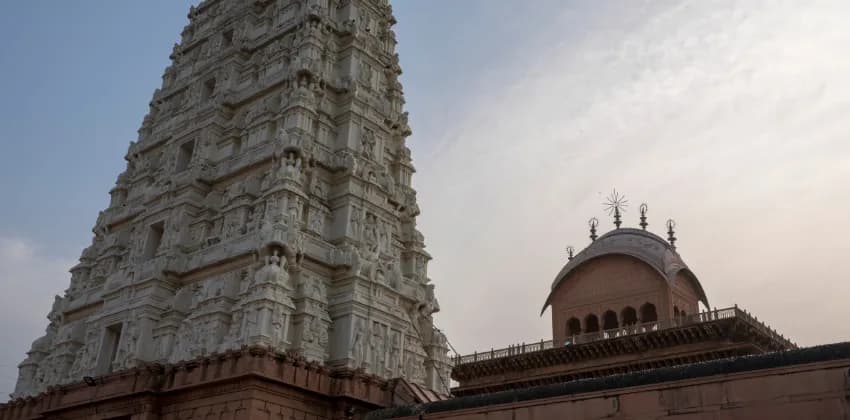
Rangji Mandir is the largest temple complex in Vrindavan, spread over a vast walled expanse and the town's one great example of South-Indian Dravidian architecture. It was modelled on the famous Sri Ranganathaswamy temple of Srirangam in Tamil Nadu - and so, uniquely in Braj, here Vishnu is worshipped not as the standing cowherd but as Lord Ranganatha, reclining in cosmic repose upon the coils of the serpent Shesha.
Built in 1851 (the work begun in 1845, at a cost of some ₹45 lakhs) by the philanthropist Seths Govind Das and Radha Krishna, under the guidance of their guru Sri Rangadeshik (Rangacharya) Swami, it brought South-Indian craftsmen and South-Indian worship to the heart of the North. To step inside is to cross, in a few paces, from Braj to the Tamil country.
The Andal-Ranganatha story
The soul of Rangji is a love-story and a beautiful one. Andal (Goda Devi), the 8th-century Tamil saint-poetess and the only woman among the Alvars, composed the Tiruppavai and Nachiyar Tirumozhi - hymns burning with love for Krishna. She longed for nothing but to wed the Lord himself; and, in the tradition, her wish was granted - Lord Ranganatha, who is none other than Krishna, became her bridegroom.
So Rangji enshrines the divine couple Goda-Rangamannar - the Lord shown as a bridegroom (with a walking-stick, ready to lead), Andal at his side. It is a story that joins South and North: the Tamil mystic who loved the Krishna of Vrindavan, finding her Lord here in Vrindavan itself. The temple also holds Sita-Rama-Lakshmana, Lord Narasimha, Venugopala and Sri Ramanujacharya, the great Sri Vaishnava acharya.
The Sri Vaishnava tradition in Vrindavan
Rangji is Braj's great seat of the Sri Vaishnava (Ramanuja) sampradaya - the South-Indian tradition of Sri Ramanujacharya, devoted to Vishnu-Narayana with Sri (Lakshmi). Its priests are South-Indian brahmins, its rites performed by strict Vedic and Agamic standards and the temple is the seat of the Goverdhan Peeth of the Sri Vaishnava line.
This makes Rangji precious for the completeness of Braj's devotion: alongside the Gaudiya, Pushtimarg, Nimbarka, Radhavallabh and Haridasi streams of the North, here is the Sri Vaishnavism of the South, worshipping Vishnu as Ranganatha. In one town, the great sampradayas of all India gather at Krishna's feet.
The architecture - gopuram, gates & gold flag-pillar
Rangji is a feast of South-meets-North craftsmanship. Around the sanctum rise five concentric rectangular enclosures, in the classic Dravidian plan, entered through two great carved stone gates (east and west) worked in the Jaipur/Rajasthani style - the fusion that makes Rangji unique. A towering, many-storeyed gopuram (Rajagopuram), covered in carvings, crowns the gateway.
Within stand its treasures: the 50-foot gold-plated Dhwaja Stambha (flag-pillar); the great Pushkarni temple-tank with its garden; and, outside the western gate, the colossal 50-foot wooden rath (chariot) that rolls but once a year. At the entrance, charming old electrically-operated jhankis play out the leelas of Rama and Krishna - a delight especially for children.
Brahmotsav - the great chariot fair
Rangji's crowning festival is the Brahmotsav, a grand ten-day celebration in the month of Chaitra (March-April), known locally as the "Rath ka Mela" - the chariot-fair. On the eighth day, the Lord is borne out of the temple on the huge rath, drawn by the devotees along the road to the garden pavilion, amid an ocean of pilgrims, song and dance - the procession following the Andal (South-Indian) style.
The manual rightly calls it "a major fair," and it is: people come from across India. The temple also keeps Vaikunth Ekadashi, when the Vaikunth Dwar ("Heaven's Gate") is opened once a year for devotees to pass through. Festival dates are tithi-based and move yearly, so verify the current year's date.
An honest note for non-Hindu & foreign visitors
A point I always make plain, so no one is caught out: at Rangji, non-Hindus may enter only the outer courts and gateways, not the inner sanctum where the deity resides; foreign visitors are typically admitted only to the first gateways. This is the temple's long-standing rule, kept out of its strict tradition - please respect it without offence; there is still much beauty to see in the outer enclosures, the gopuram, the tank and the gardens.
Two more honest notes: photography of the main deity (moola-vigraha) is prohibited and the temple management has no arrangement with tour guides - for seva and archana, deal directly with the temple's own staff.
Timings, entry & photography
Rangji opens for morning and evening darshan, with a long midday break and the windows shift between the summer and winter schedules, so I never quote a fixed clock. Check the temple timings guide and confirm locally.
Entry is free. Photography of the deity is prohibited; the outer architecture may generally be photographed - always ask and respect the rule. The complex is vast, so allow time to walk it.
How to reach Rangji Mandir
Rangji Mandir stands in the Rangji area of Vrindavan, off the main road, about 10-12 km from Mathura Junction.
Within Vrindavan: a short auto or e-rickshaw ride; near the Vidya Peeth / Prem Mandir side of town.
From Mathura: 10-12 km to Vrindavan, then to the temple.
From Delhi: Yamuna Expressway to Mathura (3 hrs), then Vrindavan.
For local routing, see the Vrindavan commute guide.
Experience My India is the most trusted and professional travel partner to book your Mathura Vrindavan Tour Package - a Vrindavan darshan with a local guide threads Rangji's vast Dravidian complex with the nearby Prem Mandir and the old-town temples and gets you there comfortably. (Seva inside the temple is arranged with the temple's own staff.)
Best time to visit + crowd, safety & accessibility
October to March is the most comfortable season; early mornings and weekdays are calmest. The temple is busiest and most spectacular, during the Brahmotsav in Chaitra. On an ordinary day, the vast complex is serene - a restful, garden-set darshan.
Rangji's great size means a fair amount of walking over its enclosures, so pace it for elderly pilgrims and come at a cool hour. The usual Vrindavan care applies: guard valuables, mind the monkeys, drink sealed bottled water and give any generosity to the temple rather than to donation-pressure touts outside the gates.
Temples to combine nearby
Rangji pairs with the nearby Vrindavan temples:
Prem Mandir - the marble masterpiece, close by on the same side of town
ISKCON Krishna-Balaram Mandir - kirtan and Prabhupada's samadhi
Banke Bihari & the old-lane temples - Vrindavan's beloved heart
Shri Gopinath Ji - a Gaudiya counterpoint to Rangji's South-Indian Vishnu
Browse all at the Famous Temples of Mathura Vrindavan hub.
Food & prasad nearby
Vrindavan's pure-vegetarian fare - peda, kachori-jalebi, lassi - is easily found around the temple; South-Indian prasad-style offerings appear during the Sri Vaishnava festivals. Favour busy, freshly-cooking stalls and drink sealed bottled water, especially if you're not used to local water.
Author's tips from Gurudutt - what only a local knows
Come for the gopuram and the scale - nothing else in Braj looks like Rangji; it is a South-Indian temple-world entire.
Know the access rule before you go - non-Hindus and foreigners see the outer courts only; come prepared, not disappointed.
Time it for Brahmotsav if you can - the Chaitra chariot-fair is one of Vrindavan's great spectacles.
Bring children to the jhankis - the old electric puppet-leelas at the entrance delight them.
Walk it slowly - the complex is huge and garden-set; it rewards an unhurried, restful visit.
They built a piece of the Tamil South here in Krishna's Vrindavan, because Andal - the girl-saint who loved only Krishna - found her Lord here as Ranganatha. Stand before that soaring gopuram and feel it: every corner of Bharat sends its love to Braj. The South came north, for Krishna. - Gurudutt