Nimbarka - the ancient Yugal lineage
The Nimbarka Sampradaya (the Kumara or Hamsa line) is among the oldest traditions to worship Radha and Krishna together as the divine couple - its very heart is Yugal Upasana, the worship of the inseparable pair. Its philosophy is Dvaitadvaita (svabhavika-bhedabheda, "natural difference-and-oneness"). By the tradition, its founder Nimbarkacharya migrated from the south to Braj and settled at Nimbagrama - today's Neemgaon - set between Barsana and Govardhan.
Its principal Braj seats:
Neemgaon (Nimbagrama), about two miles from Govardhan, where Nimbarka did his tapasya - the founding seat, with a temple to Sri Nimbarka, which it is the devotee's sampradayik duty to visit.
Dhruva Tila, Mathura - the historic Nimbarka Peeth (gadi), associated with the great acharya Sribhatta Devacharya (c. 1440-1520), who wrote the Yugala Shataka, an early Braj Bhasha work on the eightfold daily pastimes (ashtayama-lila) of Radha and Krishna.
Shriji Mandir, Loi Bazaar, Vrindavan - the centre of the Nimbarka tradition in Vrindavan.
Sri Kathia Baba Ka Sthan, Vrindavan - a major Nimbarka ashram and guru-seat.
The tradition's chief Braj kshetras are Vrindavan, Nandgaon, Barsana, Govardhan and Neemgaon. (An honest word: Nimbarka's date is much debated - the tradition reckons him very ancient, scholars place him later; and the sampradaya's principal seat today is at Salemabad in Rajasthan, with Braj as its spiritual homeland.)
Radha Vallabh - Hith Harivansh's seat
The Radha Vallabh Sampradaya was born in Braj - founded in 1535 at Vrindavan by Hith Harivansh Mahaprabhu (1502-1552). It is the most Radha-centric of all the traditions: here Radha is the Supreme and Krishna her most intimate beloved. Its scripture is the Hita Chaurasi, eighty-four verses of Braj Bhasha and its devotion is pure rasik love, declining philosophy for the relish of Radha's glory.
Its principal seat is the Radha Vallabh temple in Vrindavan, where - beautifully - there is no separate idol of Radha: a crown beside Krishna signifies her ever-present nearness. By the Braj tradition, Hith Harivansh was born at Baad Gram (Bad) near Mathura (some accounts give other birthplaces - the accounts vary). It is among the most tender and relish-filled of all Braj's traditions.
Haridasi - Swami Haridas & the Sakhi way
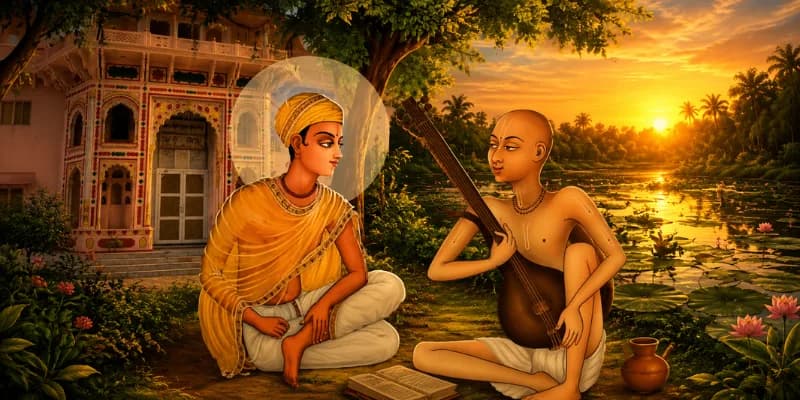
The Haridasi (Sakhi) Sampradaya is also Braj-born - founded by the great musician-saint Swami Haridas (1480-1573). A master of the Dhrupad style and, by tradition, the guru of Tansen, Haridas is revered as an incarnation of Lalita Sakhi and his devotion flows above all through music - the singing of the love of Kunj Bihari and Kunj Biharini (Krishna and Radha) in the mood of the sakhi.
Its seats:
Nidhivan - where Swami Haridas did his bhajan for most of his life and where the deity of Banke Bihari manifested before him. His samadhi is the first small shrine as you enter.
Banke Bihari temple - Vrindavan's most beloved temple, enshrining the deity Haridas revealed.
Tatiya Sthan - the austere, living heart of the tradition (below).
By tradition, Swami Haridas's family came from Multan and settled at Rajpur, near Vrindavan, before he made the holy town his home.
Tatiya Sthan - the seat of pure bhajan
Of all the Haridasi seats, Tatiya Sthan is the most extraordinary - an ashram of pure, austere devotion near the Rangji temple, "untouched by the modern world." It was founded by the seventh acharya of the Haridasi tradition, Swami Lalit Kishori Dev, who left Nidhivan to meditate beneath a secluded tree. Devotees fenced the grove with bamboo - tatiya in the local tongue - and so the place got its name. Lalit Kishori's samadhi is here.
What makes it singular: the devotees perform no aarti and no pooja. Instead, they hold a Samaj - sitting together and singing the pads of the Haridasi acharyas, the soul-music of the tradition, by which they feel the very presence of Radha and Krishna in the grove. The tradition's eight acharyas, from Swami Haridas to Lalit Mohini Dev, are revered here. It is a place to feel, more than anywhere, the Haridasi way: devotion as song, in a grove kept wild and pure.
The Rasika Triveni of Vrindavan
A beautiful thread unites these Braj-born traditions: their founders are revered together as the Rasika Triveni - the "three sacred rivers" of rasik devotion in Vrindavan. They are Hith Harivansh Mahaprabhu (Radha Vallabh), Swami Haridas (Haridasi) and Hariram Vyas (Sevak ji Maharaj) - held to be a descension of Vishakha Sakhi, whose bhajan-kutir and samadhi lie at Vyas Ghera near Seva Kunj.
These rasik saints - contemporaries in the sixteenth-century flowering of Vrindavan, alongside the Nimbarka acharya Harivyasa Devacharya and the Gaudiya Goswamis - turned Braj into the great garden of Radha-bhakti, where devotion is relished as the sweetest of all rasas. (See our saints & samadhis guide.)
An honest note
A born-Brajwasi keeps it straight:
Nimbarka's date and birthplace are debated - the tradition reckons him extremely ancient, scholars place him in the medieval centuries; I present this as varying.
The Nimbarka tradition's main seat today is in Rajasthan (Salemabad), though Braj is its spiritual homeland and Neemgaon its founding tapasya-site.
Some traditional claims - that the Nimbarka tradition was longest in Braj or first gave the Raas and Jhulan festivals - are the tradition's own accounts; I share them as such and do not adjudicate between the sampradayas.
A few dates and birthplaces vary (Swami Lalit Kishori's years; Hith Harivansh's birthplace) - I note them as given variously rather than fix a single version.
For the pilgrim
A practical word:
In Vrindavan, take the Radha Vallabh temple, Nidhivan, Banke Bihari, Tatiya Sthan (near Rangji) and the Shriji Mandir (Loi Bazaar) together - they lie close in the old town.
Near Govardhan, the Nimbarka seat of Neemgaon is a peaceful, lesser-visited founding site.
At Tatiya Sthan, come quietly, sit and listen to the Samaj - there is no aarti to attend; the music is the worship.
A guide who knows the rasik traditions opens up the meaning of these quieter seats, which the hurried pilgrim misses.
Temples to combine
Radha Vallabh temple - the seat of the Radha Vallabh tradition
Banke Bihari & Nidhivan - the heart of the Haridasi tradition
Rangji temple - beside Tatiya Sthan
Govardhan Hill - near the Nimbarka seat of Neemgaon
The Sampradayas of Braj hub - the full landscape of traditions
Browse all at the Famous Temples of Mathura Vrindavan hub.
Author's tips from Gurudutt - what only a local knows
Tatiya Sthan is the hidden jewel - quiet, wild, pure; sit for the Samaj and you'll feel why old devotees love it above the grand temples.
No aarti at Tatiya Sthan - don't wait for one; the bhajan-singing is the whole worship.
Neemgaon for the Nimbarkas - a peaceful founding seat near Govardhan, off the tourist track.
The Rasika Triveni - Harivansh, Haridas, Hariram Vyas; knowing these three saints unlocks rasik Vrindavan.
Radha is supreme here - at Radha Vallabh, the crown beside Krishna where her idol would be; a tradition all its own.
People come to Vrindavan and see Banke Bihari and think they have seen the Haridasi tradition. But go to Tatiya Sthan - sit in that wild grove where there is no aarti, no bell, only old men singing the pads of Lalit Kishori and the trees themselves seem to listen. That is the soul of it. And know that two of these traditions - Radha Vallabh and Haridasi - were born here, in our own Vrindavan, from the hearts of rasik saints who heard Radha's anklets in the kunjas. The Nimbarkas are older still, worshipping the Yugal since before memory. To walk these seats is to drink from the oldest and the sweetest of Braj's springs. - Gurudutt