Travel Guide · Travel Guides · Updated October 2026
Vrindavan vs Varanasi: Which Suits Your Trip
By Gurudutt, Experience My India·23 October 2026
Quick Answer
Quick Enquiry
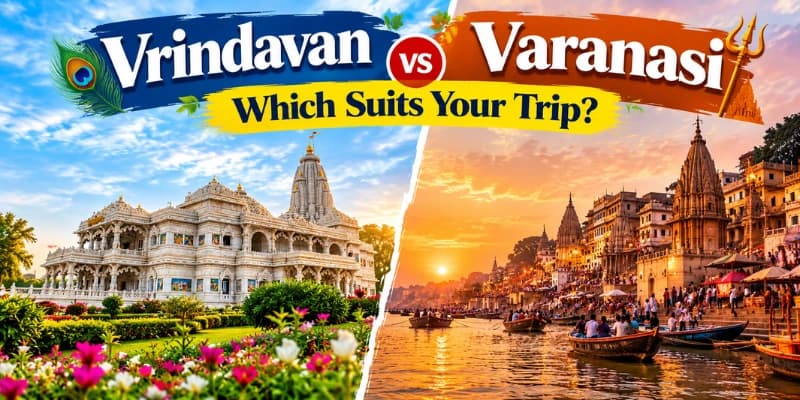
Vrindavan and Varanasi are both in Uttar Pradesh and both deeply sacred, but their spiritual flavour could hardly be more different. Vrindavan is the land of Krishna’s childhood and youthful pastimes, so it radiates madhurya, sweet, loving, celebratory devotion (bhakti), expressed in temples, bhajans, festivals and food. Varanasi is Lord Shiva’s eternal city, one of the oldest continuously inhabited places on earth, where devotion takes the form of ancient ritual, renunciation, ancestral rites and the hope of liberation (moksha) on the banks of the Ganga. One is a feast of life and love; the other a profound meditation on life, death and eternity. Knowing which energy you are seeking is the key to choosing. See our Mathura Vrindavan tour Packages or message WhatsApp +91 7302265809.
Quick comparison
A simple side-by-side across the things that shape your trip.
Feature | Vrindavan | Varanasi |
Core deity and vibe | Lord Krishna; love, kirtans and celebration | Lord Shiva; renunciation, ancient ritual and moksha |
Primary attractions | Grand colourful temples (Prem Mandir, Banke Bihari) | Historic riverfront ghats, narrow alleys, Kashi Vishwanath Temple |
Key rituals | Temple darshans, light shows, bhajan chanting | The iconic evening Ganga Aarti and morning boat rides |
Food scene | Milk sweets like pedas and pure vegetarian street food | Celebrated street food, chaat, lassi and traditional breakfasts |
Accessibility | A weekend trip from Delhi (about 3.5 hours via expressway) | Its own major railway stations and an international airport |
Choose Vrindavan if you want bhakti and celebration
Vrindavan suits travellers who want uplifting, loving, high-energy devotion and families. Confirm temple timings locally.
The experience
Vrindavan feels like a vibrant celebration of life, centred tightly on Krishna’s youthful pastimes, with a strong ashram culture and community chanting. You will navigate narrow streets packed with enthusiastic devotees rushing between temples, in an atmosphere focused on leelas (divine plays) and loving, romantic devotion. It is joyful, intense and deeply uplifting.
What you will do
Visit architectural marvels like the prem mandir for its evening light show, experience the ecstatic crowds at the banke bihari temple and walk through the mystical groves of nidhivan, with the wider Braj circuit (Mathura, Govardhan, Barsana) easily added.
Best for
Travellers looking for an uplifting, high-energy devotional environment, families and anyone combining the trip with Agra and Delhi on a short, easy getaway from the capital.
Choose Varanasi if you want ancient ritual and intensity
Varanasi suits cultural explorers, photographers and seekers who want a raw, ancient, profound experience.
The experience
Varanasi (Banaras) is one of the oldest continuously inhabited cities in the world and it offers a starker, deeper, more raw look at Hindu spiritual practice. It is a sensory overload where life and death coexist openly along the steps of the Ganga, historic, gritty and profoundly spiritual. Where Vrindavan is a feast of life, Varanasi is famously the place of renunciation, ancestral rites and liberation in death.
What you will do
Take a sunrise boat ride as the city wakes, walk the riverfront ghats (including the cremation ground at Manikarnika Ghat), explore the Kashi Vishwanath corridor and witness the grand evening Ganga Aarti, one of the most powerful spiritual spectacles in India.
Best for
Cultural explorers, photographers, history lovers and anyone wanting to experience India’s ancient, unbroken mystical traditions at their most intense and elemental.
Can you do both?
Yes and they pair together beautifully. If you have roughly 6 to 9 days, Vrindavan and Varanasi fit naturally into one larger North India spiritual circuit. A typical route runs from Delhi to Vrindavan and Mathura, down through Agra (for the Taj Mahal) and onward by expressway or train to Ayodhya and then Varanasi, taking you from Krishna’s joyful bhakti to Rama’s birthplace to Shiva’s eternal city in a single, richly varied pilgrimage. It is one of the most rewarding spiritual journeys in India and with good planning the long distances become comfortable rather than tiring. If you would like, we can design the whole circuit around your dates and pace, starting with the Braj leg; see our mathura vrindavan tour itinerary for the Vrindavan portion.
The deities and traditions behind each
The gulf in atmosphere between the two towns comes straight from the deities and traditions at their heart. Vrindavan belongs to Krishna and specifically to the Krishna of childhood and youth, so its devotion is coloured by the sweet, loving mood the tradition calls madhurya. By tradition this is the land where the pastimes of the Srimad Bhagavatam unfolded, the raas leela, the lifting of Govardhan, the love of Radha and the gopis and the whole town is organised around remembering and celebrating them through darshan, kirtan and festival. The emotional key is joy and intimacy.
Varanasi, also called Kashi or Banaras, belongs to Shiva and its traditions turn on time, renunciation and release rather than play. By tradition it is one of the oldest living cities and among the holiest of the seven sacred cities, a place where, it is said, dying within the sacred boundary brings liberation or moksha. That belief shapes everything: the cremation ghats working day and night, the ancestral rites performed by the river, the ascetics drawn to the city and the great riverfront rituals. Where Vrindavan celebrates life and love, Kashi contemplates life, death and eternity.
Seen together, the two express two of the deepest currents in the wider Hindu world, the path of loving devotion to a personal, playful Lord and the path of ritual, renunciation and liberation under the gaze of the great ascetic god. Neither is presented as superior; they answer different longings. Understanding this is the real key to choosing between them, because the choice is less about sights than about which spiritual mood your heart is seeking. As with all such matters, these beliefs are held and offered here as tradition and scripture.
Getting there, when to go and pacing
The two towns are also very different to reach and to move through, which is worth weighing before you decide. Vrindavan is an easy weekend pilgrimage from Delhi, roughly three and a half hours by the Yamuna Expressway or by train to nearby Mathura Junction and it pairs effortlessly with Agra; confirm current travel times locally. Varanasi stands on its own in the east of Uttar Pradesh, with its own major railway stations and an international airport, so it is usually a destination in its own right rather than a quick add-on, reached by a flight or a longer train journey.
On the ground the pace differs too. Vrindavan is compact and intense, a town you explore temple by temple on foot and by e-rickshaw, best enjoyed by surrendering to its energy rather than rushing it. Varanasi asks for early starts and late evenings, the sunrise boat ride and the dusk Ganga Aarti being its two great fixed points, with the maze of riverfront lanes to wander in between. Both reward a slow, unhurried approach and both can feel overwhelming if you try to see everything in a single day.
For timing, the comfortable season for both is broadly October to March, avoiding the fierce summer heat and the monsoon; confirm seasonal conditions locally. Festivals transform each place: Vrindavan is at its most extraordinary and most crowded, around Holi and Janmashtami, while Varanasi peaks around Mahashivratri and the spectacular Dev Deepawali, when the ghats are lit with countless lamps. Decide whether you want the heightened intensity of a festival or the relative calm of an ordinary week and confirm festival dates nearer the time, as they follow the Hindu lunar calendar and shift each year.
Let us plan your Vrindavan trip or the wider circuit
Whether you want a focused Vrindavan pilgrimage or the full Delhi to Varanasi circuit, we would love to plan it well. As Brajwasis, we handle the Braj leg beautifully, Banke Bihari, Prem Mandir, Nidhivan and the ghats, with Mathura, Govardhan and Barsana, timed around the crowds and temple hours, a comfortable stay and a caring guide and we can extend it with Agra and onward to Ayodhya and Varanasi. A shared Vrindavan day tour starts from around 1499 rupees per person; for a combined trip, see our agra mathura vrindavan tour or we design a private multi-day circuit. Darshan is free. Message us on WhatsApp at +91-7302265809 with your dates.
Related guides
Book Your Mathura - Vrindavan Trip Today
📞 +91-7302265809
💬 WhatsApp: +91-7302265809
We Reply in 30 Minutes
Packages start from ₹1,999/ person | Rated 4.5★ / 204+ Reviews
Explore all: Mathura Vrindavan Tour Packages
Jai Shri Krishna
Meet Gurudutt — Your Mathura Vrindavan Guide
Not just a tour operator — Gurudutt was born and raised in Braj Bhoomi. He has spent over a decade personally guiding pilgrims through the sacred lanes of Mathura & Vrindavan.
Founder – Experience My India
Gurudutt
Founder · Experience My India