Travel Guide · Travel Guides · Updated October 2026
Nathdwara and Braj: The Shrinathji Pilgrimage Route
By Gurudutt, Experience My India·23 October 2026
Quick Answer
Quick Enquiry
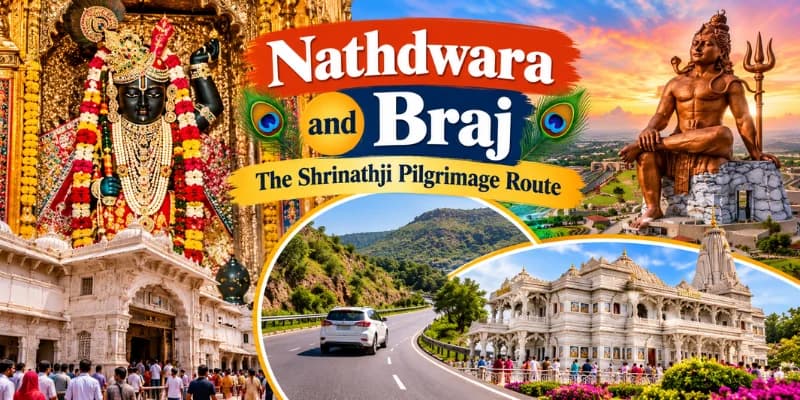
This is one of the most moving pilgrimages I know, because it is a real journey the Lord himself made. It begins here in our Braj, on Govardhan Hill where Shrinathji first appeared, and at Jatipura, where his face is said to have emerged from the rock. Many devotees of the Pushtimarg start where the story started, Govardhan, Jatipura, Mathura and Vrindavan, and then follow his path to Nathdwara in Rajasthan. I love helping pilgrims do the Braj leg properly first, standing where it all began, before they travel on to see the Lord in his Mewar home. See our Mathura Vrindavan tour Packages or message WhatsApp +91 7302265809.
The great migration: from Govardhan to Mewar
The pilgrimage follows the actual historic path taken by the priests of the Pushtimarg sect to protect the idol of Shrinathji, founded in the devotional tradition of Sri Vallabhacharya.
The origin (Braj). The black-marble deity of Shrinathji was originally manifested and worshipped atop govardhan hill, near Mathura, in the heart of Krishna’s own land. See our govardhan hill significance guide for why this hill is so sacred.
The journey. To safeguard the idol during a period of iconoclasm, devotees travelled, in 1669, in a heavily guarded chariot across Agra, through parts of central India and deep into the rugged landscapes of Rajasthan, a long and arduous passage from the plains of the Yamuna toward the Aravalli hills.
The divine destination (Nathdwara). By tradition, when the chariot reached the village of Siniad (now Nathdwara), its wheels sank deep into the mud and would not move. The priests took this as a divine command that the Lord wished to settle there and the Shrinathji temple was established around 1672. Nathdwara, in the Mewar region, has been the deity’s home ever since.
Core stops along the route
The classic pilgrimage carries you from the vast plains of the Yamuna to the Aravalli hills of Rajasthan. These are its core stops.
Stop | Region | Spiritual significance |
Mathura and Vrindavan | Braj, Uttar Pradesh | The birthplace and childhood-pastimes ground of Lord Krishna |
Govardhan Hill | Braj, Uttar Pradesh | The original home of the Shrinathji deity before the historic journey |
Jatipura | Braj, Uttar Pradesh | Where the face of the deity is said to have first emerged from the rocks |
Nathdwara | Mewar, Rajasthan | The ultimate repository of the faith, built like a fortified haveli rather than a traditional temple |
Shrinathji, Vallabhacharya and the Pushtimarg tradition
To understand this route it helps to know the tradition that carries it. Shrinathji is a svarup, a self-manifested form, of Lord Krishna as the young child who lifted Govardhan Hill on his little finger to shelter the people of Braj from the wrath of Indra. The deity shows the Lord with his left arm raised, holding up the hill and devotees worship him as Govardhan-dhari, the lifter of Govardhan. By tradition the image first appeared on the hill at Govardhan, which is why that hill and not Nathdwara, is held to be the true origin of the faith.
The worship of Shrinathji is the heart of the Pushtimarg, the path of grace expounded by the 15th and 16th century teacher Sri Vallabhacharya and carried on by his descendants, the Goswami priests. Pushtimarg seva is famously tender and domestic: by tradition the Lord is cared for through the day as a beloved child, bathed, dressed, fed, sung to and put to rest, in a cycle of darshans. This intimate mood of service is why the Nathdwara shrine is run like a great household rather than a formal temple and why pilgrims who trace the route from Govardhan to Mewar feel they are following a living relationship, not visiting a monument. All of this is given as the tradition and theology of the Pushtimarg rather than as documented history.
The Braj part of the yatra
For a pilgrim, the route begins where the story began, in Braj. Govardhan Hill is the spiritual origin of Shrinathji, so most devotees do the Govardhan darshan and if they can, the Govardhan Parikrama; see our govardhan parikrama guide. Jatipura, on the Govardhan side, is the revered spot where the deity’s face is said to have appeared from the rock and a key stop on the route. Around these, pilgrims naturally take in Mathura (Krishna’s birthplace) and the temples of Vrindavan, banke bihari temple, prem mandir and more, completing the Braj foundation of the pilgrimage before the onward journey to Rajasthan. See our mathura vrindavan tour itinerary to plan this Braj leg.
Nathdwara: the haveli shrine at the journey’s end
At the far end of the route stands Nathdwara, the gateway of the Lord, in the Mewar region of Rajasthan near Udaipur. What surprises many first-time pilgrims is that the shrine does not look like a conventional spired temple at all. It is built and run as a haveli, a grand mansion, in keeping with the Pushtimarg idea that the Lord lives here as the master of a household. There is no towering shikhara; instead there are courtyards, kitchens, stores and the inner chamber where Shrinathji is served.
By tradition the Lord is shown in a sequence of daily darshans, each with its own mood, dress and offering, from the early morning waking to the night rest and devotees plan their visit around these viewings. Nathdwara is also the home of pichwai painting, the intricate cloth hangings placed behind the deity that change with the season and the festival, an art form that spread from this very shrine and is now treasured across India. For a Braj pilgrim, arriving at Nathdwara after standing on Govardhan Hill closes a circle: the same Lord who, by tradition, appeared on the hill is here received as a king in his Rajasthan home. Darshan timings and seasonal arrangements at Nathdwara vary, so confirm them locally before you travel on from Braj.
Visitor tips and etiquette for the pilgrimage
Because this yatra crosses two states, a little planning repays itself. Treat the Braj leg and the Nathdwara leg as two distinct portions with a travel day between them, rather than trying to rush from Govardhan to Mewar in one push. On the Braj side, the Govardhan Parikrama is done barefoot by many pilgrims, so prepare for that if you intend to walk it and allow an early start to beat the heat. Dress modestly at every shrine, as is the custom across Braj and at Nathdwara alike.
At Nathdwara in particular, photography inside the shrine is strictly not allowed and phones and cameras are usually deposited before entry, so travel light and respect the rule without exception. Darshan there happens in fixed windows that can be short and crowded, so arrive in good time and be patient in the queue. Carry water, keep valuables secure and if you are travelling with elderly pilgrims, build in rest. Above all, go in the order the deity travelled, beginning where the story began in Braj, because doing the yatra in sequence is itself part of the devotion. All timings, darshan windows and travel details should be confirmed locally and nearer the time, as they shift with season and festival.
Planning the pilgrimage
The natural way to do this yatra is in the order the deity travelled: begin in Braj, then go on to Nathdwara. Spend a couple of days on the Braj leg, Govardhan and Jatipura above all, with Mathura and Vrindavan, before the longer journey into Rajasthan to Nathdwara, which sits in the Mewar region near Udaipur. Braj is easily reached (about 3 to 3.5 hours from Delhi via the expressway, with Mathura Junction the nearest major railhead), while Nathdwara is usually approached via Udaipur in Rajasthan. Because the two legs are in different states, plan enough days and sensible transport between them. See our best time to visit vrindavan guide for when to do the Braj portion.
Let us plan your Braj leg and beyond
The Braj beginning of this pilgrimage is exactly what we do best. As Brajwasis, we can take you to Govardhan Hill and Jatipura, where the Shrinathji story began, do the Govardhan darshan or parikrama and cover Mathura and the Vrindavan temples, with the history told properly in the places it happened, before you continue to Nathdwara. We can arrange the comfortable Braj portion in full and help you plan the onward Rajasthan leg. A shared Braj day tour starts from around 1499 rupees per person or we design a private plan, including a govardhan parikrama tour package. Message us on WhatsApp at +91-7302265809 with your dates.
Related guides
Book Your Mathura - Vrindavan Trip Today
📞 +91-7302265809
💬 WhatsApp: +91-7302265809
We Reply in 30 Minutes
Packages start from ₹1,999/ person | Rated 4.5★ / 204+ Reviews
Explore all: Mathura Vrindavan Tour Packages
Jai Shri Krishna
Meet Gurudutt — Your Mathura Vrindavan Guide
Not just a tour operator — Gurudutt was born and raised in Braj Bhoomi. He has spent over a decade personally guiding pilgrims through the sacred lanes of Mathura & Vrindavan.
Founder – Experience My India
Gurudutt
Founder · Experience My India