Travel Guide · Travel Guides · Updated July 2026
Barsana Parikrama: Distance, Route Map, Starting Point and Complete Guide
By Gurudutt, Experience My India·29 July 2026
Quick Answer
Quick Enquiry
Key facts at a glance
What it is | The sacred circumambulation of Barsana, the town of Radha |
Badi Parikrama | About 7 km, taking 2 to 3 hours at a gentle pace |
Chhoti Parikrama | About 4 km, taking around an hour |
Starting point | Near the Radha Rani temple, at the foot of Bhanugarh hill |
Best time | October to March, at sunrise or from mid-afternoon |
Where | Barsana, about 50 km from Mathura and 8 km from Nandgaon |
Barsana parikrama: an overview
The Barsana parikrama is the sacred circumambulation of Barsana, the beloved town of Radha, a walk that carries you around its hills, temples, ponds and lanes in an unbroken thread of devotion. To walk it is to move through the whole landscape of Radha's life, past the shrines of her leelas and the kunds of her stories, with the call of Radhe Radhe following you from every doorway. It is one of the most beautiful of the smaller Braj parikramas.
There are two circuits to choose from, a longer Badi Parikrama of about 7 km and a shorter Chhoti Parikrama of about 4 km, so you can walk it deeply or gently as suits you. This guide covers the distance, the route and the parikrama marg, the starting point, how to reach Barsana, when to go and how to walk it well. For the town's temples and sites in their own right, see our places to visit in barsana guide and for the hilltop temple our barsana radha rani temple guide.
From the ground (Gurudutt): Barsana rewards the unhurried parikrama more than almost anywhere. Neither circuit is a quick stroll: the Badi Parikrama takes 2 to 3 hours at a gentle pace and even the Chhoti takes an hour, more if you stop to sip tea, sit by a kund or talk with the sadhus and locals who greet you like an old friend. Come in the cool of the morning or the late afternoon and let the time dissolve. See our Mathura Vrindavan tour or message WhatsApp +91 7302265809.
Distance, time and starting point at a glance
Here are the essentials of the Barsana parikrama in one place, so you can plan your walk.
Detail | Badi Parikrama | Chhoti Parikrama |
Distance | About 7 km | About 4 km |
Time at a gentle pace | 2 to 3 hours | About 1 hour |
Route | The wide circuit of the whole hill, temples, ponds and sacred sites | A compact circuit closer to the main shrines and inner town lanes |
Starting point | Near the Radha Rani temple, at the foot of Bhanugarh hill | Near the Radha Rani temple, at the foot of Bhanugarh hill |
Best for | A full, immersive parikrama of all Barsana's sacred sites | A shorter, gentler walk of the central shrines |
Terrain | Town lanes, open slopes and some gentle climbs | Mostly inner lanes, gentler |
In short: The Barsana parikrama is about 7 km for the full Badi circuit, 2 to 3 hours, or about 4 km for the shorter Chhoti circuit, around an hour. Both start near the Radha Rani temple. Best walked October to March, at sunrise or from mid-afternoon.
The two parikramas: Badi and Chhoti
The Barsana parikrama distance and time depend on which of the two circles you choose and knowing the difference helps you plan.
The Badi Parikrama, the big parikrama, is around 7 km, a wide route that embraces the entire hill, all its temples, ponds and sacred sites and takes 2 to 3 hours at a gentle pace. This is the full, immersive circuit, for those who want to walk the whole of Barsana's sacred landscape.
The Chhoti Parikrama, the small parikrama, is around 4 km, a more compact journey that stays closer to the main shrines and the inner town lanes and can be completed in about an hour, though stops for tea, a kund or a conversation will happily stretch it.
Neither is a rushed stroll and both are walks of devotion rather than distance. If you have the time and the legs and want the fuller experience, choose the Badi Parikrama; if you are short of time, travelling with elders, or want a gentler walk, the Chhoti Parikrama takes in the heart of Barsana beautifully. Either way, go slowly and let the town reveal itself.
The Barsana parikrama starting point
The Barsana parikrama starting point, for both circuits, is near the Radha Rani temple, the Shriji temple, at the foot of Bhanugarh hill, also called Brahmachal, the hill the temple crowns. This is the natural heart of Barsana and the traditional place to begin and end the walk. Pilgrims often take darshan at the Radha Rani temple first, then set out on the parikrama, returning to close the circle where they began.
The first step is always the same, whichever circuit you choose: join your palms, bow slightly and take the path. From here the route winds out around the hill and the town and back, a thread that ties you to Barsana. There is no ticket and no fixed gate; you simply begin at the temple and follow the marg. Local pilgrims and guides can point you to the path and the way is well worn and well marked by the flow of devotees.
The Barsana parikrama route and marg: a map in words
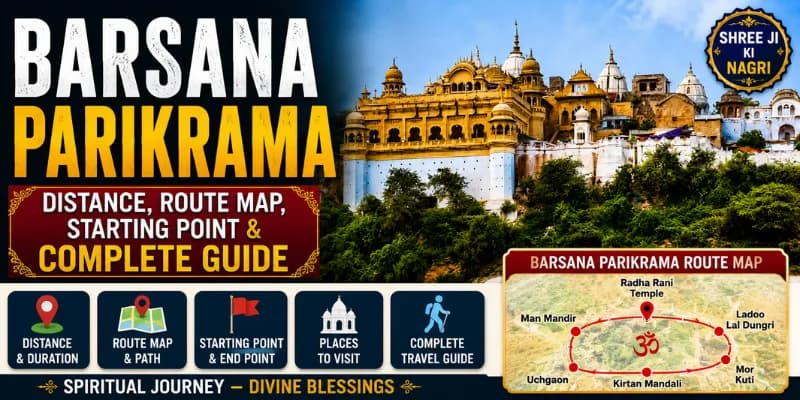
If you look at a Barsana parikrama route map, you will see more than turns and landmarks; it is a map of devotion. Since a printed map can be hard to follow on the ground, here is the parikrama marg walked in words, past its main sacred points.
The Radha Rani temple, sitting atop Bhanugarh hill, the crown of Barsana, reached by steps or a sloping path, with the view spilling across the plains dotted with temple spires; the start and end of the walk.
Maan Mandir, the temple of Radha's tender loving sulk, her maan, with its cool stone floors and soft light, where the chanting slows your heartbeat to the temple's rhythm.
Mor Kutir, named for the peacocks, mor, that still wander here, celebrating the playful leelas of Radha and Krishna, where you may hear a sudden peacock cry echo across the hill.
Dan Bihari temple, recalling Krishna's playful habit of stopping the gopis to collect a daan, a toll, on their way to market, a story retold with laughter across Braj.
The sacred kunds: Pili Pokhar, whose yellow-tinged waters are linked to Radha's ornaments and Prem Sarovar, the quiet pond where love is said to have taken form in water.
Between these, the path winds past old havelis, small shrines and shops selling everything from garlands to little brass idols, with Radhe Radhe painted on doors and walls and called out to you by strangers. The Badi Parikrama takes in the wider ring of these sites around the whole hill; the Chhoti stays closer to the central shrines. Many of these places have their own stories, covered in our places to visit in barsana guide and the nearby Kirti Mandir, dedicated to Radha's mother, is covered in our kirti mandir barsana guide.
How to reach Barsana for the parikrama
Barsana lies out in the western Braj countryside and reaching it is simple and scenic.
From Mathura, about 50 km: drive via Chhata or Govardhan, around 1 to 1.5 hours by taxi or bus.
From Vrindavan, about 52 km: a similar distance, the roads passing through rural landscapes, around an hour and a half.
From Delhi, about 150 km: take the Yamuna Expressway to Chhata, then turn towards Barsana, around 3.5 to 4 hours of travel.
Nandgaon, the village of Krishna, is only about 8 km away and the two are almost always paired.
Buses and shared tempos run regularly between the nearby towns, but for a peaceful start to your parikrama, a private taxi or auto from Mathura or Vrindavan is ideal, letting you arrive early and unhurried. The nearest major railhead is Mathura Junction, with Kosi Kalan closer. Our how to reach vrindavan guide covers the routes into the region and our gokul barsana nandgaon day trip guide covers pairing Barsana with Nandgaon.
When to walk the parikrama
The best months for the Barsana parikrama are October to March, when the air is cool and the hills are gentle underfoot; in winter, the morning mist gives the path a dreamlike feel. Within the day, there are two lovely windows.
The morning parikrama: start at sunrise for golden light and fewer crowds, and, in winter, the beautiful mist over the hills.
The evening parikrama: begin around 3 pm to finish before the sun dips, catching the aarti at the Radha Rani temple as the day closes.
Avoid the midday hours in summer, when the sun on the open slopes can be harsh and indeed avoid the peak summer months altogether if you can, since the heat makes the walk hard. The cool season, an early start and a gentle pace are the recipe for a beautiful parikrama. For choosing the season, see our braj festival calendar for the festival dates that shape the crowds.
The parikrama during festivals
On ordinary days, the parikrama is a quiet dialogue between you and the town. During festivals it transforms into something grander and far more crowded.
Lathmar Holi: the streets fill with colour, laughter and playful chases and walking the parikrama becomes part of the celebration, though the crowds are enormous.
The month of Kartik, in autumn: the path is lined with rows of lamps and bhajans flow from every corner, one of the loveliest times to walk it.
Radhashtami, Radha's appearance day: devotees throng the route, singing Radha's praises with unmatched energy and Barsana is at its most fervent.
Festival days are magical, but if you want space to pause and breathe, plan for a quieter date. For the honest crowd and safety picture of the Holi season in particular, see our all the festival dates, which follow the lunar calendar, our festival calendar.
Walking the parikrama: the experience and tips
The Barsana parikrama is as much an experience as a walk. The earth here feels different underfoot, as if it remembers every pilgrim who has passed. You may stop at a tea stall whose owner knows more of the Radha-Krishna leelas than any book, or find yourself beside a group of barefoot, singing sadhus, their voices carrying over the hills, while children run alongside you for a stretch before darting into a side lane. At some point you look back and see the path curving around the hill like a thread tying you to Barsana.
A few practical tips make it comfortable. Many pilgrims walk barefoot as an act of devotion, but comfortable shoes are perfectly fine and wise for the longer Badi circuit and the slopes. Carry water and a little cash for tea, offerings and a rickshaw if you tire. Wear modest, comfortable clothing and a hat or scarf for the sun. Take the hill climbs slowly, especially the ascent to the Radha Rani temple and rest as you need; for elders, the Chhoti Parikrama or a gentle pace with rests is kinder, as our mathura vrindavan with elderly parents guide covers. Above all, do not rush; the parikrama's gift is its unhurried devotion.
We arrange the Barsana parikrama and darshan as part of a western-Braj day, timed for the cool morning or the evening aarti and paired with Nandgaon, with the travel, the timing and a knowledgeable local companion handled so you simply walk and take darshan. A shared day tour starts from around ₹1,499 per person, darshan free throughout and our same-day govardhan barsana tour covers this side of Braj. Message me on WhatsApp at +91-7302265809 with your dates to plan it.
Related guides
Meet Gurudutt — Your Mathura Vrindavan Guide
Not just a tour operator — Gurudutt was born and raised in Braj Bhoomi. He has spent over a decade personally guiding pilgrims through the sacred lanes of Mathura & Vrindavan.

Founder – Experience My India
Gurudutt
Founder · Experience My India