Travel Guide · Temple Guides · Updated October 2026
Ashta Sakhi Temple Vrindavan: Radha Rasbihari and the Eight Sakhis
By Gurudutt, Experience My India·24 October 2026
Quick Answer
Quick Enquiry
Most visitors rush straight to Banke Bihari and never realise the Ashta Sakhi Mandir is right there beside it. I always tell guests to step in, the carving is breathtaking, and the idea behind it is beautiful: here Radha and Krishna are worshipped together with their eight dearest sakhis, the friends who serve their love. If you understand the sakhi tradition of Braj, this temple makes it visible. It is a short, rewarding stop on the way to or from Banke Bihari. See our Mathura Vrindavan tour Packages or message WhatsApp +91 7302265809.
The eight sakhis, the core of the temple
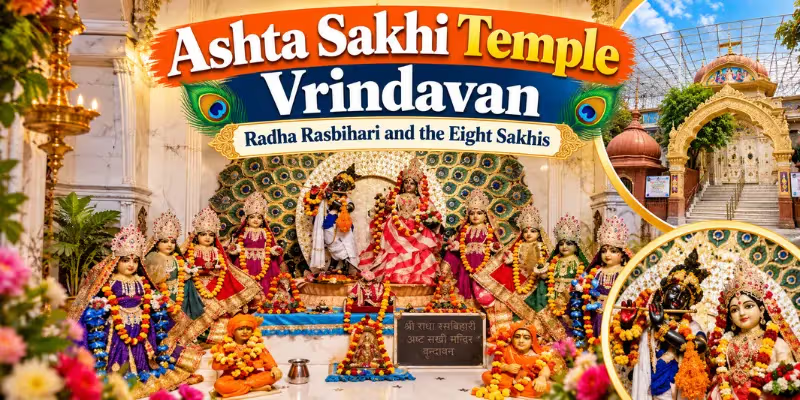
The temple is renowned as the first in India to consecrate the eight principal gopis, the Ashta Sakhis, alongside Radha and Krishna. In the Braj tradition, these eight are Radharani’s most intimate companions, each devoted to serving the divine couple’s love. Together with Radha and Krishna, they make up the ten deities of the sanctum.
Lalita Sakhi is the foremost and eldest companion, by tradition 27 days older than Radha. In the Gaudiya tradition, Swami Haridas, who is said to have manifested the Banke Bihari deity, is revered as her incarnation in the material world.
Vishakha Sakhi is the second leader, by tradition exactly Radha’s age, who lovingly oversees the dressing and ornamentation of the divine couple.
Champaklata Sakhi, Chitra Sakhi, Tungavidya Sakhi, Indulekha Sakhi, Rangadevi Sakhi and Sudevi Sakhi complete the eight, each with her own role in the service of Radha and Krishna.
The Lalita-Swami Haridas link is part of why the temple sits so meaningfully beside Banke Bihari, the deity Haridas is said to have revealed and why it is treasured by devotees of the sakhi tradition. See the banke bihari temple for that connected story.
It is worth dwelling a moment on why the eighth of ten matters so much. In most Krishna temples the focus is the divine couple, Radha and Krishna, with the wider circle of companions left to the imagination. Here the circle is made visible, carved and dressed and worshipped, so that the whole emotional world of the Ras Leela stands in front of you rather than being hinted at. For devotees schooled in the Braj bhakti tradition, that is a profound thing: the sakhis are not decorative attendants but the very medium through which Radha and Krishna’s love is served and savoured and to honour them is understood as the humblest and sweetest form of devotion.
Radha Rasbihari and the sakhi tradition explained
The presiding form here is Radha Rasbihari, Krishna as the one who revels in the rasa, the sweet essence of divine love, in the company of Radha and her friends. The temple’s full name, Shree Radha Ras Behari Ashta Sakhi Mandir, folds the whole theology into a single line: Radha first, then Krishna as Rasbihari, then the eight sakhis who make the rasa possible. Understanding that order helps a visitor read the sanctum. The couple stands at the centre and the eight sakhis fan out around them, each a distinct personality in the tradition rather than a repeated figure.
In Braj thought, the sakhi bhava, the mood of the intimate friend, is prized above almost every other devotional attitude. Where some paths approach the divine as master or as parent or as child, the sakhi tradition approaches through friendship and service to the couple’s love, seeking nothing for oneself but the joy of arranging their meeting and witnessing their happiness. This is why the sakhis are said to do everything from choosing the flowers and stringing the garlands to carrying messages and preparing the bowers. By tradition, each of the eight has a speciality, one oversees the singing, another the dressing, another the cooking of sweets, so that between them the whole art of loving service is covered.
Because the temple is revered as a Lila Sthan, a site of Krishna’s eternal play, all of this is understood not as a frozen tableau but as something ongoing. Devotees come not simply to look at ten beautiful images but to place themselves, in feeling, within that circle of service. For a first-time visitor who knows none of this, the temple is still lovely; but knowing the sakhi tradition turns a pretty shrine into a window onto the heart of Braj devotion, which is exactly why guides here spend as much time on the idea as on the carving.
Architecture and the daily rituals
Though centuries old, the temple has been painstakingly restored with exceptional craftsmanship. By tradition, its intricate stone carvings and embellishments were shaped by direct descendants of the Taj Mahal’s original sculptors and the work brings together semi-precious stones from around the world, vivid murals and modern fibre-optic lighting, an unusual blend of heritage carving and contemporary technique.
Worship in the inner sanctum follows a meticulous daily routine.
Ritual / timing | Details (confirm locally) |
The makeup ritual | Priests spend over three hours each morning adorning, painting and dressing all ten deities in custom attire and jewellery |
Opening hours | Year-round, no entry fee, typically around 5:30 AM to 8:30 PM |
Mangala Aarti | Around 5:30 AM |
Darshan Aarti | Around 7:30 AM |
Madhyan Aarti | Around 11:30 AM |
Aarti and darshan timings in Vrindavan shift with the season and with festival days, so treat these as a guide and confirm the current schedule locally before you go.
The long morning shringar is worth understanding, because it shapes what you see. The deities are treated as living presences, woken, bathed, dressed and ornamented before the day’s darshan and the attire changes with the season and the festival calendar, lighter fabrics and flower ornaments in summer, richer cloth and heavier jewellery in winter and on feast days. This is why no two visits look quite the same and why devotees who come often will tell you they return partly to see how the couple and the sakhis have been dressed that day. The semi-precious inlay and the murals catch the light differently through the day too, so the same sanctum feels one way at the soft hour of Mangala Aarti and another under the brighter mid-morning light.
Darshan, atmosphere and etiquette
Stepping in from the Banke Bihari lanes, the first thing most people notice is the contrast. Outside is the press and noise of one of Vrindavan’s busiest temple streets; inside, the Ashta Sakhi Mandir is usually calmer and more intimate, a jewel box rather than a crowd. That makes it a good place to slow down. Give yourself a minute to let your eyes adjust and take in the ten deities before moving to the carving and the murals; the temple rewards a little stillness.
As at any Vrindavan temple, a few simple courtesies go a long way. Dress modestly, with shoulders and knees covered and be ready to leave your shoes at the entrance. Keep your voice low, especially during an aarti and follow whatever the priests indicate about where to stand. Photography inside the sanctum may be limited or not allowed, so look for signs or simply ask before raising a camera and never photograph during the aarti unless you are told it is fine. If you wish to make an offering, the priests will guide you; there is no pressure to spend and the temple asks no entry fee.
Timing your visit around an aarti genuinely changes the experience. The lamps, the singing and the drawing of the curtain give the darshan a rhythm that a quiet mid-afternoon visit lacks and because the sakhi theme is all about the atmosphere of loving service, catching the deities during worship rather than simply on display lets you feel what the temple is actually about. If you can, aim for the Darshan Aarti in the morning after the shringar is complete, when the deities are freshly dressed and the light is kind.
Best time to visit
The temple is open year-round, but the comfort of your visit depends a good deal on the season. The cooler months, roughly October to March, are the most pleasant time to walk the old-town lanes to reach it, with mild days and a festive atmosphere around the big winter celebrations (confirm seasonal conditions locally). April to June in Braj is genuinely hot and while the temple itself is a cool refuge, the walk through the lanes is tiring in the heat; the monsoon adds humidity and the occasional downpour. For a fuller view of seasons across the region, see our guide to the best time to visit vrindavan and Mathura.
Within the day, early morning and early evening are the sweet spots, both for the aartis and for avoiding the worst of the Banke Bihari crush. The Banke Bihari lanes can become extremely crowded at peak darshan times and on weekends and festival days, so if you want to appreciate the Ashta Sakhi Mandir’s carving in peace, come a little before or after the rush rather than at the busiest hour. On major festivals such as Janmashtami, Radhashtami and the Holi period, expect large crowds throughout this part of Vrindavan and plan extra time; confirm festival dates nearer the time.
Where it is and how to reach it
The Ashta Sakhi Mandir is in the heart of old Vrindavan, very close to the Banke Bihari Temple, within the dense temple lanes. Because it is right beside Banke Bihari, the simplest way to visit is to pair the two and to fold both into a wider Vrindavan darshan.
Within Vrindavan. From the town centre it is a short auto-rickshaw or e-rickshaw ride to the Banke Bihari area, then a short walk through the lanes; the temple is a few steps from Banke Bihari itself. The inner lanes are narrow and pedestrian, so expect to walk the final stretch.
By train. The nearest stations are Mathura Junction and Vrindavan station; from either, a taxi or auto brings you into Vrindavan. See how to reach vrindavan for arrival options.
By air. The closest airport is Delhi (DEL), roughly 150 km away, with a cab or bus down the Yamuna Expressway into the region.
Planning your visit and nearby temples
Allow twenty to thirty minutes, enough for darshan and to take in the carving and murals. Because it sits beside Banke Bihari, the natural plan is to see the two together, ideally around an aarti and then continue to Vrindavan’s other temples such as the Gaudiya radha raman temple and the parikrama-trail sites seva kunj and nidhivan, where the Swami Haridas story continues. For a fuller list of what to combine, see places to visit in vrindavan.
Because the temple is so compact and so central, it slots into almost any Vrindavan plan without a special detour, which is really its charm. A common half-day pattern is Banke Bihari and the Ashta Sakhi Mandir together around the morning Darshan Aarti, then Radha Raman a short walk away and on to Seva Kunj and Nidhivan where the Swami Haridas story carries forward, closing the morning before the lanes get too hot and busy. Pilgrims who are walking the wider circuit of the town can simply thread it into the parikrama, since the Banke Bihari area sits squarely on the route. If you are travelling with elders or small children, the short distances between these sites are a blessing, there is very little long walking between one darshan and the next, only the narrow pedestrian lanes to manage on foot.
Let a Brajwasi show you the temples beside the famous ones
The Ashta Sakhi Mandir is exactly the kind of gem most day-trippers walk straight past. As Brajwasis, we build a Vrindavan darshan that pairs it with Banke Bihari, times the aartis, explains the sakhi tradition and the Swami Haridas link and covers the main temples without the rush. A shared Vrindavan darshan starts from around 1499 rupees per person or we design a private day; see our vrindavan tour package. Message us on WhatsApp at +91-7302265809 with your dates.
Related guides
Book Your Mathura - Vrindavan Trip Today
📞 +91-7302265809
💬 WhatsApp: +91-7302265809
We Reply in 30 Minutes
Packages start from ₹1,999/ person | Rated 4.5★ / 204+ Reviews
Explore all: Mathura Vrindavan Tour Packages
Jai Shri Krishna
Meet Gurudutt — Your Mathura Vrindavan Guide
Not just a tour operator — Gurudutt was born and raised in Braj Bhoomi. He has spent over a decade personally guiding pilgrims through the sacred lanes of Mathura & Vrindavan.

Founder – Experience My India
Gurudutt
Founder · Experience My India