Travel Guide · Travel Guides · Updated October 2026
Jhulan Yatra in Vrindavan: Swing Festival Temples and Timings
By Gurudutt, Experience My India·22 October 2026
Quick Answer
Quick Enquiry
Jhulan is pure Braj joy. For these days in Sawan, you walk from temple to temple in the evenings and each one has put up its jhoola, its swing, some simple, some covered in thousands of flowers and the kirtan carries down the lanes. What I love telling guests is that Jhulan is not just something you watch, at many temples you are invited to gently pull the ropes of the swing yourself, offering Thakur ji and Radha Rani a cool breeze, which is a very sweet, very personal seva. Come in the evening, plan a little route between a few temples, be ready for crowds and rain and let the season carry you. It is one of the most beautiful times to be in Vrindavan. See our Mathura Vrindavan tour Packages or message WhatsApp +91 7302265809.
What Jhulan Yatra is
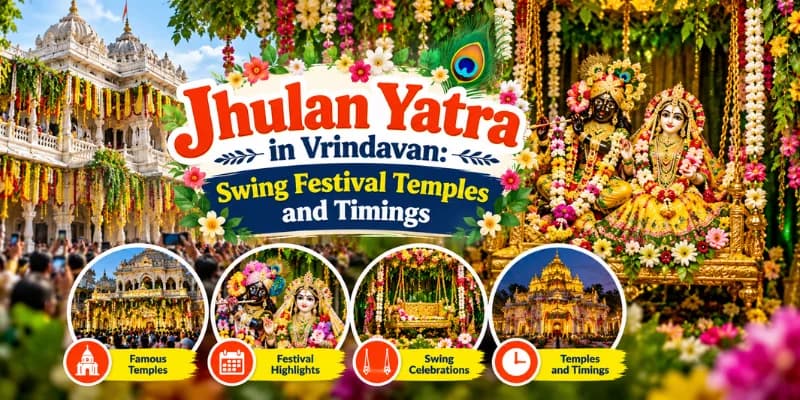
Jhulan Yatra, also called the Jhulan Utsav or simply the swing festival, is a monsoon (Sawan) celebration in which deities are placed on beautifully decorated swings to enjoy the rains. In Vrindavan it is one of the most anticipated festivals of the year, when Radha and Krishna are seated together on ornate, flower-garlanded jhulas across the town’s temples, gently swung amid song, lamplight and the fragrance of fresh monsoon blossoms.
The festival opens the wider hindola season that runs through Sawan and for several days the whole of Vrindavan takes on a festive air, with swings going up in temple after temple, each decorated in its own style. What makes Jhulan special is that it is not a single event at one place but a town-wide season of evening darshans, so a visitor can move between several historic temples over an evening and experience the swing in each one’s distinct tradition. It is at once deeply devotional and genuinely joyful, one of the loveliest and most atmospheric times to be in Braj and a festival that invites you to take part rather than simply watch.
History and significance
Jhulan Yatra is deeply rooted in ancient Braj heritage and by tradition, is inspired by the divine pastimes (lilas) described in sacred texts such as the Brahma Vaivarta Purana and the Gita Govinda. It commemorates the playful monsoon days when, in the tradition, Lord Krishna, Radha and the gopis (the cowherd girls) would escape the humid heat to swing on ornate, flower-garlanded jhulas in the lush, green groves of Vrindavan. The festival recreates that scene each year, which is why the swings are decked in flowers and set amid greenery, echoing the groves of the lila. These are devotional traditions and scriptural pastimes held dear by the faithful.
Spiritually, Jhulan Yatra is cherished as an intimate mode of bhakti, of devotional service. Rather than viewing the deities only as a static spectacle, devotees are, at many temples, invited to pull the ropes of the swing themselves, offering the practical, loving service of giving Radha and Krishna a cool breeze on a humid evening. This simple act, pulling the jhoola, turns the devotee from a spectator into a participant in the lila, which is the heart of what makes Jhulan so beloved. The sacred groves associated with these pastimes, such as seva kunj and nidhivan, add to the sense that the whole town is the setting of the divine play.
The 2027 dates
In 2027, the core Jhulan Yatra festival in Vrindavan is expected to run from Thursday 12 August to Tuesday 17 August. Because the festival follows the Hindu lunar calendar, its dates shift each year and are set by the panchang, so treat 12 to 17 August 2027 as the expected window and reconfirm the exact dates closer to the time, as they can vary slightly between calendars and between temples.
It is worth knowing that the swing season in Braj is broader than these core days. The hindola spirit begins earlier, around Hariyali Teej and swings can be seen in various temples across the weeks of Sawan, with the Jhulan Yatra window above being the main, most festive stretch in Vrindavan. If you are planning a trip specifically for Jhulan, aim for the core dates for the fullest atmosphere, but know that you may catch swings a little before and after as well. Build a little flexibility into your plans and confirm each temple’s own festive schedule nearer the date, since individual shrines manage their specific timings in their own way.
The swing festival temple by temple, with timings
While the entire holy town becomes festive, the celebrations are focused inside the historic temples and the main swing darshans happen during the evening, usually between the Sandhya (evening) aarti and the Shayan (night) aarti. Here are four of the headline temples for Jhulan, with their typical timings. Please treat all timings as indicative: each temple sets and adjusts its own schedule, often changing it for the heavy festival crowds, so always confirm locally on the day.
Shri Banke Bihari Mandir
At the famous Banke Bihari temple, the deity is brought out to a magnificent swing decorated with countless flowers and it is one of the most popular Jhulan darshans in town. The main swing darshan typically runs from about 5:30 PM to 9:30 PM. Expect this to be the busiest of all, given the temple’s popularity, so arrive early and be ready for a large crowd and controlled lanes.
Shri Radha Raman Temple
Known for its precise, centuries-old traditions, this historic temple hosts its traditional swing festival with great care and beauty, primarily from about 6:00 PM to 9:00 PM. Radha Raman is treasured for the authenticity of its seva, so the Jhulan here has a particularly traditional, intimate feel. It is a wonderful contrast to the larger temples.
ISKCON Vrindavan (Krishna Balaram Mandir)
At the iskcon vrindavan Krishna Balaram Mandir, devotees from around the world gather to pull the swing ropes amid high-energy kirtan, in a joyful, international atmosphere, typically from about 7:00 PM to 8:45 PM. If you want the participatory, singing-and-swinging side of Jhulan at its most vibrant, this is a lovely place to experience it.
Shahji Temple
Celebrated for its unique architecture and its beautifully decorated swing settings, Shahji temple offers one of the most photogenic Jhulan backdrops, typically accessible from about 5:30 PM to 7:30 PM. Its ornate interiors make the flower-decked swing especially striking and it is often a little calmer than the biggest temples.
A sensible evening plan is to pick two or three of these temples that suit your timing and energy, rather than trying to rush through all of them and to move between them on foot through the festive lanes. Our mathura vrindavan temple timings guide is a useful general reference and for the best evening aartis to pair with Jhulan see our must attend aarti guide.
How to experience Jhulan and the timing
The rhythm of Jhulan is an evening one. The main celebrations happen during evening darshan, usually in the stretch between the Sandhya aarti (the evening worship) and the Shayan aarti (the night worship, before the deities rest), which is why the temple windows above all cluster in the late afternoon and evening. Plan your visit for the evening and expect the atmosphere to build as the light fades, the lamps come on and the kirtan swells.
To get the most from it:
Go temple to temple. Jhulan is a town-wide season, so part of the joy is walking the festive lanes between a few temples, each with its own swing and style. Pick a realistic cluster rather than every temple in one night.
Take part if invited. At many temples you may gently pull the swing’s ropes as seva; do so respectfully, following the priests’ and staff’s guidance and let others have their turn.
Pair it with an aarti. Timing your visit to catch a Sandhya aarti alongside the swing darshan makes for an especially moving evening.
Dress for the season and the temple. Monsoon evenings are warm, humid and often rainy, so dress modestly but practically and carry a light raincover.
Confirm each temple’s festive schedule for the day, as the timings shift with the crowds.
Crowds, access and practical planning
Jhulan is one of the busiest and most joyful seasons in Vrindavan and in the evenings the lanes around the major temples fill with devotees. Plan for the crowd rather than be caught out by it. On high-footfall evenings the temples and local authorities often run one-way pedestrian routes near the busiest temples and restrict vehicles away from the temple core, so you will usually walk in through controlled lanes; be ready to park or be dropped some distance out.
A few practical points for a smooth visit:
It is the monsoon. Mid-August in Braj is warm, humid and frequently rainy, so carry a light raincover or umbrella, wear sandals or shoes you do not mind getting wet and protect your phone from both the rain and the crush.
Evenings are busiest. Since Jhulan darshans are in the evening, that is also when crowds peak, so arrive a little early at each temple and keep your plan flexible.
Mind the crush and the monkeys. Keep your group together, hold children and elders close and secure valuables and phones against both the crowd and Vrindavan’s well-known monkeys.
Darshan is free. Entry and swing darshan are free and open to all, so be cautious of anyone selling “VIP” access or quick-entry shortcuts.
For arrival into the region see how to reach vrindavan, for where to base yourself see where to stay in vrindavan and for the wider monsoon season see best time to visit. Confirm dates and arrangements nearer the time.
Planning your Jhulan Yatra and how a Brajwasi can help
Jhulan genuinely rewards a little local planning. Confirm the live dates (around 12 to 17 August 2027) and each temple’s evening timings nearer the event, pick a realistic cluster of two or three temples per evening, plan to pair a Sawan aarti with the swing darshan, arrange a stay within reach of the temple core, pack for the monsoon and set your expectations for big, joyful, patient crowds. Many visitors like to build a two or three day Sawan trip around it, taking in the swings in the evenings and the wider Braj sights by day.
Let a Brajwasi plan your swing-season evenings
Jhulan is a season best navigated with someone who knows the lanes, the evening rhythm and each temple’s timing. As Brajwasis, we can confirm the live festival dates and each temple’s schedule, plan the best realistic temple route for your evenings, guide you through the festive crush as smoothly as the season allows, arrange a well-placed stay and transport, keep you clear of touts and build a fuller Sawan Braj itinerary around the swings. A shared Vrindavan darshan starts from around 1499 rupees per person; see our vrindavan tour package or we design a private visit around Jhulan Yatra. Message us on WhatsApp at +91-7302265809 with your plans.
Related guides
Book Your Mathura - Vrindavan Trip Today
📞 +91-7302265809
💬 WhatsApp: +91-7302265809
We Reply in 30 Minutes
Packages start from ₹1,999/ person | Rated 4.5★ / 204+ Reviews
Explore all: Mathura Vrindavan Tour Packages
Jai Shri Krishna
Meet Gurudutt — Your Mathura Vrindavan Guide
Not just a tour operator — Gurudutt was born and raised in Braj Bhoomi. He has spent over a decade personally guiding pilgrims through the sacred lanes of Mathura & Vrindavan.

Founder – Experience My India
Gurudutt
Founder · Experience My India