Travel Guide · Travel Guides · Updated October 2026
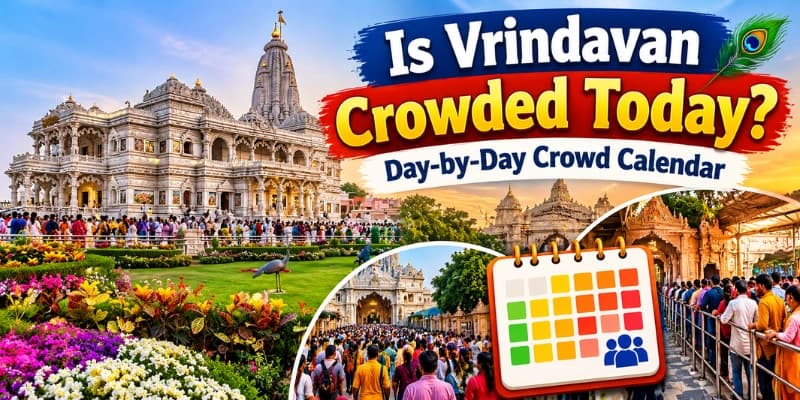
Is Vrindavan Crowded Today? Day-by-Day Crowd Calendar
By Gurudutt, Experience My India·16 October 2026
Quick Answer
Quick Enquiry
Today's crowd snapshot
Right now in Vrindavan | Expected level today |
Overall city crowd (ordinary weekday) | Moderate |
Banke Bihari Temple (peak darshan hours) | Heavy at core morning and evening hours |
Prem Mandir (before the evening light show) | Heavy just before the evening show |
Trend this week | Rising, as the Kartik season and festivals approach |
The short answer: how to tell on any day
Three things decide how crowded Vrindavan is on a given day and you can read all three before you go:
The day of the week. Weekdays, above all Tuesday to Thursday, are the calmest; Monday and Friday are a step busier; Saturday and Sunday are heavy, as weekend travellers come from Delhi and the National Capital Region.
The Hindu calendar. Ekadashi days, the Purnima (full moon) and festivals draw huge crowds, far above a normal day; the Kartik month (roughly late October to late November) is one of the busiest seasons of the year in Vrindavan, with thousands walking the parikrama.
The hour of the day. The main temples close through the afternoon for the deities' rest, so the crowd is not spread evenly: early morning and early evening are the smoothest, while late morning and the peak evening are the most packed.
Put simply: for the calmest visit, choose a weekday that is not an Ekadashi, Purnima or festival, arrive early in the morning and you will have the easiest darshan. The tables below let you place any date and any hour on this scale. For getting around the car-free core, see our how to commute in vrindavan guide. See our Mathura Vrindavan tour Packages or message WhatsApp +91 7302265809.
Day-by-day crowd calendar
A quick guide to the crowd by the type of day, with rough queue waits at Banke Bihari and a travel note:
Day type or event | Crowd level | Banke Bihari queue | Travel and parking note |
Tuesday to Thursday (ordinary weekdays) | Moderate | About 15 to 45 minutes | The best days to visit. Autos move easily; hotels are cheaper and freer. |
Mondays and Fridays | Moderate to high | About 45 to 90 minutes | Weekend overflow. Mornings are easier than evenings. |
Saturdays and Sundays (weekends) | Heavy to peak | About 2 to 4 hours | Avoid driving into the core. A big weekend influx from Delhi and the NCR. |
Long holiday weekends | Extremely heavy | About 3 hours or more | Severe foot congestion in the narrow lanes; high hotel rates. Park outside and walk. |
Ekadashi and Purnima days | Massive influx | About 3 to 5 hours | Thousands walk the parikrama, many barefoot. Lanes around the big temples are packed. |
The queue waits are rough guides for the busy darshan hours and vary a great deal with the exact time, the season and the festival; they can be far shorter if you arrive right at opening. Darshan itself is free at Banke Bihari and the temples; what the crowd costs you is time, so the aim is to choose a quieter window. See our banke bihari temple guide for that temple's own tips and prem mandir for the evening-show rush.
Hour-by-hour crowd guide
Because the major temples close through the afternoon, the crowd rises and falls sharply across the day. A typical pattern on an ordinary day:
Time window | Crowd level | What to expect |
About 7:45 to 9:00 AM | Low to moderate | The best window for morning darshan. Arrive at opening for the fastest path through the lanes. |
About 9:30 AM to 12:00 noon | Peak morning | Heavy, as tour buses and daytime pilgrims arrive together. The busiest morning hours. |
About 12:00 noon to 4:30 PM | Quiet or closed | The major temples close for the deities' rest. Best used for lunch and a hotel rest. |
About 5:30 to 7:30 PM | Moderate to high | Evening darshan opens and the crowd scales up steadily toward night. |
About 8:00 to 9:30 PM | Peak evening | The heaviest rush of the day. Lanes around Banke Bihari get very tight; keep your belongings secure. |
These windows are typical and are a guide only; the exact opening and closing hours shift with the season and on festival days, so confirm them on our mathura vrindavan temple timings guide or with your hotel or guide before you set out. The single best habit is to be at the temple gate when it opens in the morning.
Upcoming peak dates (October to November 2026)
These are the days to expect the very heaviest crowds in the coming weeks, so plan around them or come prepared for a slow, packed darshan if you visit on one. All dates verified against the Hindu calendar for 2026:
Date (2026) | Occasion | Expected crowd |
Sat 17 to Tue 20 October | Durga Puja and Dussehra long weekend (Vijayadashami on Tue 20 Oct) | Extremely heavy |
Thursday 22 October | Papankusha Ekadashi | Very heavy |
Sun 25 to Mon 26 October | Sharad Purnima and the start of the Kartik parikrama season | Massive influx |
Thursday 29 October | Karwa Chauth | Busy; rising into Kartik |
Thursday 5 November | Rama Ekadashi (just before Diwali) | Very heavy |
Around 8 to 11 November | Diwali, then Govardhan Puja (Tue 10 Nov) and Bhai Dooj | Extremely heavy |
Tuesday 24 November | Kartik Purnima and Dev Deepawali (end of Kartik) | Massive influx |
Through the whole Kartik month, from about Sharad Purnima in late October to Kartik Purnima on 24 November, Vrindavan is at its busiest and most beautiful, with the parikrama full day and night; expect heavy crowds on any day in this period and especially on the Ekadashi, Purnima and festival dates above. If you want the festival atmosphere, this is the time; if you want quiet, choose a weekday outside these dates.
Peaceful alternatives for a calm darshan
If you want the spiritual heart of Vrindavan without the pushing and the long queues, add a few of these historic, far quieter temples to your plan; they are among my favourite places to give guests a calm, personal darshan:
Radha Damodar Temple. A deeply historic temple, founded in 1542, yet usually visited by only a hundred or two pilgrims a day, so you can sit and feel its atmosphere; a favourite of the great saints of Vrindavan and a place of real peace.
Radha Vallabh Temple. A beautiful temple of the sixteenth century, of the Radhavallabh tradition, with relatively light crowds compared with its famous neighbours; serene and dear and only a short walk from the busier lanes.
Tatiya Sthan. A serene, naturally preserved ashram of great sanctity, with very few visitors; note that it keeps a strict no-phone and no-photography rule to protect its quiet, which is exactly what makes it so peaceful. Enter gently and keep silence.
Even at the busy temples, a quiet window exists if you look for it; and the historic groves and ghats of Vrindavan, such as the seva kunj vrindavan, reward an unhurried, early visit. A local guide can route you between the calm spots and the great temples at just the right hours.
Smart tips to beat the crowd
Come on a weekday, outside the festival dates. A Tuesday, Wednesday or Thursday that is not an Ekadashi, Purnima or festival is by far the easiest day; check the peak-dates table before you fix your trip.
Arrive at opening. Be at the temple gate when it opens in the morning; the first hour is the calmest and quickest of the whole day, before the buses arrive.
Use the shut afternoon well. The midday temple closure is not wasted time; take your lunch and rest then and keep your energy for a smooth early-evening or a quiet-temple darshan.
Park outside and walk or take a rickshaw. The core lanes are narrow and often car-free; on a busy day, leave the car at an outer parking and walk or take a cycle or e-rickshaw in. See our commute guide.
Travel light and stay alert in the lanes. In the peak-evening crush around Banke Bihari, keep your phone, wallet and valuables secure and close and keep children by the hand.
Go with a local guide on a busy day. On a weekend or a festival, a Braj guide who knows the lanes, the timings and the quieter side routes saves you hours and a great deal of stress.
How to plan your visit
We help guests visit Vrindavan at the right hours, with a Braj-born guide who knows the lanes, the temple timings and the quiet windows, so your darshan is calm even in a busy season. A shared day tour starts from around ₹1,499 per person, with darshan free. Our vrindavan tour package covers Vrindavan in a day, our mathura vrindavan tour the twin cities and the braj 84 kos yatra the whole of Braj; you can plan the order of the day with our mathura vrindavan tour itinerary. First-time and overseas visitors may also like our vrindavan for foreign tourists guide. Message me on WhatsApp at +91-7302265809 to plan a calm, well-timed Vrindavan visit.
Related guides
Meet Gurudutt — Your Mathura Vrindavan Guide
Not just a tour operator — Gurudutt was born and raised in Braj Bhoomi. He has spent over a decade personally guiding pilgrims through the sacred lanes of Mathura & Vrindavan.
Founder – Experience My India
Gurudutt
Founder · Experience My India