Travel Guide · Temple Guides · Updated October 2026
Hariyali Teej and the Golden Swing at Banke Bihari
By Gurudutt, Experience My India·21 October 2026
Quick Answer
Quick Enquiry
Sawan in Braj is my favourite season, the first rains, everything green and the hindolas, the swings, going up in temple after temple. At Banke Bihari, Hariyali Teej is the day the swing season truly begins and it is something special, because Thakur ji comes out into the courtyard and sits on that beautiful golden jhoola, which you only see this way once a year. The whole temple smells of fresh flowers and ghevar. I always tell guests two things: come for the evening, when the swing darshan is at its most beautiful and come expecting a big, joyful crowd, because all of Braj wants to be there that day. Be patient, keep your group close and let the atmosphere carry you. See our Mathura Vrindavan tour Packages or message WhatsApp +91 7302265809.
What Hariyali Teej at Banke Bihari is
Hariyali Teej, sometimes called Sawan Teej, is a monsoon festival that falls in the Hindu month of Shravan (Sawan) and the word hariyali means greenery, for the lush green that the rains bring. Across North India it is a women’s festival tied to Shiva and Parvati, but in Vrindavan and the wider Braj region it carries a second, very local meaning: it opens the beloved hindola or swing season, when deities across the temples are placed on decorated swings to enjoy the monsoon, echoing the swing pastimes (jhulan leela) of Radha and Krishna.
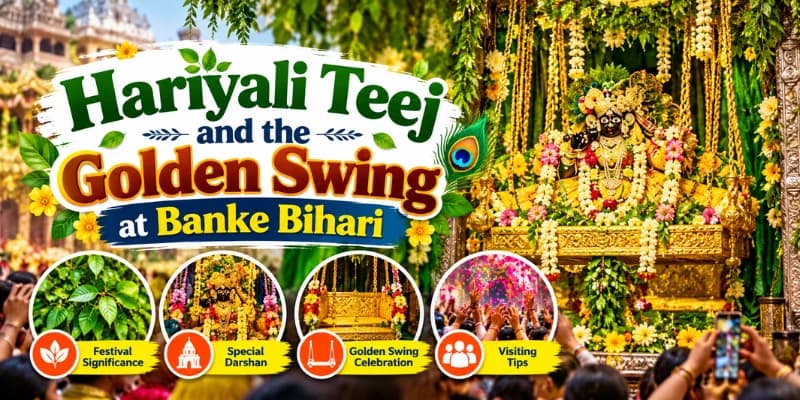
At Thakur Banke Bihari Ji’s temple, Hariyali Teej is the grand start of this season and one of the most anticipated days of the year. What makes it extraordinary is that on this single day the Lord does something He does on no ordinary day: He leaves the inner sanctum and comes out into the courtyard to sit on the temple’s famous golden swing for all to see. For devotees this is a rare and cherished darshan, a once-a-year sight of Thakur Ji on His hindola, in monsoon green, amid fresh flowers and festive song. Understanding that this is a special, single-day swing darshan and not an everyday one, is the key to appreciating both why it draws such crowds and why it is worth planning for.
The 2027 date and key timings
In 2027, Hariyali Teej is expected on Wednesday 4 August. By panchang, the Tritiya tithi (the third lunar day that marks Teej) begins at about 08:19 AM on 4 August and ends at about 05:08 AM on 5 August, which is why the celebration falls on the 4th. Because Hariyali Teej is set by the Hindu lunar calendar, its date shifts each year and is confirmed by the panchang, so treat 4 August 2027 as the expected date and reconfirm the exact day and the precise tithi timings closer to the event, as they can vary slightly between calendars.
For the darshan itself, the grand swing darshan takes place during the temple’s regular opening hours, but it is most prominent and most beautiful in the evening, roughly 5:30 PM to 9:30 PM. Please treat those evening hours as a general guide rather than a fixed schedule: the temple management sets and frequently adjusts the day’s timings close to the date because of the very high crowd volumes, so the exact opening and darshan hours for Hariyali Teej are confirmed nearer the time. Always check the current schedule locally or with us before you travel; our mathura vrindavan temple timings guide is a useful general reference for the temple’s usual hours.
The Golden Swing (Swarna-Rajat Hindola)
The heart of the celebration is the temple’s iconic golden swing, the Swarna-Rajat Hindola and the story the temple tells of it is remarkable. By the temple’s own account, the swing stands about 32 feet wide and 12 feet high and is made of solid wood entirely encased in gold and silver, said to be roughly 10 kilograms of pure gold over around 1,000 kilograms of silver. Master artisans from Banaras are said to have taken about five years to craft it and it is one of the most precious ritual objects brought out anywhere in Braj.
The swing also carries a moving link to India’s own story. According to the temple’s history, the golden hindola was commissioned by a devotee named Seth Hargulal Beriwala and was first inaugurated on 15 August 1947, the very day of India’s Independence, tying the swing forever to that date. Each year on Hariyali Teej the swing is brought out and Thakur Ji is seated upon it in the courtyard for the once-a-year darshan. These details are recounted as the temple’s tradition and history, cherished by devotees and seeing the golden swing in person, catching the light amid the flowers and the crowd, is for many the highlight of the entire monsoon season in Vrindavan.
The darshan: green poshak, bhog and Amrit Varsha
The Hariyali Teej darshan at Banke Bihari is a feast for the senses, built entirely around the monsoon-green (hariyali) theme. For this day the deity is dressed in exquisite green attire (green poshak) and adorned with fresh monsoon blossoms, in keeping with the lush Sawan mood and placed on the golden swing in the courtyard where the whole gathering can have darshan, rather than in the inner sanctum as on ordinary days.
The seva of the day includes special seasonal offerings. The Lord is offered monsoon delicacies such as ghevar and pheny, the classic Sawan sweets of the region, as part of His bhog. And at the close of the evening aarti comes one of the most loved moments of the celebration: the temple priests perform Amrit Varsha, sprinkling holy scented water over the massive gathering of devotees, a gesture that showers the crowd in blessing and sends a ripple of joy through the courtyard. Between the green attire, the fresh flowers, the fragrance of ghevar, the golden swing and the Amrit Varsha, the evening darshan on Hariyali Teej is one of the most beautiful and atmospheric in the entire Braj calendar.
The wider meaning of Hariyali Teej
It helps to understand the festival’s two layers, because they sit side by side on this day. In Vrindavan and Braj, the focus is on the divine romance and the monsoon swing pastimes of Radha and Krishna, which is why the hindola and the swing darshan take centre stage here. But across much of North India, Hariyali Teej primarily celebrates the divine union of Lord Shiva and Goddess Parvati.
By tradition, the festival commemorates the fierce penance of Parvati, who is said to have taken a great many births, 108 by the popular telling, before Shiva accepted her as His consort, which is why the day is so closely associated with marital devotion and longevity. In its wider North Indian form, women observe a fast (vrat), wear green attire, apply henna (mehndi), swing on decorated jhulas, sing seasonal songs and receive Sindhara gift hampers from their families, praying for marital bliss and the long life of their husbands. These are devotional traditions and beliefs, held dear and observed in many regional variations rather than as fixed rules. In Braj the same monsoon joy is channelled into the swing festivals and the love of Radha and Krishna, which is what you will experience at Banke Bihari.
Crowds, access and practical planning
There is no gentle way to say it: Hariyali Teej is one of the busiest days of the year at Banke Bihari and the narrow lanes of Vrindavan fill with huge crowds who come for the once-a-year swing darshan. Plan for the crowd rather than be caught out by it. On high-footfall days the temple and local authorities commonly run one-way pedestrian routes to and from the temple and restrict vehicles well away from the temple core, so you may park or be dropped some distance out and walk in through controlled lanes.
A few practical points make the day much smoother:
Come for the evening, but come early. The swing darshan is most beautiful in the evening (roughly 5:30 to 9:30 PM, confirm locally), which is also the busiest window, so arrive well before to get a manageable place.
It is the monsoon. Early August is warm, humid and often rainy, so carry a light raincover or umbrella, wear sandals or shoes you do not mind getting wet and keep your phone protected.
Guard against the crush and the monkeys. Keep your group together, hold children and elders close and secure your valuables and phone, which also helps against Vrindavan’s well-known monkeys.
Darshan is free. Entry and darshan are free and open to all, so be cautious of anyone selling “VIP” access or quick-entry shortcuts for this day.
For arrival into the region see how to reach vrindavan, for where to base yourself see where to stay in vrindavan and for the wider monsoon season see best time to visit. Confirm the date and all arrangements nearer the time.
Planning your Hariyali Teej darshan and how a Brajwasi can help
A day of this scale genuinely rewards local help and a little planning. Confirm the live date (around 4 August 2027) and the day’s timings nearer the event, plan to arrive early for the evening swing darshan, arrange a stay within reach of the controlled access, pack for the monsoon and set your expectations for a big, joyful, patient crowd rather than a quiet darshan. Many visitors also like to pair Hariyali Teej with the wider swing-festival days that follow through Sawan, when temple after temple across Braj puts up its hindola.
Let a Brajwasi plan your swing-season visit
On one of the busiest days of the Banke Bihari year, a local who knows the lanes, the timing and the crowd flow makes a real difference. As Brajwasis, we can confirm the live date and the day’s timings, advise the best realistic window for the golden-swing darshan, guide you through the controlled routes and the crush as smoothly as the day allows, arrange a well-placed stay and transport, keep you clear of touts, and if you wish, build a fuller Sawan-season Braj itinerary around it. A shared Vrindavan darshan starts from around 1499 rupees per person; see our vrindavan tour package or we design a private visit around Hariyali Teej. Message us on WhatsApp at +91-7302265809 with your plans.
Related guides
Book Your Mathura - Vrindavan Trip Today
📞 +91-7302265809
💬 WhatsApp: +91-7302265809
We Reply in 30 Minutes
Packages start from ₹1,999/ person | Rated 4.5★ / 204+ Reviews
Explore all: Mathura Vrindavan Tour Packages
Jai Shri Krishna
Meet Gurudutt — Your Mathura Vrindavan Guide
Not just a tour operator — Gurudutt was born and raised in Braj Bhoomi. He has spent over a decade personally guiding pilgrims through the sacred lanes of Mathura & Vrindavan.
Founder – Experience My India
Gurudutt
Founder · Experience My India