Travel Guide · Festivals & Events · Updated October 2026
Gopashtami in Vrindavan
By Gurudutt, Experience My India·20 October 2026
Quick Answer
Quick Enquiry
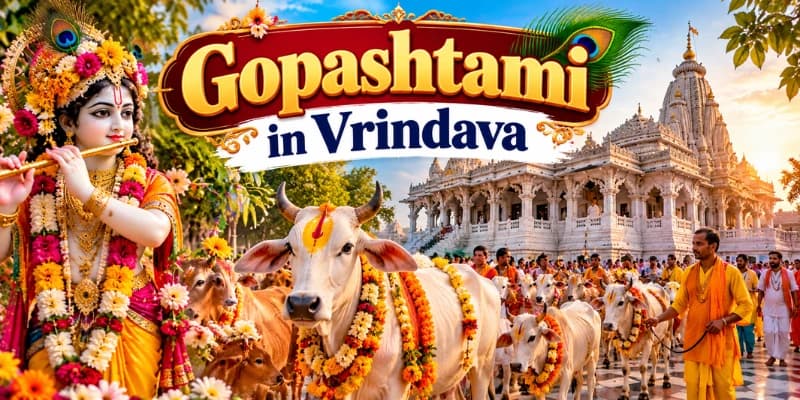
For a Brajwasi, Gopashtami is close to the heart, because Braj is the land of Krishna the cowherd, and our cows are Gau Mata, mother. On this morning the gaushalas are a picture: cows bathed and painted, horns gilded, necks heavy with marigold, calves everywhere, and families lining up to feed them gur and touch the dust of their hooves to their foreheads. I love bringing guests to a good goshala at dawn for Go-Puja, then to the temples where the deities are dressed as cowherds, and to hear the story of how little Radha slipped in as Subala to be near Krishna and the cows. Come gently, it is a soft, joyful festival. See our Mathura Vrindavan tour Packages or message WhatsApp +91 7302265809.
What Gopashtami is and the 2027 date
Gopashtami is the festival that celebrates Krishna’s first day as a true cowherd. Until this day, his foster father Nanda Maharaja considered him too young and let him tend only the small calves near home; on this Ashtami, he formally entrusted Krishna and his brother Balarama with taking the full-grown cows out to the pastures of Vrindavan for the first time. It is a tender milestone of Krishna’s childhood and in Braj, the land of his cowherd pastimes, it is also a day of deep reverence for the cow.
It falls on the Ashtami tithi of the bright fortnight (Shukla Paksha) of the month of Kartik. In 2027 that is Saturday, 6 November. Because it follows the lunar calendar, the English date shifts each year, so confirm it against the current panchang before you plan. Gopashtami comes a week after Govardhan Puja in the Kartik festival season, so it sits in one of the most beautiful and auspicious stretches of the Braj calendar. It falls in the holy month of Kartik, Braj’s most sacred season, which links it to the festivals around it: Diwali, then govardhan puja the very next day and Gopashtami about a week later. Our kartik month vrindavan guide covers the wider season, which many pilgrims use to plan a longer, deeply auspicious stay rather than a single day.
The significance of Gopashtami
Four layers of meaning come together on this one day in Braj. Together they explain why Gopashtami matters so much here.
Krishna becomes a Gopa (cowherd)
The primary significance: Gopashtami marks the day Krishna graduated from a calf-herd (Vatsapa) to an independent cowherd (Gopa). Before it, Nanda Maharaja deemed him too young and allowed him only the small calves near the house. On this Ashtami, Nanda formally entrusted Krishna and Balarama with the grand responsibility of taking the full-grown cows out to graze in the pastures of Vrindavan for the very first time, a rite of passage into his beloved cowherd life.
The coronation as Govinda
Gopashtami also concludes the Govardhan Lila. After Krishna lifted the Govardhan Hill on his little finger to shelter the people of Braj from Indra’s catastrophic rains, the rain god accepted defeat on the eighth day (Ashtami). The divine wish-fulfilling cow Surabhi then descended, bathed Krishna in her milk and consecrated him as Govinda, the protector of cows and the Supreme Lord. The name Govinda, so dear to devotees, is tied to this very day. See our govardhan hill guide for the Govardhan Lila.
Radha Rani’s Subala disguise
Vrindavan uniquely remembers a sweet pastime of Srimati Radharani on this day. Because herding cows was traditionally reserved for the boys (gopas), Radha was not allowed to join. Longing to accompany Krishna and serve the cows, she disguised herself as a boy, resembling Krishna’s friend Subala, wore a dhoti and blended in with the cowherds. Temples in Vrindavan still re-enact this or dress the deities accordingly, a detail you can look for at the radha raman temple and other Radha shrines on the day.
Gau Seva and spiritual blessings
In Braj, cows (Gau Mata) are revered as sacred beings believed to house countless celestial deities and to embody spiritual purity. Devotees hold that performing Gau Seva, service to cows, on Gopashtami clears karmic obstacles, pleases Lord Hari and invites prosperity and harmony. This is why the heart of the festival in Vrindavan is not a temple ritual alone but the loving care of the cows themselves.
Gopashtami celebrations in Vrindavan
If you visit during Gopashtami, the festivities are immersive and centred on the cows. Confirm each gaushala’s programme and timings locally.
Go-Puja at the gaushalas
Major gaushalas, including the iskcon vrindavan goshala, clean, bathe and beautifully adorn hundreds of indigenous cows and hold Go-Puja (worship of the cow). Being at a goshala in the morning for this is the most moving way to experience the day.
Decorating the cows
The cows are painted, dressed in colourful garments, heavily garlanded with fresh flowers and their hooves and horns are sometimes gilded or highlighted. The sight of a whole goshala of cows adorned this way, with calves alongside, is one of the gentlest and most beautiful in all of Braj.
Offerings and parikrama
Devotees feed the cows fresh green fodder, jaggery (gur) and sweets, then perform parikrama (circumambulation) around them and gently touch the dust of their hooves to their foreheads as a mark of deep respect. Visitors are usually welcome to take part in this Gau Seva; do it calmly and follow the gaushala staff’s guidance.
Cowherd shringar at the temples
Beyond the gaushalas, many Vrindavan temples mark the day by dressing their deities in cowherd attire, as Gopa, sometimes with a staff, a flute and a small cow beside them and by holding special darshans. Looking for this cowherd shringar as you move between temples carries the theme of the day through your darshan and the Radha shrines in particular may depict the Subala pastime. It is a lovely contrast to the goshala: the cows in the morning, the adorned deities through the day.
The cow in Braj and why Gopashtami matters here
To understand why Gopashtami is felt so deeply in Vrindavan, it helps to understand the place of the cow in Braj. This is the land where, by tradition, Krishna spent his boyhood as a cowherd and the cow is not merely livestock here but Gau Mata, revered as a mother. In the Srimad Bhagavatam and the wider Vaishnava tradition, the cow is described as a source of nourishment, gentleness and selfless giving and is said to house countless deities within her body. Serving her is therefore counted among the tender, everyday forms of devotion that Braj holds dear.
Krishna’s very names carry this bond. He is called Gopala, the protector of cows and Govinda, the one who gives pleasure to the cows, a title, by tradition, conferred on this very day. The flute, the peacock feather and the herd of cows are the images Braj loves most and Gopashtami gathers all of them into a single morning. For a pilgrim, this is why the festival is less about grand ceremony and more about a quiet, affectionate closeness to the animals Krishna himself is said to have tended.
This reverence also shapes how you should move through the day. Approaching the cows with calm and respect, offering fodder with an open palm and taking the dust of the goshala as blessing rather than treating it as a photo opportunity, all of this is in keeping with how Brajwasis themselves honour Gau Mata. Held as living tradition rather than spectacle, the day rewards gentleness and that spirit is the real heart of Gopashtami in Vrindavan.
Where to experience Gopashtami across Braj
While Vrindavan’s gaushalas and temples are the natural focus, Gopashtami is celebrated right across the Braj region and knowing the options helps you plan a morning that suits you. Within Vrindavan, the large, well-run goshalas hold the fullest Go-Puja programmes and welcome visitors for Gau Seva, while the old temples add the cowherd shringar of their deities through the day. A good plan is simply one goshala at dawn and two or three temples afterward, rather than rushing between many.
Beyond Vrindavan, the villages most tied to Krishna’s cowherd life carry their own flavour. Nandgaon and Gokul, associated with Nanda Maharaja’s home and Krishna’s infancy and Barsana, Radha Rani’s village, all mark the Kartik season warmly and a local can tell you which programmes are running in a given year. Govardhan, a short drive away, is especially fitting because Gopashtami concludes the Govardhan Lila, so some pilgrims pair the goshala morning with a visit to Giriraj. Confirm distances, timings and the year’s arrangements locally, as village programmes vary and are not fixed on a timetable.
Choosing where to go comes down to your pace and your priorities. If you want the most immersive Gau Seva, centre the day on a single large Vrindavan goshala. If you are drawn to the lila landscape, add Govardhan or one of the cowherd villages. Families and elders usually do best with one unhurried goshala and a couple of nearby temples, avoiding long drives on a busy festival day. Whichever shape you choose, keep it gentle and leave room for the slow, affectionate mood that makes the morning special.
Gopashtami, Govardhan and planning your trip
Gopashtami does not stand alone; it closes the Govardhan Lila, so it pairs naturally with a visit to Giriraj Govardhan. Many pilgrims add the Govardhan sites or walk part of the sacred hill’s circuit around the festival; if you want to include it, our govardhan parikrama guide explains the route or the govardhan parikrama tour package covers it as a planned day.
For the visit itself, aim to reach a good goshala early in the morning for the Go-Puja and the decorated cows, then take temple darshan, where many deities are dressed as cowherds for the day. Temple hours shift in winter and around festivals, so see our mathura vrindavan temple timings guide and confirm the gaushala programmes locally. Because Gopashtami falls in the busy Kartik season, book your stay well ahead; our where to stay in vrindavan guide helps you choose the right area.
For a ready-made trip, our mathura vrindavan tour itinerary maps a full plan, the vrindavan tour package suits a focused day and the mathura vrindavan tour package gives a relaxed two-day darshan that folds Gopashtami in comfortably.
Gopashtami falls in the cool, pleasant Kartik season, which is one of the loveliest times to be in Braj, so it pairs naturally with a wider Vrindavan and Mathura pilgrimage. Aim to reach a good goshala early in the morning for the Go-Puja and the decorated cows, then visit the temples, many dress their deities as cowherds for the day. Temple hours shift in winter and around festivals, so see our mathura vrindavan temple timings guide and confirm the gaushala programmes locally and our mathura vrindavan tour itinerary to plan the trip around it.
Let us plan your Gopashtami darshan and Gau Seva
Gopashtami is a soft, joyful festival and a local can open its best moments for you. As a Brajwasi, I can take you to a genuine goshala at dawn for the Go-Puja and the decorated cows, arrange respectful Gau Seva (feeding the cows gur and green fodder), guide you to the temples where the deities are dressed as cowherds, tell you the Govinda and Subala stories in the places they belong and time the day around the Kartik-season crowds. Darshan is free. A shared day tour starts from around 1,499 rupees per person and we are glad to design a private Gopashtami plan. Message us on WhatsApp at +91-7302265809 with your dates.
Related guides
Book Your Mathura - Vrindavan Trip Today
📞 +91-7302265809
💬 WhatsApp: +91-7302265809
We Reply in 30 Minutes
Packages start from ₹1,999/ person | Rated 4.5★ / 204+ Reviews
Explore all: Mathura Vrindavan Tour Packages
Jai Shri Krishna
Meet Gurudutt — Your Mathura Vrindavan Guide
Not just a tour operator — Gurudutt was born and raised in Braj Bhoomi. He has spent over a decade personally guiding pilgrims through the sacred lanes of Mathura & Vrindavan.

Founder – Experience My India
Gurudutt
Founder · Experience My India