Travel Guide · Travel Guides · Updated October 2026
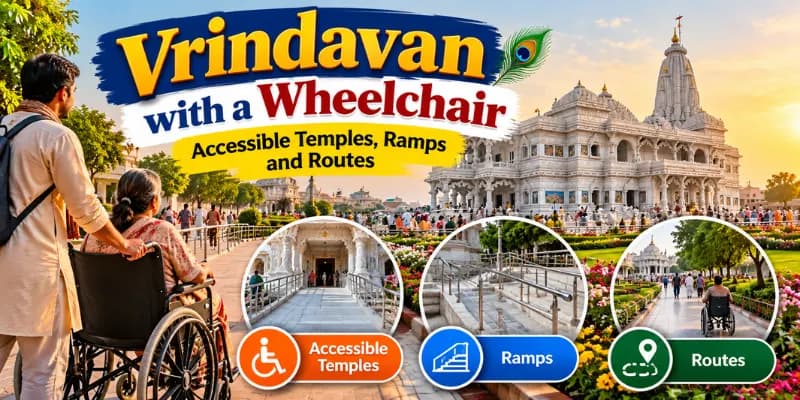
Vrindavan with a Wheelchair: Accessible Temples, Ramps and Routes
By Gurudutt, Experience My India·20 October 2026
Quick Answer
Quick Enquiry
Highly accessible temples (ramps and flat ground)
These modern or well-renovated complexes are highly accommodating, with smooth surfaces, ramps and open pathways. (Confirm current facilities before visiting.)
Prem Mandir
Widely regarded as the most senior- and disabled-friendly temple in Vrindavan. The large (reported 54-acre) compound is paved, flat and has gentle ramps and lifts; complimentary battery-operated golf carts are reported to run from the parking area to the shrine and standard cars can drive up to the eastern gate. There are benches throughout to rest. An excellent, comfortable first choice. See our Prem Mandir guide.
Sri Sri Krishna-Balaram Mandir (ISKCON)
The open courtyard is paved in smooth marble, so a wheelchair can move freely, with ramps to Srila Prabhupada’s Samadhi and the main altar and bench seating available. Wheelchair rental (confirm): ISKCON Vrindavan is reported to offer wheelchair rental (at Gate No. 2 and Gate No. 3), typically requiring a valid photo ID (Aadhaar) and a refundable cash security deposit (reported around Rs 2,000). Confirm the current availability, gates and deposit on the day and ideally bring your own chair as a backup. To stay nearby, see our iskcon vrindavan guest house guide.
Vrindavan Chandrodaya Mandir
Though parts of this grand temple are still being built, the open areas currently in use are highly accessible, with reported covered-portico car drop-offs, smooth modern ramps and lifts for comfortable movement. A good modern option; confirm which areas are open and accessible.
Chaar Dham Vrindavan
This clean, expansive (reported 11-acre) complex has smooth, obstacle-free paths and dedicated ramps. One thing to plan for: the full loop reportedly spans over 1 km, which is sustained pushing for a manual chair, so pace it, take breaks or have a helper share the effort.
Challenging heritage shrines (narrow, crowded routes)
The older historic centre has real structural barriers for wheelchairs. Plan these carefully or choose accessible alternatives.
Shri Banke Bihari Ji Mandir
The most challenging shrine for wheelchair users. Four-wheeled vehicles are banned from the narrow, congested market alleys leading to the Banke Bihari temple. In practice: private cabs drop you roughly 300 m away (around Vidyapeeth Chauraha), from where you take a local e-rickshaw through the tight lanes. The entrance has reportedly been modified for flat entry, but there are no wheelchairs available on site and the inner courtyard often has intense, shoulder-to-shoulder crowd surges. If you attempt it, go at the quietest possible time, with a strong helper and be ready to turn back if the crowd is dangerous.
Shri Radha Sneh Bihari Ji Temple (an accessible alternative)
About 50 m from Banke Bihari, this temple is an excellent, wheelchair-friendlier alternative: it has a replica of the deity but in a much quieter, cleaner space, with a reported wheelchair-accessible parking zone. For a wheelchair user, a peaceful darshan here can be far more comfortable and dignified than the Banke Bihari crush.
Shri Radha Madan Mohan Ji Mandir
This historic temple is perched on a hilltop near Kaliya Ghat and is reached by a steep flight of stairs, so it is not wheelchair accessible. Admire it from below or take darshan at the accessible temples instead; do not attempt the stairs with a chair.
Accessibility comparison matrix
A quick comparison of the main temples. All details are reported and change, so confirm before visiting.
Temple | Ramp / lift | Vehicle drop-off | Crowd / seating |
Prem Mandir | Ramps & lifts | Direct to gate (+ golf carts) | Excellent; benches throughout |
ISKCON Vrindavan | Altar & courtyard ramps | Close drop at main-road barrier | Spacious; bench seating |
Chandrodaya Mandir | Modern lifts & slopes | Covered portico car drop | Organised; low crowd strain |
Banke Bihari | Flat gate entry only | Restricted; 300 E m e-rickshaw | xtreme surges; no seating |
Strategic tips for a smooth visit
Time it for the quietest window. Aim for weekday mornings (Tuesday to Thursday), roughly 8:00 AM to 10:00 AM. Avoid weekends, Ekadashi and major festivals (Holi, Janmashtami), when the crowd rushes make handling a wheelchair genuinely dangerous.
Hire a dedicated local helper. Beyond your driver, a trusted local helper for the day is invaluable, an extra set of strong arms to lift a folding chair over an unexpected step or uneven threshold. We can arrange this for you.
Plan around the midday closure. Almost all temples close roughly 12:45 PM to 4:00 PM for the deities’ rest. Use that window for lunch and a proper rest at an accessible hotel (Chhatikara Road or near Prem Mandir), rather than waiting out in the heat.
Bring your own chair if you can. A familiar, well-maintained wheelchair (ideally a sturdy folding one) beats depending on a rental; bring a cushion for long sessions and rough ground.
Keep medicines, water and ID handy. Carry essential medicines, sealed water and a photo ID (needed for rentals and hotels), in an easy-to-reach bag.
For festival-day and daily temple hours, see our mathura vrindavan temple timings guide and reconfirm the day’s schedule locally, since timings and crowd levels shift with the season and the religious calendar.
Renting a wheelchair and arranging local help
Not everyone travels with their own wheelchair, so it helps to know the options on the ground. The single most reliable source of wheelchairs in Vrindavan is the ISKCON temple, which keeps chairs for visitors, usually free or against a small refundable deposit and a photo ID, though availability is first-come and not guaranteed on peak days. A few of the larger temples and some hospitals and medical-supply shops in Vrindavan and nearby Mathura can also arrange or rent a chair, but supply is limited and should never be assumed, so confirm in advance rather than arriving and hoping.
For anything beyond the flattest temples, a chair alone is rarely enough; a strong, caring local helper for the day makes the real difference. An extra set of arms to ease a folding chair over an unexpected step, a raised threshold or a stretch of broken lane turns many “not accessible” spots into manageable ones and it lets a family member be a companion rather than a full-time porter. If you are bringing an elderly or less mobile pilgrim, plan for both a dependable chair, ideally your own sturdy folding one and dedicated human help and keep a cushion, water, essential medicines and a photo ID in an easy-to-reach bag. We can arrange a suitable chair and a trusted helper as part of a visit.
Getting around Vrindavan with limited mobility
Moving between temples is often the hardest part of an accessible visit, because the old core of Vrindavan is a maze of narrow, congested lanes, many closed to cars, with uneven surfaces and few formal drop-off points. The practical approach is to use a car or taxi for the longer hops between temple clusters and your hotel and to accept that the final stretch into the old lanes is covered on foot or by e-rickshaw. E-rickshaws are cheap and everywhere, but they are open, a little bumpy and not designed for wheelchairs, so a helper is needed to assist on and off.
The smoothest plan is to group temples by area so you minimise transfers, use the wider, newer roads (around Chhatikara Road, Prem Mandir and the ISKCON area) where vehicles can get much closer to the entrance and save the deep old-city shrines for when you have time, help and patience. Ask your driver about the nearest accessible drop-off for each temple rather than assuming, as the closest motorable point can be several minutes’ push from the gate. Keeping the day unhurried, with generous buffers for these transfers, matters far more than trying to cover everything.
Best time to visit with limited mobility
Timing shapes an accessible visit more than almost anything else, because crowds, heat and the religious calendar all affect how manageable the lanes and queues are. The most comfortable season is the cool, dry window from October to March, when temperatures are gentle and long waits in the open are bearable; the deep summer of April to June is genuinely hard for anyone with limited mobility and the monsoon leaves the lanes slippery and waterlogged in places. Within the day, early weekday mornings, roughly 8:00 AM to 10:00 AM, are calmest, before both the heat and the crush build.
It is worth planning firmly around the midday temple closure, when almost all shrines shut for the deities’ rest in the early afternoon; rather than waiting it out in the heat, use that block for lunch and a proper rest at an accessible hotel. Above all, avoid the big festival peaks, Holi, Janmashtami and major Ekadashi days, when the crowd surges make handling a wheelchair genuinely unsafe. Confirm the exact daily timings and any special festival schedule locally before you set out, since these shift through the year and a wasted trip to a closed or impossibly crowded temple is exhausting for a less mobile pilgrim.
Let us plan a barrier-free pilgrimage
Planning an accessible visit is exactly where a knowledgeable local makes the difference. We can map a barrier-free route around the accessible temples, arrange a suitable vehicle with easy drop-offs, provide a strong, caring local helper for lifting and support, time everything for the calm, low-crowd windows, book a genuinely accessible hotel (ground-floor or lift access, near the main temples) and gently handle the harder shrines or substitute easier alternatives, so your loved one has a comfortable, dignified darshan. A shared day tour starts from around 1499 rupees per person and we are glad to design a private accessible plan. Darshan is free. Message us on WhatsApp at +91-7302265809 with your needs and we will tailor it with care.
Related guides
Book Your Mathura - Vrindavan Trip Today
📞 +91-7302265809
💬 WhatsApp: +91-7302265809
We Reply in 30 Minutes
Packages start from ₹1,999/ person | Rated 4.5★ / 204+ Reviews
Explore all: Mathura Vrindavan Tour Packages
Jai Shri Krishna
Meet Gurudutt — Your Mathura Vrindavan Guide
Not just a tour operator — Gurudutt was born and raised in Braj Bhoomi. He has spent over a decade personally guiding pilgrims through the sacred lanes of Mathura & Vrindavan.
Founder – Experience My India
Gurudutt
Founder · Experience My India