Travel Guide · Travel Guides · Updated October 2026
Deeg Palace and Jal Mahal: A Braj Day Trip
By Gurudutt, Experience My India·29 October 2026
Quick Answer
Quick Enquiry
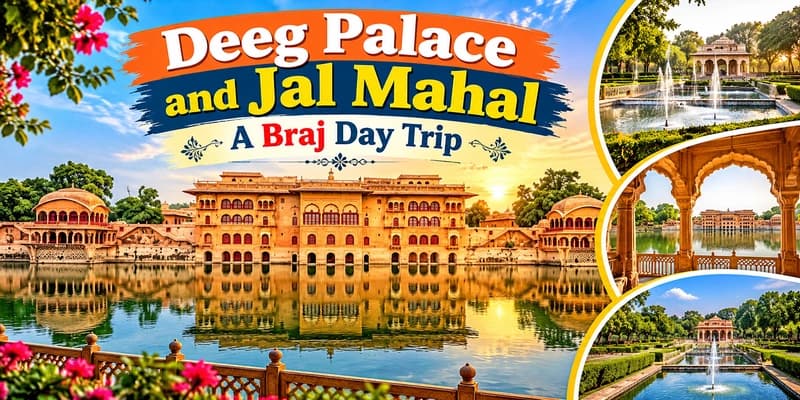
Deeg is one of my favourite surprises to show travellers doing Braj. Just over into Rajasthan, near the Govardhan parikrama’s Rajasthan stretch, this Jat water palace is a genuine engineering wonder, lower rooms built to sit in water for cooling, hidden pipes feeding thousands of fountains, a pavilion that fakes a thunderstorm. It is quieter and less known than the big forts, which is its charm. Just remember the fountains only run on special days, so plan for that. See our Mathura Vrindavan tour Packages or message WhatsApp +91 7302265809.
The water engineering and the bhawans
What sets Deeg apart is its sophisticated 18th-century hydraulic design, built to interact dynamically with its environment rather than sit beside a static lake.
The water system
Twin reservoirs. The complex is flanked by two large water bodies, Gopal Sagar to the west and Rup Sagar to the east. The main pavilion foundations are engineered so the lower storeys stay submerged in water, keeping the structure naturally cool.
Terracotta plumbing. A massive overhead reservoir, holding roughly 600,000 gallons, feeds an intricate network of buried terracotta pipelines that pressure more than 2,000 hidden ornamental fountains across the complex.
Weather simulation. The crowning glory is Keshav Bhawan, the monsoon pavilion, with hollow pillars holding stone balls; when water is pumped through, the rolling balls create a rumbling thunder effect while water cascades like heavy rain.
The architectural bhawans
The layout mirrors the formal symmetry of the Mughal Charbagh (four-fold garden), fused with robust Rajput elements.
Gopal Bhawan, the grandest building, with sweeping water views, marble thrones and carved arches.
Suraj Bhawan, built almost entirely of off-white marble, which, it is said, was dismantled and reassembled from Mughal buildings in Delhi.
Nand and Kishan Bhawan, formal structures with arched facades used for royal audiences.
Sawan-Bhadon pavilions, twin structures named after the monsoon months, shaped with traditional Bangaldar curved roofs.
The Deeg Fort
Just east of the palace grounds sits the older Deeg Fort, built by Maharaja Suraj Mal around 1730. Encircled by massive mud-rubble walls and deep moats designed to withstand cannon fire, its watchtower gives an exceptional 360-degree view over the whole Deeg township. A large historical cannon, by tradition looted from the Agra Fort, still stands on the ramparts as a symbol of Jat military power. The fort makes a natural companion to the palace, a contrast of military strength and refined water-palace leisure, side by side.
The Jat rulers and the story of Deeg
Deeg is not merely a pretty palace; it is the cradle of the Bharatpur Jat state and understanding that story makes the visit far richer. In the early 18th century, as Mughal authority weakened across north India, the Jat chieftains of this region carved out an independent kingdom. By tradition, Deeg served as an early seat and summer capital of this rising power before Bharatpur itself grew into the main stronghold, which is why the town carries so much royal architecture for its size.
Maharaja Suraj Mal, remembered as the most capable of the Jat rulers, is the figure most closely associated with Deeg’s golden age. He is credited with raising the fort around 1730 and with developing the water palace as a cool-season retreat for the court. Under him and his successors the Jats grew confident enough to campaign against the declining Mughals and local accounts hold that marble, fittings and the great cannon now standing on the fort ramparts were carried back from Delhi and Agra as spoils of those campaigns. These details are recounted as historical tradition rather than as fully documented fact, but they capture the real spirit of a regional power asserting itself against a fading empire.
For the traveller, this history explains the character of the whole complex. The marble bhawans, the thousands of fountains and the elaborate monsoon pavilion were deliberate statements of wealth and ambition, while the thick-walled fort beside them was the hard military reality that made such luxury possible. Deeg, in other words, holds both halves of the Jat story in one place, the sword and the garden, side by side. Walking it with that in mind turns a simple sightseeing stop into a window on how a new power announced itself in 18th-century Rajasthan.
A curated day-trip itinerary
The palace takes roughly 1.5 to 2 hours to explore fully, so it pairs well with a wider sweep of Bharatpur district.
Time | Activity | Notes |
9:30 AM | Depart Bharatpur | An easy, direct 1-hour drive through countryside state highways |
10:30 AM | Arrive at Deeg Palace | Enter via the majestic Singh Pol; a registered local guide at the gate can explain the hidden plumbing |
12:30 PM | Explore Deeg Fort | Walk up to the watchtower for the bastions and military architecture |
1:30 PM | Lunch in Deeg town | Local sweets and Braj-style vegetarian food in the central market |
3:00 PM | Return to Bharatpur | Head back for Lohagarh Fort and the state museum to round off the day |
This is a guide, not a fixed schedule; adjust it to your pace and the season. Deeg also pairs well from the Braj side, see places to visit near mathura and for the nearby Rajasthan stretch of the hill circuit, our govardhan parikrama guide.
Practical essentials
Detail | Information (confirm locally) |
Timings | 9:00 AM to 5:00 PM |
Weekly closure | Closed on Fridays |
Entry fee | Around 25 rupees for Indian citizens; about 200 to 300 rupees for foreign tourists (a small extra fee may apply for the inner museum) |
Location | Deeg, about 35 to 38 km north of Bharatpur, Rajasthan |
When the fountains run (important). The iconic 2,000-plus fountains do not run daily. They are operated by gravity pressure only on special regional occasions, primarily the lively Braj Holi festival around March or on select government-designated tourism days. If seeing the fountains is the point of your trip, cross-check the dates locally with the Rajasthan Tourism Development Corporation (RTDC) or the site before booking, so you are not disappointed. On an ordinary day you will see the palace, the pavilions and the plumbing, but the fountains will be still.
Best time to visit and how long to spend
Because Deeg sits in the dry plains that edge Rajasthan, the weather matters a great deal to how much you enjoy it. The comfortable window runs broadly from October to March, when the days are mild and walking the open courtyards and climbing the fort watchtower is a pleasure rather than an ordeal. April to June can be punishing, with fierce heat radiating off the exposed stone and while the monsoon months bring welcome greenery around the lakes, the famous fountains still stay off except on their special festival days. All of these seasonal notes are a general guide, so confirm conditions locally before you set out on a long drive.
Within the day, aim to arrive close to the opening time in the morning, both for the softer light on the marble and to finish the palace and fort before the afternoon sun climbs. Remember that the site is closed on Fridays, so build your week around that. Plan on roughly 1.5 to 2 hours for the palace and another hour for the fort and watchtower, which together make a relaxed half-day; treat these durations as approximate and confirm locally, as entry procedures can change.
The one date that transforms the whole experience is the running of the fountains. By tradition they flow only on select occasions, chiefly around the Braj Holi season in spring or on certain government tourism days, so if that is the reason for your trip, confirm the exact dates nearer the time with the state tourism body or the site itself. On an ordinary day you will still see the palace, the pavilions and the clever plumbing, but the water itself will be at rest and arriving with that expectation saves the classic Deeg disappointment.
Nearby places to combine with Deeg
Deeg rewards travellers most when it is folded into a wider loop rather than visited in isolation and its position on the Rajasthan edge of Braj makes that easy. The closest natural pairing is Bharatpur itself, about an hour away, where the sprawling Lohagarh Fort and the state government museum round out the Jat story you began at Deeg. Confirm distances and drive times locally, as road conditions and diversions vary through the year.
A short further hop brings you to Keoladeo National Park, the celebrated wetland bird sanctuary on the edge of Bharatpur, which is at its finest in the winter birding season and makes a gentle, green contrast to the stone of Deeg. From the Braj direction, Deeg connects with Kaman (Kamyavan), one of the traditional forests of the Braj Chaurasi Kos circuit and with Govardhan, whose parikrama route brushes the Rajasthan stretch close by. This is why pilgrims on a deeper Braj yatra can slot Deeg in without a long detour from their route.
For those building a broader cultural trip, Agra and the Taj Mahal sit within comfortable day-trip range, as do Mathura and Vrindavan on the Uttar Pradesh side. A sensible way to picture Deeg is as the hinge between a Braj pilgrimage and a Rajasthan heritage swing: it is close enough to the temples to suit devotees, yet firmly a historical monument in its own right, so it broadens a trip without pulling it off course. Plan the exact sequence around your own pace and the Friday closure and confirm all timings and distances locally before committing to a schedule.
Planning your visit
Deeg is an offbeat heritage day trip rather than a Braj temple, so it suits travellers who enjoy history, architecture and engineering alongside their pilgrimage. It sits just into Rajasthan, close to the Govardhan parikrama’s Rajasthan stretch and the Kaman (Kamyavan) area, so it can be woven into a deeper western-Braj journey or combined with Bharatpur, Keoladeo National Park and Agra. For the comfortable months, see best time to visit; October to March is ideal and the Holi season adds the chance to see the fountains. For arrival into the wider region, see how to reach vrindavan and for a Taj pairing, places to visit in agra.
Let a Brajwasi add Deeg to your Braj journey
Deeg is the kind of offbeat gem we love to add for travellers who want more than the standard circuit. As Brajwasis, we can fold Deeg Palace and Fort into a deeper Braj journey alongside the Rajasthan-side sites like Kaman, help you time a visit for the Holi-season fountains and arrange comfortable transport and a local palace guide. We extend our braj tour package into these further sites; a shared Braj day starts from around 1499 rupees per person or we design a private plan. Message us on WhatsApp at +91-7302265809 with your dates.
Related guides
Book Your Mathura - Vrindavan Trip Today
📞 +91-7302265809
💬 WhatsApp: +91-7302265809
We Reply in 30 Minutes
Packages start from ₹1,999/ person | Rated 4.5★ / 204+ Reviews
Explore all: Mathura Vrindavan Tour Packages
Jai Shri Krishna
Start with these
Related guides
Meet Gurudutt — Your Mathura Vrindavan Guide
Not just a tour operator — Gurudutt was born and raised in Braj Bhoomi. He has spent over a decade personally guiding pilgrims through the sacred lanes of Mathura & Vrindavan.

Founder – Experience My India
Gurudutt
Founder · Experience My India