Travel Guide · Travel Guides · Updated October 2026
Photography Rules in Vrindavan Temples, Temple by Temple
By Gurudutt, Experience My India·20 October 2026
Quick Answer
Quick Enquiry
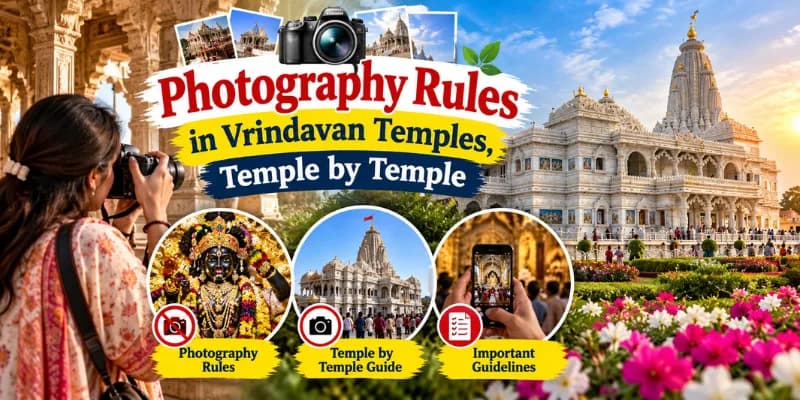
The question I hear most from photo-loving guests is “can I take pictures in the temples?” and the honest answer is: inside the sanctums, almost never and the rules are getting stricter every year, Banke Bihari and ISKCON have clamped down hard. But do not be disappointed, Vrindavan is still wonderfully photogenic in the right places: the marble and fountains of Prem Mandir, the Yamuna at Keshi Ghat at sunset, the old lanes and temple facades. My advice is simple: never point a camera at the deity or an aarti, leave the DSLR and selfie stick behind at the strict temples and keep your phone zipped away from the monkeys. Shoot the beauty around the worship, not the worship itself. See our Mathura Vrindavan tour Packages or message WhatsApp +91 7302265809.
The general rule and why
The single rule that covers almost every Vrindavan temple is this: photography and video are strictly prohibited inside the inner sanctums and prayer halls and you must never photograph or film the deities, the altars or any ritual or aarti in progress. This is the universal baseline and if you remember only one thing, remember that the moment of worship and the deity itself are off-limits to your camera almost everywhere.
There are good reasons behind it, which help a visitor accept the rules gracefully rather than feel restricted. Spiritually, the darshan is meant to be a direct, heartfelt meeting between devotee and deity, not something to be filmed and many traditions hold that photographing the deity is disrespectful. Practically, cameras and phones held up in a dense darshan queue block others, slow the line and disturb the devotional atmosphere and in recent years several temples have tightened or newly banned photography precisely because phones and selfies were disrupting worship. So the trend is firmly towards stricter rules, not looser ones. The rest of this guide shows exactly where each major temple stands, and just as usefully, where you can happily take beautiful photographs instead.
Temple-by-temple photography rules
Rules differ in the details from temple to temple, so here is where the main ones stand. These tighten from time to time, so always confirm the current policy at the gate.
Banke Bihari Temple
A complete and total ban on photography and video inside the main courtyard, the Jagmohan viewing area and anywhere near the deity. Mobile phones and electronic gadgets are strongly discouraged or restricted from being carried inside at all. Treat Banke Bihari as a no-camera, phone-away temple and simply immerse yourself in the darshan.
ISKCON Vrindavan (Sri Sri Krishna Balaram Mandir)
Under updated, stricter rules, all photography, selfies and video are banned inside the main temple building. Casual photography is restricted to the open garden and exterior areas of the complex, which are themselves beautiful, so shoot the gardens and architecture outside, not the temple hall within.
Prem Mandir
The most photography-friendly of the major temples in its open areas: photography is freely allowed across its vast grounds, white-marble courtyards, gardens and musical fountains, which are stunning, especially in the evening. However, professional cameras, tripods and selfie sticks are restricted and photography is banned inside the inner sanctum. So enjoy the grounds with your phone, but not the sanctum.
Radha Raman Temple
Photographing the self-manifested (swayambhu) deity or capturing images inside the inner sanctum is strictly forbidden at this historic temple. Respect the sanctum completely; the atmosphere and the darshan here are the experience, not a photograph.
Nidhivan
Photography is heavily restricted and taking pictures of the central shrines or the interior of the sacred grove is prohibited. Given the deep sanctity and folklore of Nidhivan, treat it as a place to witness quietly rather than to photograph.
Shri Krishna Janmabhoomi (Mathura)
Security is very tight. Mobile phones and electronic devices are strictly banned inside the main sanctum and must be deposited at the security cloakroom before you enter. Plan to leave your phone at the cloakroom and carry nothing electronic inside.
Keshi Ghat
The good news for photographers: Keshi Ghat on the Yamuna is fully open to photography with no electronic restrictions. It is the prime spot for sunrise and sunset river reflections and the beautiful evening Yamuna aarti, so this is where to bring your camera.
Govind Dev Ji Mandir and heritage ruins
At the historic Govind Dev Ji temple and similar heritage sites, the exterior architecture, the historic red-sandstone structures and the open courtyards can generally be photographed freely, provided you stay out of any active prayer spaces and respect the sanctum. These make wonderful heritage and architecture shots.
Where you can photograph freely
It is easy to leave Vrindavan with beautiful images despite the sanctum bans, because the town’s most photogenic subjects are mostly in the open, unrestricted areas. The grounds of Prem Mandir are the obvious highlight: fifty-plus acres of white marble, gardens, carved pavilions and musical fountains, glorious in the evening light and all open to your phone camera. Keshi Ghat on the Yamuna is the other great spot, open with no restrictions, ideal for sunrise and sunset reflections on the water and the atmospheric evening aarti.
Beyond these, the temple exteriors and the old town itself reward a camera: the red-sandstone heritage architecture of temples like Govind Dev Ji, the carved facades, the narrow kunj lanes with their colour and life, the markets and the general atmosphere of this ancient pilgrimage town. The rule of thumb is simple and reliable: photograph the beauty around the worship, the architecture, the river, the light, the lanes, rather than the deities and rituals themselves. Approached this way, Vrindavan is a genuinely rewarding place to photograph and you never have to breach a temple’s sanctity to do it. For more of what to see, our places to visit in vrindavan guide is a good companion.
Gear rules: phones, DSLRs, tripods and selfie sticks
Beyond the where, there is the what and the type of equipment matters as much as the location. Smartphones are generally tolerated in the open, non-restricted areas of most temples, which is why the practical advice throughout this guide assumes a phone camera. But as soon as you bring out serious kit, the restrictions tighten sharply.
DSLR and mirrorless cameras, tripods and selfie sticks are prohibited or heavily restricted on most active temple premises, even in some areas where a phone would be tolerated. Professional-looking gear draws attention, is treated as commercial or intrusive and is often stopped at security. Tripods and selfie sticks in particular obstruct crowds and are widely banned. So unless you have specific permission, leave the DSLR, the tripod and the selfie stick behind when visiting the active temples and rely on your phone in the areas where photography is allowed. If you are a serious photographer wanting to shoot the architecture or the ghats with professional gear, do it at the open, unrestricted spots like Keshi Ghat and the temple exteriors and consider seeking permission in advance for anything more. Rules on gear, like everything else here, vary and tighten, so confirm locally.
The monkey hazard for your phone and camera
A warning that belongs in any Vrindavan photography guide: the monkeys are a serious threat to your device. The rhesus macaques in the older sections, especially around the Banke Bihari lanes, Nidhivan and the Loi Bazar area, are expert thieves who specifically target phones, glasses and anything held up or left exposed and a raised phone taking a photo is an obvious target.
Protect your gear accordingly. Secure your phone tightly in a strap or a zipped pocket and do not stand in these lanes holding it out to photograph, which is practically an invitation to a monkey. Keep it away entirely in the worst areas and only bring it out in safer, open spots. If a monkey does snatch your phone, do not chase or fight it; let a local help you offer a food item (a biscuit packet or a drink) so it drops the device in exchange. The combination of strict temple rules and monkey-prone lanes means the old core is simply not a place to wave a camera around, one more reason to do your serious shooting at the open, safer locations like Keshi Ghat and the Prem Mandir grounds.
Etiquette and respectful photography
Even where photography is allowed, a little etiquette keeps you welcome and keeps the devotional atmosphere intact. The golden rule bears repeating: never photograph or film the deities, the altars or any aarti or ritual in progress, anywhere, even if no one stops you in the moment. Beyond that, ask before photographing people close up, especially sadhus, priests and worshippers and never push a camera into someone’s prayer or private moment; a nod or smile first is simple courtesy.
Keep your shooting unobtrusive: do not block darshan queues, climb on structures or disrupt worship for a shot and switch off flash near deities and in low-lit shrines. Dress and behave respectfully as you would anyway in a dham and follow every posted no-photography sign and any instruction from temple staff without argument, the rules exist to protect the sanctity of the place. If you keep to the open areas, photograph the architecture and the river rather than the worship and treat the people and the rituals with respect, you will capture the real beauty of Vrindavan while being a welcome guest rather than an intrusion. That balance, beautiful photos and genuine respect, is entirely achievable here.
Planning your photography and how a Brajwasi can help
A little planning lets you come away with lovely images without any friction. Plan your serious shooting for the open, unrestricted spots and the best light: Keshi Ghat at sunrise or for the sunset aarti, the Prem Mandir grounds and fountains in the evening and the heritage exteriors and old lanes in the soft morning light. Carry a phone for these and leave the DSLR, tripod and selfie stick behind for the active temples. Keep your phone zipped away in the monkey lanes, confirm each temple’s current rule at the gate and simply enjoy the strict temples as pure darshan, camera away. For timing the light and the season, see best time to visit and for arrival, how to reach vrindavan.
Let a Brajwasi show you the best shots
Knowing exactly where photography is allowed, where the light is best and how to avoid the monkeys and the crowds is where a local truly helps. As Brajwasis, we can guide photography-loving guests to the most beautiful, permitted spots at the right hours, the Keshi Ghat aarti, the Prem Mandir fountains, the heritage facades and kunj lanes, while keeping you clear of the strict-temple rules, the touts and the monkey-prone lanes, so you come away with wonderful images and a smooth visit. A shared Vrindavan darshan starts from around 1499 rupees per person; see our vrindavan tour package or we design a private, photo-friendly itinerary. Message us on WhatsApp at +91-7302265809 with your dates.
Related guides
Book Your Mathura - Vrindavan Trip Today
📞 +91-7302265809
💬 WhatsApp: +91-7302265809
We Reply in 30 Minutes
Packages start from ₹1,999/ person | Rated 4.5★ / 204+ Reviews
Explore all: Mathura Vrindavan Tour Packages
Jai Shri Krishna
Meet Gurudutt — Your Mathura Vrindavan Guide
Not just a tour operator — Gurudutt was born and raised in Braj Bhoomi. He has spent over a decade personally guiding pilgrims through the sacred lanes of Mathura & Vrindavan.
Founder – Experience My India
Gurudutt
Founder · Experience My India