Travel Guide · Travel Guides · Updated October 2026
Dandvat Parikrama: Rules, Time Taken and Where Pilgrims Do It
By Gurudutt, Experience My India·29 October 2026
Quick Answer
Quick Enquiry
Dandvat Parikrama is the deepest surrender I know. To cross our 21 km Govardhan circuit not by walking but by lying flat, body-length by body-length, for a week or more, is a sadhana few can imagine. I have deep respect for the devotees who undertake it. It is not a tourist activity but a true austerity and it must be done with preparation, the right season, ashram stays along the way and inner focus on the holy names. For those who cannot do dandvat, the walking parikrama carries the same love. See our Mathura Vrindavan tour Packages or message WhatsApp +91 7302265809.
What Dandvat Parikrama is
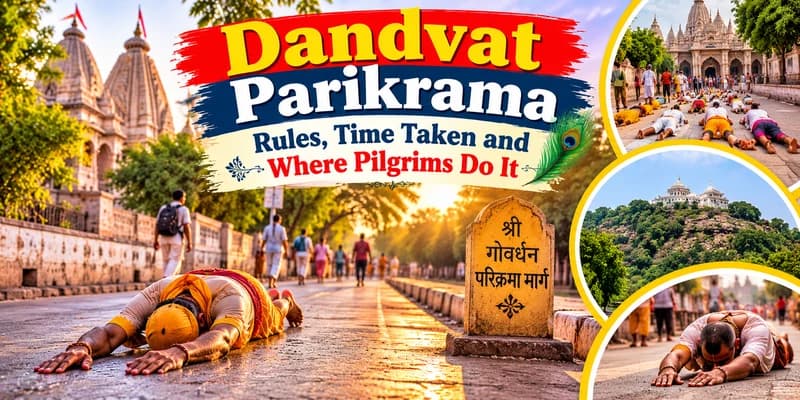
The word “Dandavat” stems from danda, a stick: in this practice the pilgrim bows down flat on the ground like a fallen stick, a full prostration (Sashtanga Dandavat), to express total surrender to the divine. Rather than walking the circuit, the pilgrim measures it out with their own body, advancing one body-length at a time. It is meant as a profound, continuous meditation, not a physical feat, with the mind and voice absorbed in the holy names throughout. It is among the most austere devotional practices in the Vaishnava tradition, undertaken as an act of love and surrender.
The spiritual meaning and mood of surrender
To understand dandvat it helps to see what it is not: it is not an endurance challenge or a feat to be completed and treating it that way misses its whole point. In the Braj tradition the practice is read as the body making visible what the heart feels, that before the Lord and before the holy dust of Govardhan, the devotee has nothing to stand on and nothing to prove and so lays the whole self flat on the ground again and again. Each prostration is a small death of the ego, a letting go of comfort, status and hurry, offered in the one coin a pilgrim truly owns, their own body and time.
This is why teachers stress that the inner state matters far more than the distance covered. A dandvat done with a restless, competitive mind is considered to have missed its fruit, while even a short stretch done with real feeling and the holy names on the lips is held to be precious. The mood is one of humility and love rather than severity for its own sake. Pilgrims often describe a deep, unexpected sweetness that grows over the days, as the repetition quiets the mind and the chanting carries them forward. Keeping this spirit at the centre is what separates dandvat as sadhana from dandvat as a physical ordeal and it is the first thing any sincere pilgrim is encouraged to settle before beginning.
Where pilgrims do it
While Dandvat Parikrama can be performed around various holy sites, it is most famously undertaken in the Braj Bhumi of Uttar Pradesh.
Govardhan Hill (Giriraj Ji). The 21 km circuit around Govardhan Hill in Mathura district is the primary and most iconic location for Dandvat Parikrama. See our govardhan parikrama guide for the route and govardhan hill for the hill itself.
Vrindavan town. Devotees also perform it along the roughly 10 km perimeter path of Vrindavan; see the vrindavan parikrama route.
Radha Kund and Shyam Kund. Some pilgrims do shorter Dandvat circuits around these highly sacred lakes; see our radha kund guide.
Govardhan is the heart of the practice, which is tied to the hill’s sanctity; see govardhan hill significance.
Time taken
Because the pilgrim moves the length of their own body at a time rather than walking, Dandvat Parikrama takes far longer than a standard foot pilgrimage.
Form | Typical time |
Standard Dandvat Parikrama (21 km Govardhan) | Usually 7 to 12 days for a single round |
108 Dandvat Parikrama (extreme, mostly by ascetics) | Several months to over a year |
The 108-dandavat version is an extreme sadhana, mostly undertaken by ascetics (sadhus), in which the pilgrim carries 108 stones and performs 108 prostrations in the exact same spot before advancing a single body-length. It can take from several months to more than a year. The standard version is itself a days-long commitment, so pilgrims plan for ashram stays along the route and a realistic, sustainable pace.
Rules and how it is performed
Dandvat Parikrama follows a strict set of traditional rules that preserve its sanctity.
The prostration process. Stand at the start, lie completely flat on the stomach with arms extended forward (Sashtanga Dandavat), place a small stone or marker where the fingertips reach, stand, walk to that marker and repeat from there, advancing one body-length at a time.
Strict clockwise direction. The parikrama must be done clockwise (pradakshina), keeping the holy hill or town constantly on your right.
Do not step on the sacred hill. When circling Govardhan, pilgrims are strictly forbidden from climbing or stepping on the hill itself, as Govardhan is worshipped as a direct manifestation of Lord Krishna.
Mental and vocal devotion. The practice is a deep meditation: pilgrims continuously chant the holy names (“Hare Krishna”, “Radhe Radhe”) and keep strict inner focus, rather than treating it as a physical challenge.
Continuous journey, with night pauses. Devotees usually pause at night in local ashrams along the path and resume from the exact spot they left off.
Variations. It may be done individually, as a Couple Dandavat (seeking blessings for family life) or within a close spiritual group.
A day on dandvat: pace, ashrams and what to carry
For those considering the practice, it helps to picture an ordinary day on a multi-day dandvat, because the rhythm is very different from a walking yatra. Most pilgrims begin before sunrise while it is cool, prostrate steadily through the morning with frequent short rests, pause through the hottest midday hours and resume in the late afternoon until dusk, when they stop at whatever ashram or dharamshala is nearest and resume from the exact spot the next morning. The distance covered in a day varies greatly with a person’s strength and the ground, which is why a 21 km round stretches across roughly a week to twelve days rather than being forced into a fixed schedule.
Simple preparation makes a real difference. Pilgrims commonly wear long, modest, hard-wearing clothing to protect the body against the road and many use a cloth pad or thin mat and gloves to spare the hands, elbows and knees over thousands of prostrations. Carrying drinking water, keeping a companion or a slow backup vehicle within reach and knowing where the next ashram and clean washroom lie all turn a daunting undertaking into a manageable one. None of this lessens the austerity; it simply removes the avoidable risks so the pilgrim can give full attention to the chanting. Anyone with a heart condition, joint trouble or other health concern should take honest advice before attempting it and should never hesitate to switch to the walking parikrama.
Planning and a word on preparation
Dandvat Parikrama is a serious physical and spiritual undertaking, not a casual activity, so honest preparation matters. A standard Govardhan round means days of repeated full prostrations over a 21 km circuit, which is strenuous and hard on the body. Undertake it only if you are reasonably fit and prepared, go in the cooler months (October to March), carry water, pace yourself, rest at ashrams along the way and listen to your body. Those who cannot manage dandvat, including elderly or less mobile pilgrims, perform the walking parikrama instead, which carries the same devotion with far less strain; see our govardhan parikrama guide. For when to come, see best time to visit and for arrival, how to reach vrindavan.
Let a Brajwasi support your parikrama
A dandvat or walking parikrama of Govardhan is far safer and more peaceful with local support, someone to arrange the ashram stays, carry water, keep a backup vehicle nearby and handle the logistics so you can focus on the chanting. As Brajwasis, we support pilgrims doing the Govardhan parikrama, whether the austere dandvat over several days or the walking circuit in a day, at your own pace and in the right season. See our govardhan parikrama tour package; a shared Braj day starts from around 1499 rupees per person or we design a private, multi-day dandvat support plan. Message us on WhatsApp at +91-7302265809 with your dates.
Related guides
Book Your Mathura - Vrindavan Trip Today
📞 +91-7302265809
💬 WhatsApp: +91-7302265809
We Reply in 30 Minutes
Packages start from ₹1,999/ person | Rated 4.5★ / 204+ Reviews
Explore all: Mathura Vrindavan Tour Packages
Jai Shri Krishna
Meet Gurudutt — Your Mathura Vrindavan Guide
Not just a tour operator — Gurudutt was born and raised in Braj Bhoomi. He has spent over a decade personally guiding pilgrims through the sacred lanes of Mathura & Vrindavan.
Founder – Experience My India
Gurudutt
Founder · Experience My India