Travel Guide · Travel Guides · Updated October 2026
Phool Bangla Season at Banke Bihari
By Gurudutt, Experience My India·22 October 2026
Quick Answer
Quick Enquiry
Phool Bangla is the most beautiful season to come to Banke Bihari. On a hot Braj evening you step in from the dusty lane and the whole sanctum is a bower of jasmine and marigold, with the cool scent of khus (vetiver) in the air, all made fresh, twice a day, to keep our Thakur ji cool. My honest advice is about timing: come on a quiet weekday morning for the freshest flowers and the calmest darshan, stay well away from the opening and closing days and the big festival crush and be ready to leave your phone in your pocket, because there is no photography inside. Plan it right and it is pure joy. See our Mathura Vrindavan tour Packages or message WhatsApp +91 7302265809.
What Phool Bangla is
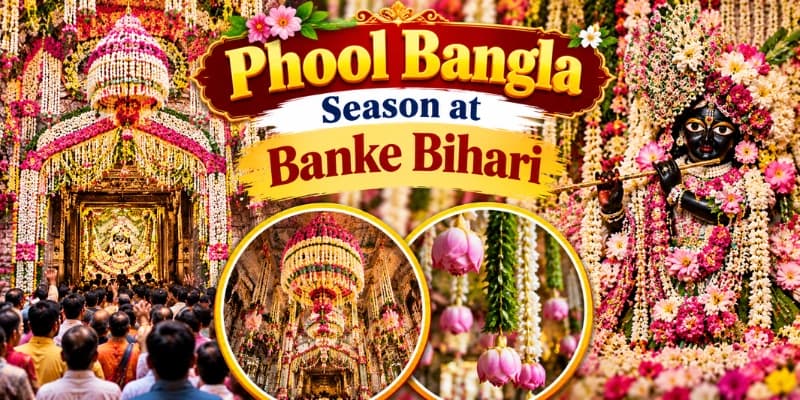
Phool Bangla literally means a “flower bungalow”. It is a seasonal seva in which artisans and sevadars build a small decorative bungalow, along with canopies, pillars and backdrops, entirely out of fresh flowers and set the deity within it for darshan. At Banke Bihari it is one of the most beautiful sights of the year and it is a deeply practical act of devotion rather than mere decoration: the fragrant, cooling flowers and the vetiver (khus) curtains are there to help the deity stay comfortable through the punishing Braj summer.
In the Braj tradition the deity is served not as a distant idol but as a beloved who feels heat, cold and rest just as a person does, so as the hot weather sets in, the seva turns to cooling things, light summer dress, cooling bhog and above all the flower bungalow. The blooms used are the classic flowers of the Braj summer, jasmine (mogra), marigold and others, chosen as much for their cooling fragrance as their colour and each day’s bungalow is built fresh. Witnessing it is considered a blessing of the season and understanding this tender idea, that a whole community lovingly keeps its Lord cool with flowers, turns a Phool Bangla darshan from a pretty sight into something genuinely moving.
The 2027 season dates and why about 108 days
For 2027, the Phool Bangla season at Banke Bihari is expected to run from about Saturday 17 April (Kamada Ekadashi) to about Monday 2 August (Hariyali Amavasya). That is roughly 108 days, the festival’s standard length, which it returns to in 2027 after an unusually long 138-day season in 2026. The 2026 season was extended because of an extra lunar month (adhik maas) in the Hindu calendar, which lengthened the summer period; with no adhik maas in 2027, the season comes back to its usual span.
It is important to treat these as expected, calendar-based dates rather than fixed appointments. The start and end of the Phool Bangla season are tied to the Hindu lunar calendar (opening around Kamada Ekadashi and closing on Hariyali Amavasya) and the temple confirms its exact programme close to the time, so the precise dates can shift by a day and the daily arrangements are the temple’s to decide. If you are planning a trip specifically around Phool Bangla, use the April-to-early-August window as your guide and reconfirm the current dates with the temple or with us before you book. For the wider seasonal picture of visiting Braj, see our best time to visit guide.
What to expect: the twice-daily bungalows
The most remarkable thing about Phool Bangla at Banke Bihari is that the floral bungalow is not built once but twice a day, with an entirely new structure for the morning and the evening, so that the flowers are always fresh and cool for the deity.
Morning Shringar darshan. The first unique bungalow of the day is unveiled at the morning shringar. The air is noticeably cooler and the flowers are completely fresh, which is why this is the preferred window for most visiting families and the loveliest time to see it.
Evening Gwal and Shayan darshan. A second, entirely new floral structure is built for the evening viewing, leading up to the deity’s night rest (shayan). It is a fresh bungalow again, distinct from the morning’s.
Special attire days. On select days through the season, the deity is adorned in intricate garments woven entirely from real flower petals, an especially beautiful sight if your visit happens to fall on one.
Alongside the flowers, cooling vetiver (khus) curtains are used to keep the sanctum fresh and fragrant against the heat. Because every bungalow is handmade from thousands of fresh flowers and changed twice daily, no two darshans look exactly the same, which is part of what draws devotees back through the season. Exact darshan timings shift between the summer and winter schedules and are set by the temple, so confirm the day’s hours locally; our mathura vrindavan temple timings guide is a useful reference.
The best darshan window within the season
If you want the finest experience, aim for the morning Shringar darshan. That is when the first, completely fresh bungalow of the day is unveiled, the air is still cool, the fragrance is at its strongest and the crowds are usually lighter than the evening, which is why it is the window most families prefer. An early-morning visit also spares you the worst of the day’s heat, which matters a great deal in a Banke Bihari summer.
The evening Gwal and Shayan darshan is beautiful too, with its own entirely new bungalow built for the night and it suits those who cannot make the morning or who want to see a second, different arrangement. Be aware, though, that evenings in peak season can be more crowded and still very warm. Whichever you choose, go on a quiet weekday rather than a weekend or festival day, arrive with time in hand and be patient in the queue, as Banke Bihari gives its darshan in glimpses, drawing the curtain open and closed, which is a cherished tradition of this temple. The combination of a weekday morning and the freshest bungalow is the sweet spot of the whole season.
Strategic planning tips
Because the Phool Bangla months, especially May and June, bring punishing summer heat and very heavy pilgrim crowds, careful timing makes the difference between a joyful darshan and a gruelling one. A few specific tips help most.
Avoid the opening, closing and weekends. The opening day in 2027 (around 17 April) falls on a Saturday and a major Ekadashi, so the narrow lanes will be heavily congested and the final day on Hariyali Amavasya (around 2 August) draws massive crowds too. For a smoother experience, pick a quiet weekday in between.
Watch out for regional mega-festivals. Keep in mind that Mudiya Purnima at govardhan hill is expected around Sunday 18 July 2027, which causes immense gridlock across the whole Mathura-Vrindavan religious circuit, so avoid the days around it for a Banke Bihari visit.
Plan for the heat. Through May and June, come for the early-morning darshan, rest through the midday temple closure in an air-conditioned room and carry water; the Braj summer is genuinely fierce.
Logistics and the walk. Local authorities maintain a strict vehicle-free perimeter around the temple, so expect a walk of roughly 300 metres through the bustling lanes to reach the main gates. Keep belongings secured against the monkeys in these lanes.
No photography inside. Photography is strictly prohibited inside the temple premises, so plan to witness the Phool Bangla with your eyes, not your camera and keep your phone put away.
These festival and lunar dates follow the Hindu calendar, so confirm all of them nearer the time. For arrival and getting around, see how to reach vrindavan.
Phool Bangla at other Vrindavan temples
While Banke Bihari is the most famous place to see Phool Bangla, it is a wider Vrindavan summer tradition and part of the pleasure of a summer visit is seeing how different temples offer the seva in their own style. The historic Goswami temples, especially the radha raman temple and the radha vallabh temple, are known for their refined flower-bungalow and summer decorations and several other old temples of the kunj lanes join in through the hot months.
Pairing a Banke Bihari Phool Bangla darshan with one or two of these makes for a rich summer morning or evening of darshan and lets you see the same loving idea, keeping the Lord cool with flowers, expressed in different temple traditions. Because all of them follow the same summer-season rhythm, your Banke Bihari trip can easily take in a couple more without much extra planning. For a fuller list of what to see while you are in town, see our places to visit in vrindavan guide.
Planning your Phool Bangla visit and how a Brajwasi can help
Because the season, the daily bungalows and the darshan timings are all set by the temple and shift with the summer schedule, a Phool Bangla trip rewards flexible dates and local timing. Treat the April-to-early-August window as your guide, confirm the current dates and hours close to the time, aim for a quiet weekday morning, avoid the opening and closing days and the Mudiya Purnima gridlock around mid-July and plan firmly around the midday heat and closure. Be ready for the car-free walk to the gates and the no-photography rule inside.
Let a Brajwasi time it right for you
Phool Bangla is a season where local timing makes all the difference, knowing which morning the bungalow and the crowds are best, confirming the live dates, approaching Banke Bihari smoothly through the summer lanes and avoiding the festival gridlock. As Brajwasis, we build a comfortable summer darshan around the Phool Bangla season, pacing it for the cool hours and pairing Banke Bihari with the old Goswami temples that also show the flower bungalows. A shared Vrindavan darshan starts from around 1499 rupees per person; see our vrindavan tour package or we design a private visit timed to the season. Message us on WhatsApp at +91-7302265809 with your dates.
Related guides
Book Your Mathura - Vrindavan Trip Today
📞 +91-7302265809
💬 WhatsApp: +91-7302265809
We Reply in 30 Minutes
Packages start from ₹1,999/ person | Rated 4.5★ / 204+ Reviews
Explore all: Mathura Vrindavan Tour Packages
Jai Shri Krishna
Start with these
Meet Gurudutt — Your Mathura Vrindavan Guide
Not just a tour operator — Gurudutt was born and raised in Braj Bhoomi. He has spent over a decade personally guiding pilgrims through the sacred lanes of Mathura & Vrindavan.

Founder – Experience My India
Gurudutt
Founder · Experience My India