Travel Guide · Travel Guides · Updated October 2026
Vrindavan Research Institute: Manuscript Collection and Visiting Hours
By Gurudutt, Experience My India·24 October 2026
Quick Answer
Quick Enquiry
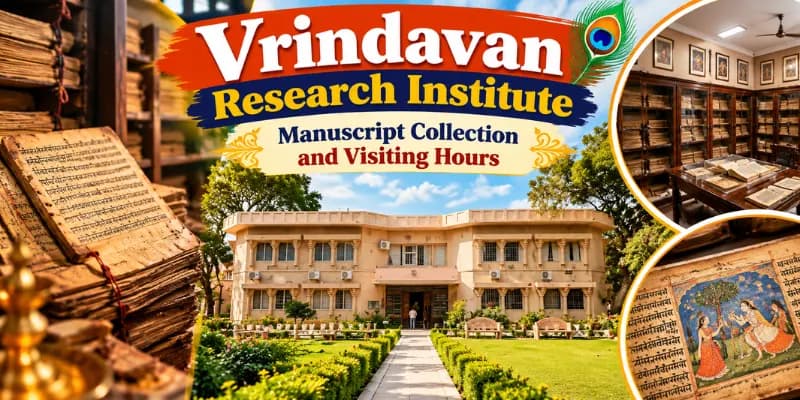
The Institute houses a monumental library of rare literary and historical material, much of it from the 16th to 18th centuries. Its scale and range are what make it significant.
Size. Roughly 30,000 to 35,000 rare manuscripts are preserved here.
Languages. The manuscripts span Sanskrit, Hindi, Bengali, Oriya, Punjabi, Gujarati, Urdu, Arabic and Persian.
Mediums. They are written on diverse historical materials, including palm leaf, bamboo leaf, Bhojpatra (birch bark) and ancient paper.
Notable texts. The collection safeguards handwritten works connected to prominent saints and scholars of the Chaitanya/Gaudiya tradition, among them Roop Goswami, Sanatan Goswami, Jeeva Goswami and Krishnadas Kaviraj, reportedly including a copy in the hand of Sanatan Goswami dated to 1534 CE.
Historical documents. The archives are reported to hold Mughal farmans (royal decrees) recording land grants made by emperors for building historic temples across the Braj area.
The Goswami connection ties the Institute closely to Vrindavan’s Gaudiya heritage, the same lineage behind temples such as the radha raman temple. For the wider story of the town’s old shrines, see our guide to the historical temples of Mathura and Vrindavan. See our Mathura Vrindavan tour Packages or message WhatsApp +91 7302265809.
The Braj Culture Museum
Beyond the manuscripts, the facility includes museum galleries devoted to Braj culture, which is what most general visitors come to see.
Gallery holding | Detail |
Miniature paintings | A collection reported at around 200 miniature paintings |
Sculptures | Ancient stone sculptures from the region |
Coins and artifacts | Historic coins and other regional cultural objects |
For visitors who are not researchers, the museum is the main draw: a compact, well-kept window into the art and material history of Braj and a quiet contrast to the busy temples.
Visiting hours and access
Detail | Information (confirm locally) |
Operating days | Tuesday to Sunday |
Weekly closing | Closed Mondays; some wings, such as the museum, also close on the second Sunday of the month |
Museum hours | Generally 10:30 AM to about 4:00 to 4:30 PM |
Entry fee | Free, for both the museum and the institute grounds |
Research access | A reference library of 15,000-plus reference books, catalogues and theses, open to registered research scholars and students |
Opening days, hours and closures at a specialised institute like this can change and the museum wing may keep slightly different hours from the rest, so confirm the current schedule directly with the Institute before you plan a visit around it, especially if you are travelling specifically to see it.
A note for researchers. If you intend to consult manuscripts or the reference library rather than only tour the museum, access is for registered scholars and students, so contact the Institute in advance about registration, permissions and any rules on handling or reproducing material, rather than expecting walk-in access to the collection.
Where it is, how to reach it and planning
The Institute is on Bhaktivedanta Swami Marg in Raman Reti, Vrindavan, the same part of town as the ISKCON Krishna Balaram Mandir, which makes it easy to combine with a Raman Reti visit.
Within Vrindavan. From the town centre it is a short auto-rickshaw or e-rickshaw ride to the Raman Reti / ISKCON area. The iskcon temple is close by, so the two pair naturally; see our iskcon vrindavan guide for that visit.
By train. The nearest stations are Mathura Junction and Vrindavan station; from either, a taxi or auto brings you into Vrindavan. See how to reach vrindavan for arrival options.
By air. The closest airport is Delhi (DEL), roughly 150 km away, with a cab or bus down the Yamuna Expressway into the region.
Allow forty-five minutes to an hour for the museum galleries, more if you have research access and plan to work in the library. Because it sits in Raman Reti, it combines well with ISKCON and the nearby temples, so most visitors fold it into a morning in that part of Vrindavan. For a fuller list of what to combine, see places to visit in vrindavan and for timing your trip, best time to visit vrindavan.
The Goswamis and why these texts matter
By tradition, Vrindavan as a place of organised devotion was shaped in the 16th century by the Six Goswamis, the scholar-saints sent by Chaitanya Mahaprabhu to recover the lost sites of Krishna’s childhood lila and to set down the theology of the Gaudiya tradition in writing. Roop Goswami, Sanatan Goswami and Jeeva Goswami, among others, are remembered not only as the founders of temples but as prolific authors and it is their written legacy that gives the Research Institute much of its scholarly weight.
What the Institute preserves, then, is not simply old paper but the documentary spine of a living tradition. When a manuscript here is connected by name to Sanatan Goswami or to Krishnadas Kaviraj (author, by tradition, of the Chaitanya Charitamrita), it links the visitor directly to the hands that are said to have written the foundational works of Braj bhakti. For a scholar that is a primary source; for a pilgrim it can feel like standing near the source of the current that carries the whole town. The same lineage that produced these texts also installed the deities and raised the shrines, so the collection and the temples are two expressions of one movement.
The Mughal farmans in the archive tell the other half of the story. These royal decrees, said to record land grants made for building temples across Braj, are reminders that the great shrines of Vrindavan and Mathura rose within a specific political history, often with the cooperation of rulers in Agra and Delhi. They anchor the devotional story in documented administration and for anyone curious about how the sacred landscape of Braj was actually assembled, stone by stone and grant by grant, they are quietly fascinating primary documents.
It is worth holding all of this lightly and respectfully. The Institute presents these as its reported holdings and the headline attributions, a 1534 CE autograph, specific imperial decrees, are best treated as the collection’s own account rather than as settled fact. That caution does not diminish the experience; if anything it is part of why the visit rewards the curious, because you are looking at the raw material of history and tradition, not a finished verdict on it.
Best time to visit and how long to spend
The Research Institute is an indoor, year-round stop, so it is far less weather-dependent than Vrindavan’s open ghats and parikrama paths. Even so, the most comfortable window to be in Braj at all is the cooler, drier stretch from roughly October to March, when a mid-morning or early-afternoon visit to the galleries fits easily into a day of darshan without the fierce heat of May and June or the humidity of the monsoon. Confirm seasonal conditions locally, as Braj summers can be extreme.
Within the day, aim to arrive after the museum opens in the late morning rather than at the very end of the afternoon, so you are not hurried before closing. Because the Institute keeps to its own schedule, Tuesday to Sunday with Mondays closed and some wings also shut on the second Sunday of the month, it pays to plan the visit for a day you can confirm is open. A wasted trip to a closed museum is an easy mistake when everything else in Vrindavan runs on temple time rather than museum time, so confirm the current timings locally before you build a morning around it.
For most general visitors, forty-five minutes to an hour is enough to see the manuscript displays and the Braj culture museum galleries at an unhurried pace. If you have arranged research access and intend to work in the reference library or consult specific manuscripts, set aside a half-day or more and remember that this part of the Institute runs on registration and appointment rather than walk-in browsing. Either way it is a calm, reflective place, so there is little advantage in trying to rush it; the quiet is part of what you have come for.
Fitting it into a Braj heritage itinerary
The Institute’s location in Raman Reti is its great practical advantage. It sits in the same quiet, tree-lined part of Vrindavan as some of the town’s most visited modern and heritage sites, so it slots into an itinerary without a special detour. The most natural pairing is with the ISKCON Krishna Balaram Mandir a short distance away, which gives you one devotional stop and one cultural one within the same morning, with very little travel in between.
A thoughtful heritage half-day might begin with darshan at ISKCON soon after it opens, move to the Research Institute’s museum once its galleries open in the late morning and then continue to the older temples of central Vrindavan in the afternoon. Because the Institute explains, through its manuscripts and farmans, how those temples and their texts came to be, seeing it early can add real depth to everything you visit afterwards; the carved shrines in the old lanes stop being merely beautiful buildings and become the visible end of a long written tradition.
Travellers with a deeper interest in history can extend the theme across Braj more widely, pairing the Institute with the heritage temples of the old town and the wider Mathura circuit over a second day. For families or mixed groups it works well as the calm, sheltered middle of a day that is otherwise spent on foot in the sun, a chance to sit, slow down and absorb before heading back out into the temples and ghats. In every case it is best thought of not as a destination in its own right but as the quiet, explanatory heart of a Vrindavan day built around darshan.
Let a Brajwasi build the heritage side of your trip
Vrindavan is not only temples and for travellers who love history and the scriptures behind the tradition, we like to add quieter, deeper stops like the Research Institute. As Brajwasis, we can build a Vrindavan day that pairs the museum with ISKCON and the Raman Reti temples, times it around the Institute’s opening hours and gives the context that makes the manuscripts and farmans come alive. A shared Vrindavan darshan starts from around 1499 rupees per person or we design a private day; see our vrindavan tour package. Message us on WhatsApp at +91-7302265809 with your dates.
Related guides
Book Your Mathura - Vrindavan Trip Today
📞 +91-7302265809
💬 WhatsApp: +91-7302265809
We Reply in 30 Minutes
Packages start from ₹1,999/ person | Rated 4.5★ / 204+ Reviews
Explore all: Mathura Vrindavan Tour Packages
Jai Shri Krishna
Meet Gurudutt — Your Mathura Vrindavan Guide
Not just a tour operator — Gurudutt was born and raised in Braj Bhoomi. He has spent over a decade personally guiding pilgrims through the sacred lanes of Mathura & Vrindavan.
Founder – Experience My India
Gurudutt
Founder · Experience My India