Travel Guide · Travel Guides · Updated October 2026
Akshaya Patra Vrindavan: Can You Visit the Kitchen?
By Gurudutt, Experience My India·24 October 2026
Quick Answer
Quick Enquiry
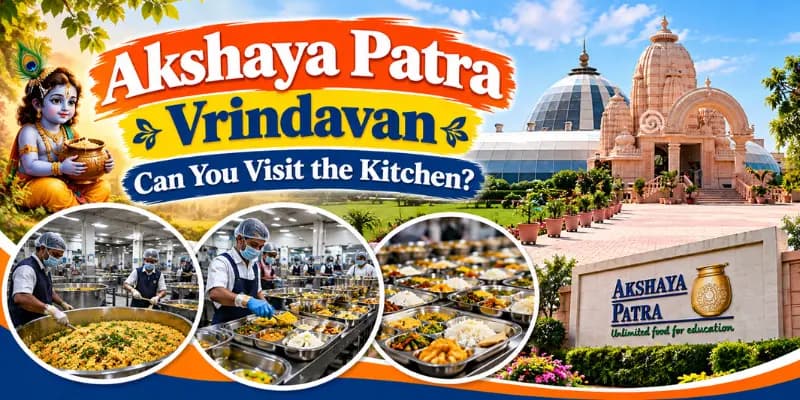
People often ask me if they can see the famous Akshaya Patra kitchen, and I always give them the honest answer: you can visit the temple and grounds freely, but to actually walk the cooking floor you have to arrange permission first, it is a working food facility feeding over a lakh children a day, not a tourist spot. When a visit is arranged, it is genuinely moving to see, those giant roti machines, the satvic scale of it. As a Brajwasi, I have watched the delivery vans pulling out of the Chhatikara Road gate at first light while the rest of Vrindavan is still waking, and it changes how you think about seva, feeding is one of the oldest acts of devotion in Braj, and here it happens on an industrial scale with the same spirit. I help travellers who care about it plan it properly and respectfully, and I am always clear that the grounds and the Radha Vrindavan Chandra Mandir are the part you can count on seeing, while the kitchen floor is a privilege the Foundation alone can grant. See our Mathura Vrindavan tour Packages or message WhatsApp +91 7302265809.
Can you actually visit and what is open to all
It helps to separate the two parts of the campus.
Open to everyone. The adjoining Radha Vrindavan Chandra Mandir temple, the gift shops and the outer grounds can be explored freely, like any Vrindavan temple campus.
Permission required. An interactive walkthrough of the actual production floors of the mega kitchen must be requested from the administration team beforehand. Because the kitchen prepares over a lakh meals a day under continuous hygiene and safety monitoring, access to the cooking floor is limited and is not a walk-in experience.
So the honest answer to “can you visit the kitchen” is: you can visit the campus and temple any time, but the cooking floor itself only with prior, approved permission. Many visitors arrive expecting a ticket counter and a viewing gallery, the way a factory or a brewery might run public tours and leave a little surprised. It is worth setting that expectation before you come: this is a mid-day-meal production unit bound by food-safety law and donor responsibility, so the default position is no floor access and an arranged visit is the exception rather than the rule. If you simply want to stand in the campus, offer a prayer at the Radha Vrindavan Chandra Mandir, browse the shop and get a sense of the scale from the outside, you can do that like any other pilgrim, no permission needed.
A second thing worth understanding is why the distinction exists at all. The meals cooked here go straight into the mouths of schoolchildren, many of them young and vulnerable, so a single lapse in hygiene has consequences far beyond an ordinary restaurant kitchen. Limiting who walks the floor and when, is part of how the Foundation keeps that chain clean. Reading the access rules in that light makes them feel less like red tape and more like the natural caution of people who take responsibility for a lakh plates a day. When you approach the administration, it helps to come across as someone who understands that, rather than as a tourist chasing a photo.
The name and the story behind Akshaya Patra
The name itself carries the whole idea. In tradition, an akshaya patra is an inexhaustible vessel, a bowl that never empties however much food is taken from it. The best-known account is in the Mahabharata, where, it is said, the Pandavas receive such a vessel during their years in the forest so that Draupadi can always feed any guest who arrives and the pot keeps giving until she herself has eaten. By tradition the vessel is linked to the Sun god’s grace and to Krishna, who, in one much-loved episode, satisfies the hunger of the sage Durvasa and his disciples from a single remaining grain stuck to the pot. Whether you read these as scripture, as lore or simply as a beautiful idea, the meaning is clear: food given in the right spirit multiplies and no sincere guest should ever go hungry. That is the thought the modern kitchen is named after.
The organisation that runs it grew out of this spirit of annadaan, the giving of food as worship. By its own account it began at the turn of the millennium as a small effort to feed schoolchildren a free hot meal so that hunger would never be the reason a child stayed away from a classroom and it grew into one of the largest such programmes in the world, with kitchens in many cities. The Vrindavan unit, on Chhatikara Road, is one of its mega kitchens, chosen fittingly for the land of Krishna, where feeding and devotion have always gone together. For a visitor, knowing this backstory changes the experience: the automated roti line is not just impressive machinery, it is the Mahabharata’s inexhaustible pot reimagined for a region of government schools, a very old idea wearing very modern clothes.
Braj has always treated food as prasad, as something first offered and then shared and the town is full of smaller daily expressions of the same instinct, from temple bhog to the free meals handed out at ashrams. Seen that way, the Akshaya Patra kitchen is not an outsider’s novelty dropped into Vrindavan but the local culture of annadaan scaled up with steel and steam. That continuity is part of why so many pilgrims feel a pull towards it, it speaks the language of the place.
The mid-day meal mission and the seva behind it
Behind the engineering is a straightforward social mission: a hot, nutritious, freshly cooked lunch delivered to government and government-aided schools, so that children come to school, stay through the day and are not trying to learn on an empty stomach. The mid-day meal is one of the oldest tools for keeping children, especially girls, in education and a centralised kitchen like this one exists to make that meal reliable, safe and the same quality for every school it serves. The reported figure of well over a lakh meals a day (around 1,20,000 to 1,40,000, confirm current numbers with the Foundation) is best understood not as a boast but as a measure of how many children depend on the vans leaving on time each morning.
The human side is as striking as the machinery. A great deal of the preparation, the cleaning, cutting and sorting of tons of vegetables, is done by local women, so the kitchen is also a source of dignified work in the area. The cooking is deliberately plain and wholesome, rice or roti with dal and a vegetable, seasoned to children’s tastes and to satvic rules, rather than rich or elaborate. Nothing about it is designed to impress a visitor; everything about it is designed to feed a child well and safely at the lowest honest cost. That is precisely why a visit moves people, you are watching care expressed as logistics.
For travellers who want their trip to Braj to mean something beyond darshan, understanding this mission matters more than seeing the floor. You do not need to walk the cooking line to take part in the spirit of the place. Offering a prayer at the temple, learning how the programme works, and if you wish, supporting the cause are all ways of honouring it. If anything, the Foundation would rather a visitor left as a well-informed supporter than as someone who simply ticked off a kitchen tour and that is the frame of mind that also makes an access request more likely to be welcomed.
How to coordinate a kitchen tour
Step | Detail (confirm with the Foundation) |
Official permission | Connect with the management or administrative office at the campus on Chhatikara Road to request an educational or donor tour slot, in advance |
Early-morning timing | The kitchen starts at around 4:00 AM to prepare, pack and load food so vans reach remote village schools before midday; an approved tour means arriving early to see the machines in live operation |
Who it suits | Educational groups, donors and genuinely interested visitors, rather than casual drop-ins |
Because this is a working charitable kitchen, not a ticketed attraction, treat a floor tour as a privilege to be arranged respectfully and well in advance and confirm the current process, any eligibility and timings directly with the Foundation rather than assuming a tour will be possible on the day.
What you will see inside
If your tour is approved, what makes the kitchen remarkable is its sheer engineering scale, built so food is barely touched by hand.
Mega-scale automation. Highlights include massive automated dough kneaders, multi-tier steam-jacketed cauldrons and high-speed roti machines reported to produce tens of thousands of chapatis an hour.
Strict satvic operations. Everything is prepared to rigorous satvic standards, completely free of onion, garlic and eggs, in keeping with the devotional setting.
An impressive logistics model. From tons of fresh vegetables prepared by local women to the large specialised delivery containers and customised vans, the raw-material and distribution scale is a study in logistics as much as cooking.
It is genuinely inspiring to witness, a devotional act of feeding at industrial scale, which is why approved educational and donor visits can be so memorable.
What stays with most people is not any single machine but the choreography. The flour, the water, the vegetables and the fuel all move in one direction, towards the loading bay, timed so that the first vans can leave while the chapatis are still warm. There is very little noise of the kind you expect in a kitchen, no shouting of orders, because so much runs on gravity-fed lines, conveyor belts and steam. Staff in caps and aprons move with the calm of a routine done thousands of times. If you have ever stood in a temple at the moment bhog is offered, the feeling is oddly similar: a quiet, ordered seriousness around food. Approved visits usually include a short explanation of how a day’s menu is planned, how portions are calculated per school and how the sealed containers keep the food hot and safe on the road, so you leave understanding the system and not just admiring the hardware.
Visitor essentials and etiquette
Hygiene gear. If you are given floor access, you must follow strict health guidelines, typically a hairnet, face mask and protective shoe covers, alongside the usual modest temple dress (shoulders and knees covered).
Dining. The charity does not run a public restaurant on the cooking floor. The temple courtyard offers quick snacks and there is good egg-free satvic dining nearby in Vrindavan, such as Ekyam Sattvic Kitchen and Annakoot, among others; for more options see our guide to famous food of Vrindavan and Mathura. Check current details and hours directly, as these change.
Respect the setting. Remember this is first a charitable kitchen feeding children, not an attraction; keep groups small, follow all staff instructions and avoid disrupting operations.
Photography. Do not assume you may photograph the cooking floor. On a working food line, cameras can be restricted for hygiene and privacy reasons, so always ask before taking pictures and accept a no gracefully. The temple and grounds are usually fine for respectful photos.
Children and large groups. If you are bringing a school or youth group, flag the numbers and ages when you request the visit, as the Foundation may cap group size or ask for extra supervision on the floor.
A small point of etiquette goes a long way here. Because the staff are busy feeding a region, the kindest thing a visitor can do is be punctual, brief and low-maintenance, arrive at the time you were given, stay with your guide, ask your questions in one go rather than drifting off to look at machines and thank the people doing the work. Treating the visit as you would a darshan slot, with gratitude rather than entitlement, is both the right spirit and practically, what keeps the Foundation willing to host visitors at all.
Best time to visit and how it fits a Braj day
Timing matters more at Akshaya Patra than at an ordinary temple, because the kitchen and the temple keep different clocks. If your interest is the kitchen in action and you have an approved visit, the only time that works is very early, around the 4:00 AM start and the hours after it, when the lines are running at full tilt and the vans are loading (confirm the current timing with the Foundation). Come mid-morning and the cooking is largely done; come in the afternoon and the floor is being cleaned for the next day. So an arranged kitchen visit is, by its nature, a pre-dawn commitment, best suited to people who are happy to start their Braj day in the dark.
If you are only visiting the Radha Vrindavan Chandra Mandir and the grounds, the picture is easier. Like most of Vrindavan, the campus is most pleasant in the cooler months, roughly October to March, when the days are mild and walking around is comfortable; the summer from April to June is genuinely hot and the monsoon brings its own humidity (confirm seasonal conditions locally). Within the day, a morning or late-afternoon visit avoids the midday heat and sits neatly alongside the other Chhatikara Road temples. For a wider view of when to plan your trip, see our guide to the best time to visit vrindavan and Mathura.
In itinerary terms, the campus behaves as a Chhatikara Road stop, not a town-centre one. Because it sits on the main approach road, it fits best at the start or end of a Vrindavan day, paired with Prem Mandir and the ISKCON temple that lie along the same stretch, so you are not doubling back into the crowded old-town lanes. A common pattern is to see Prem Mandir, step across to the Akshaya Patra campus and temple and then move on to ISKCON, treating the three as one cluster. An approved early-morning kitchen tour, by contrast, is better treated as its own event at the very start of the day, after which you rest or have breakfast before the regular darshan begins. For the full list of what else to fold in, see places to visit in vrindavan.
Where it is, how to reach it and planning
The campus is on Chhatikara Road, the main approach into Vrindavan, which also makes it easy to combine with the temples along that route. See our chhatikara road guide for what else is on this stretch.
Within Vrindavan. It is on Chhatikara Road near the main entry to town, a short ride from the centre and close to prem mandir and the iskcon temple area.
By train. The nearest stations are Mathura Junction and Vrindavan station; from either, a taxi or auto brings you in. See how to reach vrindavan for arrival options.
By air. The closest airport is Delhi (DEL), roughly 150 km away, with a cab or bus down the Yamuna Expressway into the region.
For most visitors the temple, grounds and shops take thirty to forty-five minutes; an approved kitchen tour is a separate, early-morning commitment. Because it sits on Chhatikara Road, it pairs naturally with Prem Mandir and the nearby temples, so most people fold it into a wider Vrindavan day rather than making a special trip. If you are driving in from Delhi or Agra, it is one of the first worthwhile stops you reach, which makes it a tidy way to begin or end your time in town.
Let a Brajwasi plan it respectfully
Fitting a visit like this into a Vrindavan day and timing the Chhatikara Road temples around it, is exactly what we help with. As Brajwasis, we can build a day that takes in the Radha Vrindavan Chandra Mandir and grounds, pairs it with Prem Mandir and ISKCON and guides you on how to approach the Foundation if you want to request a kitchen visit, without over-promising access that only they can grant. A shared Vrindavan darshan starts from around 1499 rupees per person or we design a private day; see our vrindavan tour package. Message us on WhatsApp at +91-7302265809 with your dates.
Related guides
Book Your Mathura - Vrindavan Trip Today
📞 +91-7302265809
💬 WhatsApp: +91-7302265809
We Reply in 30 Minutes
Packages start from ₹1,999/ person | Rated 4.5★ / 204+ Reviews
Explore all: Mathura Vrindavan Tour Packages
Jai Shri Krishna
Meet Gurudutt — Your Mathura Vrindavan Guide
Not just a tour operator — Gurudutt was born and raised in Braj Bhoomi. He has spent over a decade personally guiding pilgrims through the sacred lanes of Mathura & Vrindavan.
Founder – Experience My India
Gurudutt
Founder · Experience My India