Travel Guide · Travel Guides · Updated August 2026
Sankari Khor, Barsana: The Narrow Pass of Krishna's Dana Leela, a Complete Guide
By Gurudutt, Experience My India·5 August 2026
Quick Answer
Quick Enquiry
Key facts at a glance
What it is | A famously narrow pass at Barsana |
The name | Sankari, narrow and Khor, lane |
So narrow that | Only one person can pass at a time |
Revered for | Krishna's Dana Leela, the tax-collector pastime |
Between | The Brahmagiri and Vilasa hills of Barsana |
Where | About 2 km from Barsana's Radha Rani temple |
Sankari Khor: an overview
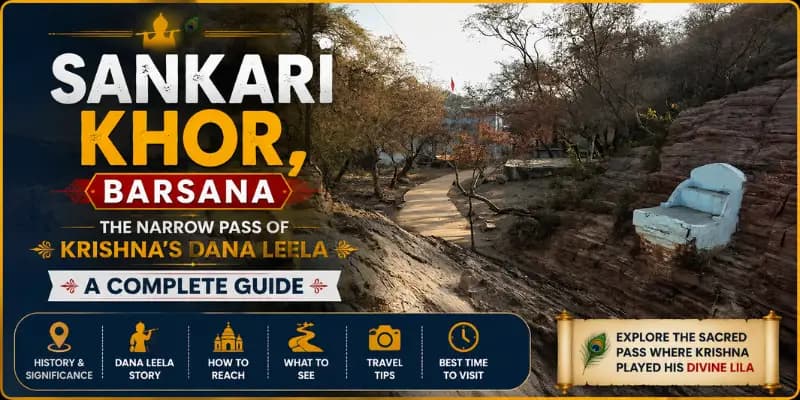
Sankari Khor is one of the most beloved and playful of the sacred sites of Barsana, the town of Radha, a famously narrow pass between two of the town's hills, so narrow that only one person can pass through it at a time. Its name says exactly what it is: sankari, narrow and khor, lane; the narrow lane. It is revered above all as the site of Krishna's Dana Leela, the tax-collector pastime, one of the sweet, mischievous pastimes of his boyhood, where, by the tradition, Krishna and the cowherd boys would block this passage and demand a toll from the gopis.
Set among the hills of Barsana, Sankari Khor is a place of joy and devotion, cherished for its charming leela and revered by pilgrims who squeeze through its narrow way. This guide covers Sankari Khor and its story, the hills of Barsana, the Dana Leela, the pastimes and the offerings and how to reach and visit it. It lies near the great sites of Radha's town; see our radha rani temple barsana guide for the hilltop temple and our kirti mandir barsana guide for the shrine of Radha's mother, both nearby.
From the ground (Gurudutt): Sankari Khor is a small but joyful site, best understood by knowing its sweet story, so come knowing the Dana Leela, the playful toll Krishna demanded of the gopis and enjoy passing through the famously narrow way yourself, as pilgrims have for ages. It is a place of delight as much as devotion. Being a natural rock pass among the hills, wear comfortable shoes and take care on the uneven ground. Combine it with the Radha Rani temple and the other Barsana sites and let a local guide bring the charming leela of the tax collector alive as you pass through. See our Mathura Vrindavan tour or message WhatsApp +91 7302265809.
The pass at a glance
Here are the essentials of Sankari Khor in one place.
Detail | Information |
What it is | A famously narrow rock pass at Barsana |
The name | Sankari, narrow and Khor, lane |
So narrow that | Only one person can pass at a time |
Revered for | Krishna's Dana Leela, the tax-collector pastime |
Between | The Brahmagiri and Vilasa hills of Barsana |
The offering | Milk and yogurt, to commemorate the leela |
Where | About 2 km from Barsana's Radha Rani temple |
Best combined with | The Radha Rani temple and the Barsana sites |
In one line: Sankari Khor is the famously narrow single-file pass between Barsana's hills, revered as the site of Krishna's Dana Leela, the playful tax-collector pastime with the gopis.
What is Sankari Khor?
Sankari Khor is a narrow natural pass or lane, between two hills at Barsana, the town of Radha, in the western part of Braj. Its name comes from sankari, meaning narrow and khor, meaning a lane or passage; so Sankari Khor is simply the narrow lane. It is famously narrow: by the tradition, no matter whether one is lean or stout, only a single person can pass through it at a time and it is impossible for two to walk side by side, so pilgrims pass through in single file.
So Sankari Khor is a natural rock passage among the hills of Barsana, revered not for any building but for the beloved leela that, by the tradition, took place here, Krishna's Dana Keli, the tax-collector pastime. It lies between the Brahmagiri hill and the Vilasa hill of Barsana, at their meeting. So it is a small but cherished sacred site, a place of a sweet and playful pastime of Krishna's boyhood. We present its sanctity and its leela as the cherished belief and tradition of Braj, held with faith and recounted with reverence.
The hills of Barsana and the boon of Brahma
To understand Sankari Khor, it helps to know the hills of Barsana between which it lies. By the tradition, drawn from the Padma Purana, the creator Brahma once performed severe austerities out of a longing to witness the pastimes of Radha and Krishna and to receive the dust of their lotus feet upon his head; and Krishna, pleased with him, granted him the boon to manifest as the hills of Barsana, so that he might forever be present at their leelas.
So, by the tradition, Brahma manifested as the Brahmagiri hill of Barsana, with its peaks representing his heads and a second hill nearby, the Vilasa or Vishnu hill, is revered as a manifestation of Vishnu. The peaks of these hills bear the names Bhangarh, Managarh, Danagarh and Vilasgarh, each linked with a leela; and on the highest, by the tradition, Vrishabhanu Maharaj, Radha's father, had his palace and Radha manifested her childhood pastimes. Sankari Khor is the narrow pass between the Brahmagiri and Vilasa hills. We present the boon of Brahma and the sanctity of the hills as the cherished belief and tradition of Braj, held with faith.
The Dana Leela: Krishna the tax collector
The beloved leela for which Sankari Khor is revered is the Dana Leela or Dana Keli, the tax-collector pastime, one of the sweet and mischievous pastimes of Krishna's boyhood. By the tradition, the gopis, the cowherd maidens, would carry their pots of milk, yogurt and butter through the narrow pass of Sankari Khor on their way to sell them in the villages and markets around Barsana, for it lay on their daily route.
And each day, by the tradition, Krishna, with his cowherd friends, would block the narrow passage and, playing the part of a tax collector, demand a toll, a dana, of milk and yogurt from the gopis before letting them through. Sometimes the gopis would refuse and try to push their way past and the boys would push back, in a joyful tug of war; sometimes they gave in and sometimes Krishna took his due. The boys would toss pebbles at the clay pots to break them and scamper to catch the streaming milk, while the gopis tried in vain to stop the leaks, all in a scene of laughter and play. So the Dana Leela is a sweet, playful pastime of Krishna's boyhood at Sankari Khor. We recount it, as we do all the leelas of Braj, as the cherished belief and tradition of the sampradayas, held with faith and recounted with reverence, in a joyful, devotional spirit.
The gopis' retaliation and Radha's compassion
By the tradition, the playful tale of Sankari Khor has a delightful turn. Having had enough of Krishna's daily toll, the gopis one day plotted a clever retaliation: many of them hid in the thick bushes on either side of the narrow pass, while a few walked through as usual. When Krishna and the cowherd boys stopped these few to demand their toll, the hidden gopis sprang out and, playfully overpowering the boys, tied their hair-locks to the branches and teased them to their hearts' content.
In the tradition, the boys were freed only through the compassion that Radha felt for Krishna's plight and only after Krishna and his companions had playfully apologised and surrendered to the will of Radha. So the leela of Sankari Khor shows the sweet, loving play of Radha and Krishna and the gopis and the supremacy of Radha's grace, a favourite of the devotees of Barsana. We present this pastime, as we do all the leelas, as the cherished belief and tradition of Braj, held with faith and recounted with reverence, part of the joyful devotion of the town of Radha.
The rocks and the offerings
By the tradition, the rocks of Sankari Khor still bear the marks of the Dana Leela: the lotus handprints of Krishna and the white spots left by the yogurt and milk that spilled from the gopis' broken pots, cherished as living traces of the pastime. Pilgrims come to see and touch these revered marks as they pass through the narrow lane.
And in remembrance of the tax-collector pastime, devotees offer milk and yogurt to the rocks of Sankari Khor, honouring the leela of Krishna playing the tax collector, a sweet and living custom of the place. So a visit to Sankari Khor brings not only the passage through the famously narrow way but the darshan of the marks of the leela and the offering of milk and yogurt. We present the marks on the rocks and the custom of offering as the cherished belief and tradition of Braj, held with faith, part of the living devotion of the sacred pass at Barsana.
Timings and how to visit
Sankari Khor, being a natural rock pass among the hills rather than an enclosed temple, is open to pilgrims through the daylight hours, with no fixed timings and is best visited in the daylight, ideally the cooler morning. There is no entry fee and the site is free.
To visit, you pass through the famously narrow lane in single file, as pilgrims have for ages, seeing the revered marks on the rocks and offering milk or yogurt if you wish. Dress modestly, wear comfortable shoes for the uneven rock and the hills, carry water and take care on the narrow, uneven ground, especially if it is crowded or slippery. Allow a short while for the pass itself, more if you take in the surrounding Barsana hills and sites. Being a little apart from the main temple, it is often less crowded, though busy at festivals. Beware anyone pressing for large donations; keep offerings voluntary.
How to reach Sankari Khor
Sankari Khor is at Barsana, the town of Radha, in the western part of Braj, among the town's hills, so reaching it means reaching Barsana.
It lies at the meeting of the Brahmagiri and Vilasa hills, about 1 km from the Barsana bus stand and about 2 km from the Barsana Radha Rani or Shreeji, temple.
Barsana is about 9 km from Nandgaon, 20 km from Govardhan and about 45 to 50 km from Mathura, in the western Braj.
Reach Barsana by taxi, local transport or a planned tour from Mathura or Vrindavan; within Barsana, reach Sankari Khor on foot or by a local motorcycle or auto, then walk to the pass.
The nearest major railway station is Mathura Junction and the nearest airports are Agra and Delhi.
Because it lies among the hills a little apart from the main temple, the final approach to Sankari Khor is on foot or by a local motorcycle or auto to the nearest point and then walking. A local guide makes finding it easy and brings its leela alive. Our how to reach vrindavan guide covers arriving in Braj and our gokul barsana nandgaon day trip guide the western-Braj circuit that takes in Barsana. Barsana is glorious but very crowded at its Lathmar Holi with Nandgaon.
Combining with Barsana and the western Braj
Sankari Khor is best visited as part of a fuller Barsana and western-Braj pilgrimage, with the sites around it.
With the Radha Rani temple: the hilltop temple of Radha, about 2 km away, the heart of Barsana.
With the Barsana hills and sites: Maan Garh, where Radha withdrew in loving pride; the Daan Garh temple; Kirti Mandir; and the sacred grove of Gahvar Van.
With Nandgaon: the town of Krishna, about 9 km away, bound to Barsana by the Lathmar Holi.
With Govardhan: the sacred hill, about 20 km, for the parikrama and the kunds.
So a visit to Sankari Khor fits naturally into a Barsana pilgrimage and a western-Braj day taking in Nandgaon and Govardhan, the land of Radha and Krishna. We arrange western-Braj days taking in Barsana, Sankari Khor and the region, with the transport, the routing, the timing and a knowledgeable local guide to bring the leela of the tax collector alive. A shared day tour starts from around ₹1,499 per person, with darshan free throughout and our same-day govardhan barsana tour and two-day mathura vrindavan tour cover this side of Braj. The pass is also a cherished stop on the braj chaurasi kos yatra. Our best time to visit vrindavan mathura guide helps you plan. Message me on WhatsApp at +91-7302265809 to arrange your visit to Sankari Khor and the western Braj.
Related guides
Meet Gurudutt — Your Mathura Vrindavan Guide
Not just a tour operator — Gurudutt was born and raised in Braj Bhoomi. He has spent over a decade personally guiding pilgrims through the sacred lanes of Mathura & Vrindavan.
Founder – Experience My India
Gurudutt
Founder · Experience My India