Travel Guide · Travel Guides · Updated November 2026
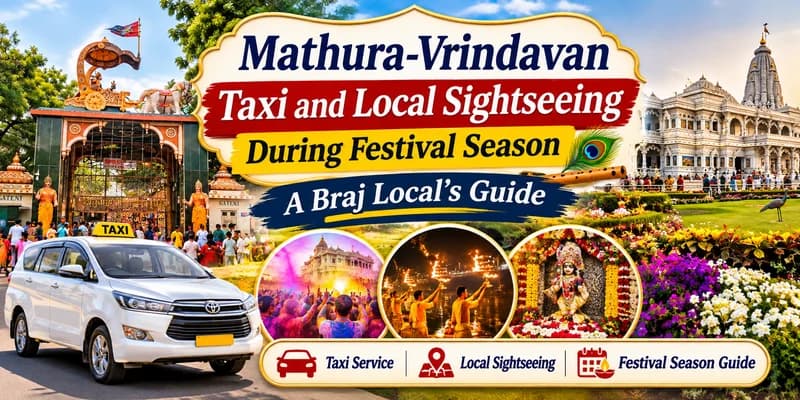
Mathura-Vrindavan Taxi and Local Sightseeing During Festival Season: A Braj Local’s Guide
By Gurudutt, Experience My India·14 November 2026
Quick Answer
Quick Enquiry
Festival season in Braj is the most beautiful and the most chaotic time to visit and the single biggest mistake people make is treating the taxi like a city cab that drops them at the temple door. It does not work that way here. On Janmashtami or Holi, the police barricade the inner lanes, your car parks on the outskirts and you walk or take an e-rickshaw in. So the right way is: a pre-booked private taxi for the day, a local e-rickshaw for the last mile and a strict morning-and-evening schedule around the afternoon closure. Book your cab weeks ahead, not on the day. Do this and even a festival-day darshan is smooth. We handle exactly this for our guests, the car, the e-rickshaws, the timing and the crowd navigation. Radhe Radhe. See our Mathura Vrindavan tour Packages or message WhatsApp +91 7302265809.
Location and connectivity
Mathura and Vrindavan are twin cities in Uttar Pradesh, in the Braj Bhoomi region, separated by about 15 km, a 30 to 45-minute drive, along the Yamuna River.
Access. The region is connected via NH-19 and the Yamuna Expressway; the main railhead is Mathura Junction (MTJ); the nearest airports are Agra (about 60 km) and Delhi IGI (about 150 to 160 km). See our delhi to vrindavan and how to reach vrindavan guides.
Between the two towns. About 15 km; see our mathura to vrindavan distance guide.
Local transport. Taxis (sedans, SUVs, Tempo Travellers), auto-rickshaws and battery e-rickshaws. The e-rickshaw is the workhorse of the inner lanes, especially during festivals.
The key fact for planning is that the two towns are close enough to cover together, but their inner cores, old Mathura and central Vrindavan, are not freely drivable, which shapes everything about festival-season transport.
Why festival season needs a different plan
In an ordinary month, you can hire a taxi and move fairly freely. In festival season, three things change the game and planning around them is the whole secret.
Vehicle restrictions and barricades. During major festivals, Janmashtami, Holi, Radhashtami, Diwali and Annakut, Kartik Purnima and the Ekadashi days, police bar outside four-wheelers from entering central Vrindavan and old Mathura. Your taxi drops you at outer-perimeter parking and you go in on foot or by e-rickshaw.
Afternoon temple closures. Most shrines close in the early afternoon (roughly 12:00 PM to 4:00 PM) so the deities can rest, giving two darshan windows a day, morning and evening, not one continuous day.
Massive crowds. Festivals draw millions of pilgrims, turning the narrow lanes into dense, slow-moving gatherings. Timing and patience become essential.
Together these mean a casual, drive-up approach fails. What works is a pre-booked taxi plus last-mile e-rickshaws, run on a strict split-shift schedule (see below).
Taxi and local transport in festival season
Here is how to handle the transport, which is the heart of a smooth festival visit.
Pre-book a private taxi. Book a full-day local cab in advance, ideally two to three weeks before a major festival, through a local operator such as Experience My India or the Vrindavan Mathura Guide team, rather than relying on finding one on the day. A pre-booked car gives you a driver who knows the barricades, the parking zones and the timing.
App-based cabs vs pre-booked. App-based services like Uber and Ola work reasonably for intercity drops from Delhi or Agra, but they are largely unusable inside the towns during busy festival hours, where a pre-booked local cab and e-rickshaws are far more reliable.
Last-mile e-rickshaws. From your taxi’s drop-off at the outer parking, use local battery e-rickshaws to reach the narrow inner lanes near Banke Bihari and Dwarkadhish. Expect e-rickshaw fares to surge, often to about 1.5 to 2 times normal rates, on peak festival days.
Indicative fares (confirm current rates). Taxis are typically hired on an hourly or kilometre-capped basis. As a rough guide: a sedan from around 9 rupees per km; a local full-day sightseeing package for Mathura and Vrindavan from around 1,500 to 2,500 rupees for a sedan; larger vehicles (SUV, Tempo Traveller) or longer full-day packages roughly 3,500 to 6,500 rupees or more; and full-day outstation tours covering the outer Braj circuit (Govardhan, Barsana) from around 2,999 rupees. These are per-vehicle, indicative and vary by vehicle, duration, season and festival demand, so always confirm the current rate when you book.
The reliable pattern is simple: private car for the day and the drop-offs, e-rickshaws for the last mile, booked ahead.
The split-shift sightseeing schedule
Because of the afternoon closures and the crowds, a strict split-shift itinerary is the single most useful planning tool for festival season.
Morning (about 6:30 to 11:00 AM): Mathura. Cover Mathura’s shrines early, before the crowds peak, the Krishna Janmabhoomi, Dwarkadhish and Vishram Ghat.
Midday (about 12:00 to 4:00 PM): rest. Use the temple closure for lunch and rest. Fighting the midday heat and shut temples is pointless; recharge instead.
Evening (after about 4:30 PM): Vrindavan. Visit Vrindavan’s temples in the evening reopening, Banke Bihari, Prem Mandir, ISKCON and end at the Yamuna ghats for the aarti and, in Kartik, the Deep Daan.
This morning-Mathura, evening-Vrindavan rhythm, with a midday rest, lets you see the most while working with, not against, the temple schedule and the crowds. For the aartis worth timing your evening around, see our must-attend aarti guide.
Key Mathura sightseeing and timings
Here are Mathura’s main sights for the morning shift, with general (winter/standard) timings. Treat all timings as indicative and confirm locally, as they shift with the season and are extended or altered on festival days.
Shri Krishna Janmabhoomi. Built over the prison cell where, by tradition, Krishna was born; one of the holiest sites in Mathura. General timings about 5:00 AM to 12:00 PM and 4:00 PM to 9:30 PM (the inner Garbha Griha closes briefly midday and timings extend during festivals). Note: electronic devices, phones and bags must be left in the outer cloakrooms before security screening. See our shri krishna janmabhoomi guide.
Shri Dwarkadhish Temple. A historic Pushtimarg shrine (built in 1814 in Rajasthani haveli style) worshipping Krishna in his royal form as the King of Dwarka, known for its swing festival and vibrant architecture. General timings about 6:30 AM to 11:00 AM and 4:00 PM to 7:30 PM. See our shri dwarkadhish guide.
Vishram Ghat. The central Yamuna bathing ghat where, by tradition, Krishna rested after defeating the tyrant Kansa; the site of the grand evening Yamuna aarti (around 6:30 to 7:00 PM). Open through the day. See our vishram ghat guide.
For the wider Mathura circuit, see our places to visit in mathura guide.
Key Vrindavan sightseeing and timings
Here are Vrindavan’s main sights for the evening shift, with general (winter) timings. Confirm locally, as festival days change schedules and crowds.
Shri Banke Bihari. One of the most sacred and heavily visited shrines, established by Swami Haridas in the 16th century, with its distinctive curtain-drawn darshan and no bells or conches. General winter timings about 8:45 AM to 1:00 PM and 4:30 PM to 8:30 PM; crowds peak dramatically during festivals, so go early morning or off-peak. See our banke bihari guide.
Prem Mandir. A sprawling white-marble complex built by Jagadguru Kripalu Maharaj, depicting Krishna’s life in carvings, with an evening light and musical-fountain show (best after about 6:30 to 7:00 PM). Open through the day. See our prem mandir guide.
ISKCON Krishna Balaram Mandir. Founded in 1975 by A.C. Bhaktivedanta Swami Prabhupada, internationally renowned for continuous kirtan and its clean, accessible courtyards. General timings about 4:10 AM to 12:45 PM and 4:00 PM to 8:45 PM. See our iskcon vrindavan guide.
Shri Govind Dev Ji Mandir. Constructed in 1590 by Raja Man Singh of Amber in red sandstone, a rare fusion of Hindu, Rajput and Mughal styles. General timings about 5:00 AM to 12:00 PM and 4:00 PM to 9:00 PM.
Nidhivan and Seva Kunj. Sacred, mystical groves of intertwined trees where, by cherished local lore, Radha and Krishna perform their Rasa Lila each night, so the premises are vacated strictly after dusk. General timings about 5:00 AM to 12:00 PM and 4:00 PM to 7:00 PM (strict sunset exit). See our nidhivan and seva kunj guides.
Keshi Ghat. A scenic riverside ghat for the evening aarti and, in Kartik, the Deep Daan; lovely for a boat ride at dusk. See our keshi ghat guide.
Other great temples, such as radha raman, are worth adding; for the full circuit see our places to visit in vrindavan guide.
Festival crowd and safety tips
A few honest, practical warnings make a festival-season visit safer and smoother.
Beware of fake VIP passes and touts. Major shrines like Banke Bihari and ISKCON offer free general entry and do not sell official online VIP or skip-the-line tickets. Avoid any tout claiming to offer paid fast-track access, it is not genuine. Do not pay strangers for darshan access.
Protect your belongings from monkeys. Aggressive rhesus monkeys around Banke Bihari, Govind Dev Ji and the old Vrindavan lanes frequently snatch eyeglasses and phones. Keep spectacles in a hard case and phones in a zipped bag while walking.
Footwear and the cold floors. You remove your shoes at every temple, so wear slip-on footwear (leave expensive shoes locked in the taxi), carry a small bag for them and wear thick cotton socks to protect your feet from the cold marble floors in winter.
Dress modestly. Wear modest clothing covering the shoulders and knees; sleeveless tops and shorts are restricted at several shrines. A shawl helps (and keeps you warm in the cold mornings and evenings).
General care. Keep your group together with an agreed meeting point (phone networks get congested in crowds), carry little, keep small change for e-rickshaws and offerings, carry water and look after elders and children in the crush.
These simple precautions, especially avoiding touts and protecting against monkeys, prevent the most common festival-day mishaps.
History and spiritual significance
Mathura and Vrindavan are the heart of Braj Bhoomi and among the most sacred places in the Sanatan tradition. Mathura is revered as the Janmabhoomi, the birthplace of Lord Krishna, while Vrindavan is where, by tradition, he spent his childhood and performed his Bal Leela (childhood pastimes). These are cherished devotional and scriptural traditions.
The region is a core pilgrimage hub with a continuous living tradition of worship, classical music and large-scale seasonal festivity, cherished over the ages. It is this depth that makes the festivals so powerful: Janmashtami (Krishna’s birth, with midnight celebrations at the Janmabhoomi), the Braj Holi season (including the famous Lathmar Holi of Barsana and Nandgaon; see our mathura vrindavan holi guide), Radhashtami and the Diwali-to-Annakut and Kartik observances (see our kartik guide). At these times the twin towns draw millions of pilgrims, transforming the narrow lanes into dense, joyful spiritual gatherings, which is exactly why the transport and timing planning in this guide matters so much.
Planning your festival-season visit
For a festival-season trip, plan at least 2 to 3 days to cover Mathura, Vrindavan and a nearby Braj extension (Govardhan or Gokul) without rushing, more if you are here for a specific festival, which deserves a day of its own. Base yourself in Vrindavan to be close to the temples; see our where to stay in vrindavan guide and book your stay and your taxi well ahead, as both fill up for festivals.
Put the pieces together: a pre-booked private taxi for the day and the intercity legs, local e-rickshaws for the last mile, the split-shift schedule (morning Mathura, evening Vrindavan, midday rest) and the safety precautions above. A ready-made mathura vrindavan tour plan helps you structure the days and our best time to visit and famous food guides round out the trip. A local operator who knows the barricades, the parking and the timing turns a potentially stressful festival visit into a smooth one.
Let a Brajwasi plan your visit
Festival season in Braj is unforgettable, but the crowds, the vehicle bans and the afternoon closures make it the one time of year when local help truly pays off. As Brajwasis running Experience My India, we handle the whole transport-and-sightseeing puzzle: a pre-booked private taxi (sedan, SUV or Tempo Traveller) for your days and the Delhi or Agra legs, the last-mile e-rickshaws through the barricaded lanes and a split-shift schedule timed around the temple closures and the crowds, Mathura in the morning, Vrindavan in the evening, the Yamuna aarti and, in Kartik, the Deep Daan. We know the parking zones, the safe routes and how to avoid the touts and the monkey-prone lanes and we can add Govardhan, Barsana or Gokul for a fuller Braj trip. A shared Mathura and Vrindavan darshan starts from around 1,499 rupees per person and private full-day taxi packages are available on request; see our mathura vrindavan tour or our govardhan barsana tour and agra mathura vrindavan tour for extensions. Message us on WhatsApp at +91-7302265809 and we will plan your festival-season visit. Radhe Radhe.
Related guides
Book Your Mathura - Vrindavan Trip Today
📞 +91-7302265809
💬 WhatsApp: +91-7302265809
We Reply in 30 Minutes
Packages start from ₹1,999/ person | Rated 4.5★ / 204+ Reviews
Explore all: Mathura Vrindavan Tour Packages
Jai Shri Krishna
Start with these
Meet Gurudutt — Your Mathura Vrindavan Guide
Not just a tour operator — Gurudutt was born and raised in Braj Bhoomi. He has spent over a decade personally guiding pilgrims through the sacred lanes of Mathura & Vrindavan.
Founder – Experience My India
Gurudutt
Founder · Experience My India