Travel Guide · Travel Guides · Updated November 2026
Morning Aarti in Vrindavan: Timings, Temples and the Ashtayama Seva
By Gurudutt, Experience My India·25 November 2026
Quick Answer
Quick Enquiry
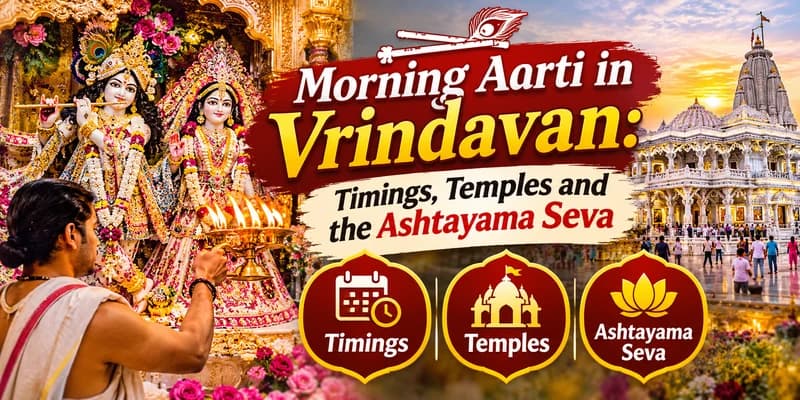
The pre-dawn aarti is the soul of Vrindavan. If you want to feel why this town is special, wake in the dark and go to the Mangala Aarti, ISKCON at 4:30, Radha Raman or Prem Mandir around 5:30 in winter, when the conches blow and the curtain opens on the Lord freshly woken. It is quiet, cold and utterly beautiful, this is Brahma Muhurta, the holiest hour. One thing confuses many visitors: Banke Bihari has no pre-dawn aarti. Our Bihari Ji rests late after his night of Raas Leela, so his first darshan is the Shringar Aarti later in the morning, around 8:55 in winter. Plan an early temple-hop: Mangala somewhere at dawn, then Banke Bihari for Shringar. Go early, go humble and let the morning carry you. Jai Shri Radhe and Radhe Radhe. See our Mathura Vrindavan tour Packages or message WhatsApp +91 7302265809.
Morning aarti timings by temple
Temples follow seasonal routines and since it is currently the winter season, most follow the winter schedule. Here is the first morning aarti at the main temples (confirm locally, as timings shift).
Temple and location | First morning aarti | Summer timing | Winter timing |
ISKCON Vrindavan (Raman Reti) | Mangala Aarti | 4:30 AM | 4:30 AM |
Prem Mandir (Chhatikara Road) | Mangala Aarti | 5:00 AM | 5:30 AM (varies) |
Radha Raman temple (Panchayatana) | Mangala Aarti | 5:00 AM | 5:30 AM |
Shri Banke Bihari (Bihari Pura) | Shringar Aarti | 7:55 AM | 8:55 AM |
Important, Banke Bihari has no pre-dawn Mangala Aarti. It is performed there only once a year, on Krishna Janmashtami. By tradition, priests believe Thakur Ji rests late after performing Raas Leela at night and should not be woken early, so his first darshan of the day is the later Shringar Aarti. So for a dawn Mangala Aarti, go to ISKCON, Radha Raman or Prem Mandir; for Banke Bihari, plan the mid-morning Shringar darshan. See our banke bihari, iskcon vrindavan, prem mandir and radha raman guides and for the full round of aartis, our must-attend aarti guide.
The daily morning aarti sequence
Major temples divide the morning worship into distinct stages, each a step in caring for the deity.
Mangala Aarti. The pre-dawn ritual that wakes the deities, with conch shells, bells and devotional kirtan. Priests offer light sweets (Mangala Bhoga) before opening the altar curtains. This is the first and, for many, the most moving darshan of the day.
Shringar Aarti. Held later in the morning, it marks the first darshan after the deities are bathed, dressed in fresh garments and adorned with jewellery and flowers (shringar means adornment). At Banke Bihari this is the first aarti of the day.
Dhoop and Raj Bhog Aarti. Priests offer incense (dhoop) around mid-morning, followed by the grand midday meal offering (Raj Bhog) around 12:00 PM. Temples close immediately afterward so the deities can rest.
So a classic morning in Vrindavan is: a dawn Mangala Aarti at one temple, the Shringar darshan at another (and Banke Bihari), then out before the midday closure. For the full day’s timings, see our mathura vrindavan temple timings guide.
A suggested early-morning plan
4:30 AM, ISKCON (Raman Reti): begin with the Mangala Aarti and the dawn kirtan, the earliest and most atmospheric.
Around 5:30 AM (winter), Radha Raman or Prem Mandir: a second Mangala or early darshan as the sky lightens.
A walk by the Yamuna: the ghats at keshi ghat and the riverfront (see our braj yamuna ghats guide) are serene at dawn.
Around 8:55 AM (winter), Banke Bihari: the Shringar Aarti, Bihari Ji’s first darshan of the day, before the crowds peak.
Before noon: finish your temple round before the midday closure, resting through the afternoon.
This dawn-to-mid-morning rhythm gives you the calmest, most beautiful darshan of the day and avoids both the heat and the crowds. For where to stay close to the temples, see our where to stay in vrindavan guide and to time your overall trip, our best time to visit guide.
History and the Ashtayama Seva
The morning aartis are part of the Ashtayama Seva, the structured eight-period daily worship of Krishna. These are cherished devotional and historical traditions.
Origins in the Bhakti tradition. The eightfold Ashtayama Seva was formalised in the 16th century by the Six Goswamis of Vrindavan, disciples of Sri Chaitanya Mahaprabhu, who revived the town’s sacred worship.
Vatsalya Bhava (parental love). Unlike temples where God is worshipped solely as a majestic ruler, Vrindavan temples treat Krishna as a beloved child or dear friend. Every aarti mirrors a loving daily care routine, waking, bathing, dressing, feeding, resting the Lord, rather than a rigid ceremony.
The eight periods. The day’s worship is divided into eight stages from the pre-dawn waking (Mangala) through to the night’s rest (Shayan), each with its own aarti, bhoga and mood.
Understanding this makes the morning aarti far more moving: you are not watching a ritual, you are witnessing a household lovingly waking and caring for its beloved child-God.
Why the pre-dawn hour matters
Brahma Muhurta. The pre-dawn window, roughly 90 minutes before sunrise, is called Brahma Muhurta and is considered the most spiritually potent time of day. Attending aarti then is believed to bring mental clarity, peace and a deep spiritual connection.
The calmest darshan. The dawn aartis are far less crowded than the day, so you can stand in the quiet and truly absorb the darshan.
The freshest mood. The deity, newly woken and freshly adorned, is at his most tender and beautiful in the morning.
So if you make one special effort in Vrindavan, let it be a pre-dawn Mangala Aarti, it is the experience pilgrims remember most. These are cherished devotional beliefs.
Practical tips for the morning aarti
Arrive early. Reach the temple at least 20 to 30 minutes before the scheduled aarti, especially on weekends and Ekadashi, when crowds are larger.
Know the curtain (jhanki) system. At Banke Bihari, priests draw and open the altar curtain every few minutes during darshan, so devotees are not overwhelmed by gazing continuously at the deity; do not expect a long, continuous view.
Entry is free. Entry to all major temples is completely free; ignore anyone selling “VIP darshan.”
Dress modestly in traditional attire and leave footwear at the designated shoe stalls outside.
Travel light. Phones and bags are restricted at some temples (and photography is often not allowed inside), so carry little.
Plan the cold. Winter pre-dawns in Vrindavan are genuinely cold, carry a shawl.
Mind the monkeys and the lanes on the way, especially near Banke Bihari.
For travelling with elders to the early aartis, see our mathura vrindavan with elderly parents guide and for the approach into the old town, our chhatikara road guide.
A little context: Vrindavan’s aarti culture
Vrindavan is, by tradition, the land of Krishna’s childhood leelas and its worship reflects an intimate, loving relationship with the Lord. The town holds thousands of temples, from the historic Goswami shrines to the great modern complexes and the daily rhythm of aartis, from the pre-dawn Mangala to the night Shayan, is the heartbeat of the place. For the full roster of temples to include in a morning round, see our places to visit in vrindavan guide and for the sacred grove tied to the night Raas Leela (and why Banke Bihari wakes late), our nidhivan guide. These are cherished devotional traditions.
Best days and seasons
The morning aarti runs every day, but some days and seasons are especially powerful. Ekadashi (the eleventh lunar day), Purnima (full moon) and the holy month of Kartik (October to November) bring much larger crowds, longer kirtan and a heightened atmosphere, wonderful if you want the full fervour, but arrive extra early. The cool season (October to March) is the most comfortable for the pre-dawn starts (though genuinely cold), while summer dawns are milder in temperature but the timings shift a little later. For a calm darshan, pick an ordinary cool-season weekday morning; for the grand devotional surge, come on Ekadashi, Purnima or during Kartik. Whatever you choose, the pre-dawn Mangala Aarti is the jewel of a Vrindavan morning.
Let a Brajwasi plan your visit
The pre-dawn aarti is the most magical thing in Vrindavan and a Brajwasi makes it effortless to reach. As locals running Experience My India, we get you to the right temple at the right hour: ISKCON for the 4:30 AM Mangala Aarti, Radha Raman or Prem Mandir for the dawn darshan and Banke Bihari for the mid-morning Shringar (remembering it has no pre-dawn aarti), all sequenced so you flow from one to the next without backtracking through the dark lanes. Our car and driver handle the early pickup and the parking and we steer you past the touts and fake “VIP darshan” offers (darshan is free). We can build the whole morning around the aartis and continue into a full Vrindavan and Mathura darshan and for Ekadashi, Purnima and Kartik, having a local host is the difference between chaos and a serene morning. A shared Mathura and Vrindavan darshan starts from around 1,499 rupees per person. See our vrindavan tour package or our mathura vrindavan tour and a ready-made mathura vrindavan tour plan. Message us on WhatsApp at +91-7302265809 and we will plan your morning aarti darshan. Jai Shri Radhe and Radhe Radhe.
Related guides
Book Your Mathura - Vrindavan Trip Today
📞 +91-7302265809
💬 WhatsApp: +91-7302265809
We Reply in 30 Minutes
Packages start from ₹1,999/ person | Rated 4.5★ / 204+ Reviews
Explore all: Mathura Vrindavan Tour Packages
Jai Shri Krishna
Start with these
Meet Gurudutt — Your Mathura Vrindavan Guide
Not just a tour operator — Gurudutt was born and raised in Braj Bhoomi. He has spent over a decade personally guiding pilgrims through the sacred lanes of Mathura & Vrindavan.

Founder – Experience My India
Gurudutt
Founder · Experience My India