Travel Guide · Travel Guides · Updated July 2026
Agra to Mathura to Vrindavan: Distance, Routes & the Timing-Smart Day Trip
By Gurudutt, Experience My India·4 July 2026
Quick Answer
Quick Enquiry
At-a-glance
Detail | Information |
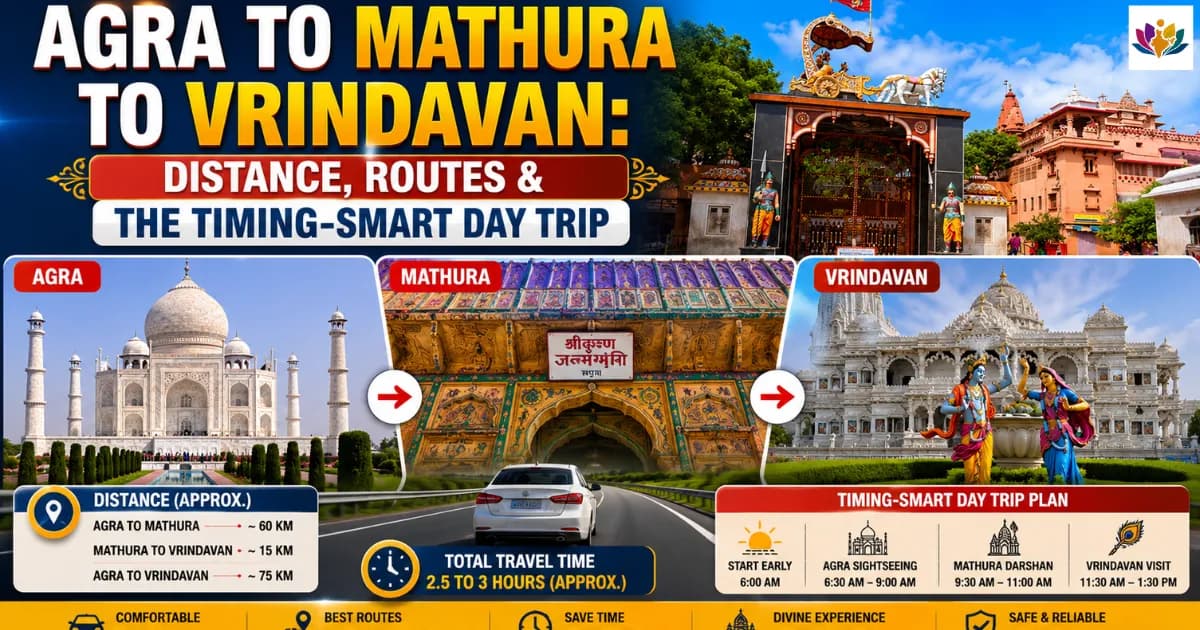
Agra to Mathura distance | 58-63 km · 1 hr-1 hr 30 min |
Mathura to Vrindavan distance | 10-12 km · 15-20 min |
Agra to Vrindavan (total) | 70-75 km · 1.5 hrs |
Best route | Agra to Yamuna Expressway / NH-19 to Mathura to Vrindavan |
Easiest mode | Private AC cab (door-to-door, flexible stops) |
Cheapest mode | Bus to Mathura + shared e-rickshaw to Vrindavan |
Fastest train | Agra Cantt to Mathura Junction, 30-45 min |
Typical one-way cab fare | ₹1,500-₹3,200 by car type |
Ideal departure from Agra | 6:00-7:00 AM, to beat the noon temple closure |
Same-day trip? | Yes - comfortably, if you plan around temple timings |
Conversion | WhatsApp +91-7302265809 · packages from ₹1,499 |
Agra to Mathura to Vrindavan distance at a glance
Think of this trip as two short hops rather than one long drive. From Agra to Mathura - the birthplace of Shri Krishna - it is roughly 58-63 km, an easy hour to ninety minutes on a good road. From Mathura to Vrindavan, where the child Krishna grew up among the cowherds , it is only another 10-12 km, about fifteen to twenty minutes. Put together, Agra to Vrindavan is around 70-75 km, comfortably covered in about an hour and a half.
You will see slightly different figures on different websites - some quote 65 km, some 78 km - and that is simply because the number changes with which exit you take and where you start in Agra (the Taj area, Agra Cantt, or Idgah). None of these differences matter much on the ground; the journey feels short either way. What does matter is the timing of your day, and we will come to that, because in Braj the clock is decided not by the road but by the temples.
The route: which road to take
There is one sensible road and a handful of confusing shortcuts. Take the sensible one.
From Agra, join the Yamuna Expressway (or NH-19) heading north, run smooth and fast past the fields until Mathura, take the exit toward Mathura town, and then continue the short stretch on to Vrindavan. The expressway portion is excellent - wide, well-lit at night, with clean pit stops and dhabas. The slowdown only begins after Mathura: the last few kilometres into Vrindavan are narrow, busy with e-rickshaws and pilgrims, and the temple lanes themselves are pedestrian-only in their final stretch. Keep a small time buffer for that tail end.
A word of caution: map apps sometimes offer a "shorter" route through interior village roads to shave a few kilometres. On paper it looks faster; in practice it sends you down narrow lanes with unpredictable traffic. The expressway route is slightly longer in distance but reliably smoother and safer - especially after dark.
How to reach by private cab (the easiest way)
For most visitors - and certainly for families, elders, or anyone carrying offerings - a private AC cab is the simplest and least stressful option. You leave when you want, you are picked up and dropped at the door, and you can add stops at Mathura's temples, Govardhan, or a roadside dhaba without renegotiating anything.
A typical one-way Agra to Vrindavan cab fare runs about ₹1,500-₹3,200, depending on whether you take a sedan, an SUV, or a larger vehicle, and on the season. That is a market range, not a fixed quote - confirm the fare and what it includes (waiting time, tolls, parking) before you start. A full day-trip cab that waits for you through Mathura and Vrindavan and brings you back to Agra is priced differently again, usually as a round-trip package with included waiting.
This is where a local arrangement earns its keep. A driver who knows Braj will park where vehicles are actually allowed, route you to each temple in the right order for its opening hours, and not waste your morning circling closed gates. If you would rather have the route, timing, and darshan order handled end-to-end, Experience My India can plan an Agra-pickup Braj day for you - WhatsApp +91-7302265809 and you will have an itinerary within 30 minutes.
How to reach by train
There is no direct train into Vrindavan from Agra - the rail route goes via Mathura. Take a train from Agra Cantt (or Raja ki Mandi) to Mathura Junction; the run is short, roughly 30-45 minutes, with several trains through the day. From Mathura Junction, hire an auto, e-rickshaw, or cab for the 10-12 km hop to Vrindavan.
Train suits the budget-minded and anyone who enjoys watching the countryside roll by, but it adds the friction of getting to and from stations at both ends, and Mathura Junction can be busy. Always check live timings on the IRCTC app before you bank on a specific train - schedules change.
How to reach by bus
Buses are the cheapest way and run very frequently. From Agra's Idgah Bus Stand (or ISBT), buses to Mathura leave roughly every 15-20 minutes through the day. From the Mathura bus stand, take a shared or private e-rickshaw or auto onward to Vrindavan - shared seats cost only ₹10-₹50 per person.
Bus plus shared auto is ideal for solo pilgrims, students, and backpackers who do not mind a few stops and a little crowd. It is less comfortable with luggage, small children, or limited mobility - for those travellers, the cab wins easily.
Can you do Agra to Mathura to Vrindavan in one day?
Yes - and it is one of the most popular day trips in North India - but only if you plan around the single fact that trips up most first-time visitors: the temples close in the middle of the day.
Almost every major temple in both towns shuts at or before 12:00-1:00 PM and does not reopen until 4:00-5:30 PM. Pilgrims who imagine they will "do Mathura in the morning and squeeze in Vrindavan before lunch" arrive at Banke Bihari at 12:15 PM to find the gates closed for the afternoon - Banke Bihari's summer afternoon break is the longest of all, about 5.5 hours.
The fix is simple once you know it: Mathura's birthplace temples in the morning, a relaxed afternoon (lunch, and the temples that stay open through midday), and Vrindavan's Banke Bihari in the evening session. Get that order right and a single day is plenty.
Book Mathura Vrindavan Tour Packages.
The timing-smart same-day route plan (hour by hour)
A workable shape for a day starting from Agra, built around real opening hours. Treat times as a template and confirm each temple's current summer/winter schedule before you go.
Time | Where | Why this slot |
6:00-7:00 AM | Depart Agra via Yamuna Expressway | Beat traffic and reach Mathura for the morning session |
8:00-8:30 AM | Arrive Mathura | Krishna Janmabhoomi opens early (5 AM); morning is calmest |
8:30-10:30 AM | Krishna Janmabhoomi + Dwarkadhish + Vishram Ghat | Mathura's core, all within 2.5 km, before the noon closure |
10:30-11:00 AM | Drive Mathura to Vrindavan (10-12 km) | Reach Vrindavan before its lanes choke up |
11:00 AM-12:30 PM | Prem Mandir & ISKCON | These stay open through midday - use the closure window wisely |
12:30-4:00 PM | Lunch + rest | The mandatory afternoon gap; do not fight it |
4:30-5:30 PM | Keshi Ghat / Yamuna aarti area | Golden-hour Vrindavan as temples reopen |
5:30-7:00 PM | Banke Bihari (evening session) | The jhanki is most active in the first hour after opening |
7:00-7:30 PM | Prem Mandir light show (optional) | The illuminated fountains at dusk |
7:30-9:00 PM | Return drive to Agra | Smooth expressway run back |
For the deeper version of this - what fits in one day versus two or three, and where to add Gokul, Govardhan, or Barsana - see our full Vrindavan-Mathura itinerary guide.
What to see in Mathura
Mathura is Krishna's birthplace , and its sacred core is compact and walkable. The essentials:
Shri Krishna Janmabhoomi - the temple complex around the prison cell where, by tradition, Krishna was born to Devaki and Vasudeva. This site sits beside the Shahi Idgah; it is a sensitive, contested location, and the two communities hold different views of its history. Visit respectfully; expect tight security.
Dwarkadhish Temple - built in 1814, run by the Pushtimarg (Vallabh) tradition , with lavish royal-style worship near Vishram Ghat.
Vishram Ghat - the principal Yamuna ghat, lovely at the evening aarti.
For exact darshan and aarti hours, see our dedicated Krishna Janmabhoomi timings guide.
What to see in Vrindavan
Vrindavan is where Krishna's childhood leelas unfold , and it is dense with temples. On a day trip, prioritise:
Banke Bihari Temple - Vrindavan's most beloved shrine, where the curtain (jhanki) is drawn every few moments rather than left open.
Prem Mandir - a vast modern marble temple with an evening light-and-fountain show; open through the afternoon.
ISKCON Krishna Balaram Mandir - no afternoon break, so it's the reliable midday darshan.
Nidhivan and Keshi Ghat - for atmosphere and the Yamuna.
Temple timings you must plan around
The one rule that makes or breaks this trip: build a four-hour rest gap into your afternoon. In brief, and subject to seasonal change:
Krishna Janmabhoomi (Mathura): roughly 5:00 AM-12:00 PM, reopens 4:00 PM.
Banke Bihari (Vrindavan): summer 7:45 AM-12:00 PM & 5:30 PM-9:30 PM; winter 8:45 AM-1:00 PM & 4:30 PM-8:30 PM.
ISKCON Vrindavan: 4:30 AM-8:45 PM, no afternoon break.
Prem Mandir: open through the day, roughly 8:30 AM-8:30 PM, with the evening light show.
Confirm the exact session before you travel - the Banke Bihari timings guide carries the current summer/winter schedule and the jhanki briefing.
Best time to make this trip
October to March is the comfortable window - pleasant weather for walking the lanes and standing in darshan queues. April to June is genuinely hot in Braj; if you go in summer, finish Mathura early and rest through the afternoon. The monsoon (July-September) cools things but can make ghats and lanes slippery - watch your step.
If you want the festivals: Holi in Braj (especially Barsana's Lathmar Holi and Banke Bihari's Phoolon ki Holi) in March, Janmashtami in August/September, and Radhashtami are spectacular - and extremely crowded. For a calm darshan, a plain weekday in winter beats any festival. Festival dates follow the Hindu lunar calendar and shift every year - confirm by panchang.
Where to stop and eat on the way
The Agra-Mathura stretch has reliable highway dhabas and food courts for tea, parathas, and a clean break. In Mathura, the famous peda is the thing to carry home; in Vrindavan, simple sattvik thalis and lassi near the temple lanes do the job. Many temples and their lanes are strictly vegetarian and alcohol-free - eat accordingly out of respect.
Combining with the Taj Mahal (and the reverse trip)
This route is the natural companion to a Taj Mahal visit: see the Taj and Agra Fort, then drive up to Braj for a day of darshan - heritage and devotion in one trip. Many travellers do it in reverse too (Vrindavan to Agra), since the Vrindavan-to-Agra drive is the same 70 km and equally easy. If you are continuing to Delhi afterwards, Agra to Delhi is about 233 km on the Yamuna Expressway. We can plan the whole Agra + Mathura + Vrindavan loop as one itinerary - just tell us your start and end points.
Cost breakdown: cab vs train vs bus vs package
Mode | Rough cost | Comfort | Best for |
Private AC cab (one-way) | ₹1,500-₹3,200 | High | Families, elders, first-timers |
Day-trip cab (round, with waiting) | Custom quote | High | Doing all three in a day, stress-free |
Train (Agra Cantt to Mathura Jn) + auto | Low | Medium | Budget travellers who don't mind stations |
Bus (Idgah to Mathura) + shared auto | Lowest | Basic | Solo pilgrims, backpackers, students |
Guided package (cab + guide + darshan plan) | From ₹1,499 pp | Highest | Anyone who wants it fully handled |
Cab and fare figures are typical market ranges and change with season, fuel, and vehicle - always confirm what's included (tolls, parking, waiting) before you start.
Practical tips & safety
Dress modestly. Banke Bihari and most temples enforce a dress code - no shorts, sleeveless tops, or ripped jeans. Kurta-pyjama or full trousers for men; salwar-kameez or saree with dupatta for women.
Security at Krishna Janmabhoomi is strict - phones, cameras, and bags are not allowed inside the main complex. Use the lockers outside and keep your time buffer for the checks.
There is no "VIP darshan" at Banke Bihari. No paid pass, no priority line exists - anyone selling one is running a scam. The only edge is timing: arrive at the start of a session.
Mind the monkeys in Vrindavan - they grab spectacles, phones, and prasad. Hold your belongings.
The last 300 m to Banke Bihari is vehicle-free - switch to an e-rickshaw or walk the lane.
Monsoon ghats and parikrama paths are slippery - wear grippy footwear and watch elderly travellers on steps.
Start early. Almost every problem on this route - heat, crowds, closed gates - is solved by leaving Agra by 6-7 AM.
Why travel this route with a local guide
The Agra-Mathura-Vrindavan day is easy to get to and surprisingly easy to get wrong - closed gates, missed sessions, parking chaos, and the small scams that target out-of-town pilgrims. Gurudutt and the Experience My India team are Brajwasis; we plan the order around live temple hours, brief you on each darshan, position you for the jhanki, and keep the logistics invisible so your day stays devotional, not stressful. We never sell VIP passes - our only advantage is knowing Braj by heart.
Tell us your Agra pickup point and travel date on WhatsApp +91-7302265809 and you'll have a timing-smart itinerary within 30 minutes. Packages from ₹1,499.
Meet Gurudutt — Your Mathura Vrindavan Guide
Not just a tour operator — Gurudutt was born and raised in Braj Bhoomi. He has spent over a decade personally guiding pilgrims through the sacred lanes of Mathura & Vrindavan.
Founder – Experience My India
Gurudutt
Founder · Experience My India