Travel Guide · Temple Guides · Updated August 2026
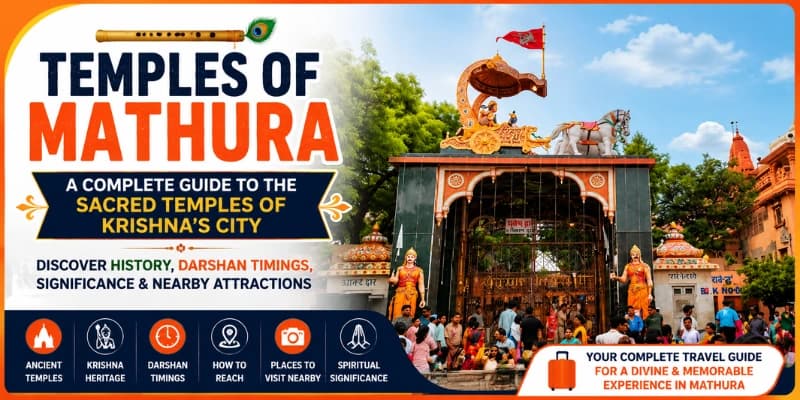
Temples of Mathura: A Complete Guide to the Sacred Temples of Krishna's City
By Gurudutt, Experience My India·1 August 2026
Quick Answer
Quick Enquiry
Key facts at a glance
Chief temple | The Krishna Janmabhoomi, birthplace of Krishna |
Grand temple | The Dwarkadhish temple in the old city |
Serene temple | The Gita Mandir, or Birla Mandir |
The guardians | Four ancient Shiva temples ring the city |
Also | Revered goddess shrines and a major Jain temple |
Time needed | A day for the main temples, around the midday closure |
Temples of Mathura: an overview
Mathura, the birthplace of Krishna and one of the seven holiest cities of Hinduism, is a city of temples, thousands of them, ancient and new, filling the old city and its surroundings. At their heart is the Krishna Janmabhoomi, the sacred birthplace, but the city holds far more: the grand Dwarkadhish temple, the serene Gita Mandir, four ancient Shiva temples that, by tradition, guard the city and revered shrines of the goddess, along with an important Jain temple that recalls Mathura's ancient heritage across faiths.
This guide is a complete directory of the temples of Mathura, the chief ones in depth and the notable others besides, with their significance, what to see and how to visit. It focuses on the temples themselves; for the city's wider sights, the ghats, the museum and the historic places, see our places to visit in mathura guide and for seeing them together our mathura vrindavan local sightseeing guide. Most of Mathura's temples cluster in and around the old city and can be seen in a rewarding day.
From the ground (Gurudutt): The key to a temple tour of Mathura, as of all Braj, is the midday closure: the great temples shut for a few hours in the middle of the day and reopen in the late afternoon, so plan a morning round and an evening round, with the midday for the museum, lunch or rest. Begin at the Krishna Janmabhoomi early, when it is calmest and end at Vishram Ghat for the evening Yamuna aarti. Plan around that rhythm and you will take darshan at every temple without finding its doors closed. See our Mathura Vrindavan tour or message WhatsApp +91 7302265809.
The main temples at a glance
Here are the principal temples of Mathura in one view.
Temple | What it is | Known for |
Krishna Janmabhoomi | The birthplace of Krishna | The city's holiest and chief temple |
Dwarkadhish | A grand old-city temple | Ornate darshan, festival splendour |
Gita Mandir (Birla Mandir) | A serene modern temple | The Gita on its pillars, gardens |
Bhuteshwar Mahadev | An ancient Shiva temple | A guardian deity of Mathura |
Rangeshwar, Pippaleshwar, Gokarneshwar | Ancient Shiva temples | The four guardians of the city |
Gayatri Tapo Bhoomi | A temple and ashram | The Gayatri tradition |
Chaurasi Jain temple | A Digambar Jain temple | Mathura's Jain heritage |
In one line: Mathura's chief temples are the Krishna Janmabhoomi, the Dwarkadhish and the Gita or Birla Mandir, with four ancient Shiva temples guarding the city and revered goddess and Jain temples besides, most in and around the old city.
The Krishna Janmabhoomi
The Shri Krishna Janmabhoomi is the chief and holiest temple of Mathura, revered as the very birthplace of Krishna, by tradition the prison of the tyrant Kansa where Krishna was born. In the west of the old city near Bhuteshwar, it is a large temple complex, with the sacred garbha griha, the birth-chamber shrine, at its heart, along with the Keshavdev temple and other shrines. It is the spiritual centre of Mathura and the reason the city is one of the seven holiest of Hinduism.
For the pilgrim, to take darshan at the Janmabhoomi is among the most moving of all, standing where Krishna is said to have entered the world. It is busiest and most fervent at Janmashtami, his birth, celebrated here through the night more grandly than anywhere. Being a high-security site, phones and cameras are generally not allowed inside, so leave them behind. It is the essential first temple of any Mathura visit. Our krishna janmabhoomi temple guide covers its history, darshan and how to visit in full.
The Dwarkadhish temple
The Dwarkadhish temple is one of Mathura's grandest and most important temples, in the old riverside quarter near Vishram Ghat, dedicated to Krishna as Dwarkadhish, the lord of Dwarka. Built in the nineteenth century, it is known for its beautiful architecture, its ornately decorated shrine and its lively, joyful darshan, especially during festivals such as Holi and Janmashtami, when it is splendidly adorned. It is a hub of old-city devotion and life.
A visit to Dwarkadhish combines naturally with the nearby Vishram Ghat and the old-city bazaars, at the sacred heart of old Mathura by the Yamuna. Its swings, its seasonal decorations and its darshan make it a beloved and atmospheric temple. It keeps the usual morning and evening darshan hours, closing midday. Our dwarkadhish temple guide covers its timings, festivals and how to visit and our vishram ghat mathura guide the ghat beside it.
The Gita Mandir and Birla Mandir
The Gita Mandir, also called the Birla Mandir, is a serene and beautiful temple on the Vrindavan road, built by the Birla family and a calm contrast to the busy old-city temples. It is known above all for having the entire Bhagavad Gita inscribed on its pillars, along with fine architecture, scriptural art and peaceful gardens. Dedicated to Lakshmi-Narayan, with a revered image of the Gita's teaching, it is a lovely, contemplative temple.
Being on the Vrindavan road, a little outside the old city, it is easily visited on the way in or out of Mathura, or between Mathura and Vrindavan and its calm gardens make it a restful stop on a temple tour. It is a good temple to visit in the quieter middle of the day when others are closed, as its grounds are more open. Our birla mandir guide covers it in detail. Together with the Janmabhoomi and Dwarkadhish, it is one of Mathura's three essential temple visits.
The Shiva temples: the guardians of Mathura
Though famed for Krishna, Mathura is also, by an ancient tradition, guarded by Lord Shiva, in the form of four Shiva temples set at the cardinal points around the city, revered as its protectors, the Adikeshava or guardian deities of the sacred town. These four ancient Shiva temples are:
Bhuteshwar Mahadev: near the Krishna Janmabhoomi, the most prominent of the four, revered as the chief guardian of Mathura.
Rangeshwar Mahadev: to the south, another of the ancient guardian Shiva temples.
Pippaleshwar Mahadev: to the east, by the Yamuna, guarding that quarter.
Gokarneshwar Mahadev: to the north, completing the ring of four guardians around the city.
By the tradition, these four Shiva temples have guarded Mathura since ancient times and pilgrims revere them as the protectors of the holy city, so that a fuller pilgrimage takes in Shiva's guardianship alongside Krishna's birthplace. Bhuteshwar, by the Janmabhoomi, is the easiest to combine with the main temple round. We present the tradition of the four guardians as it is held in Mathura, giving the city a Shaiva as well as a Vaishnava sanctity, a reminder that Mathura is sacred to more than one path.
Other notable temples of Mathura
Beyond the chief temples, Mathura holds many more worth knowing.
Gayatri Tapo Bhoomi: a revered temple and ashram associated with the Gayatri tradition and the sage tradition, a centre of spiritual practice.
Pagal Baba temple: a tall, many-storeyed temple on the Vrindavan road, well known on the Mathura-Vrindavan route, with shrines and dioramas of the leelas.
Goddess shrines: revered temples of the goddess, including Kankali Devi and other Devi shrines of the ancient city.
The Chaurasi Jain temple: the Digambar Jain temple marking the nirvana site of Jambu Swami, recalling Mathura's ancient Jain heritage alongside its Krishna fame.
These temples, with the ancient Shiva and goddess shrines, show that Mathura's sanctity runs deep and wide, across Vaishnava, Shaiva, Shakta and Jain traditions, a layered sacred city. A fuller temple tour can take in as many as your time and devotion allow, though the Janmabhoomi, Dwarkadhish and Gita Mandir are the essential three. We present the significance of each as its tradition holds it, with respect.
Temple timings and darshan
The temples of Mathura, like those across Braj, generally keep morning and evening darshan hours and close for a few hours in the middle of the day, reopening in the late afternoon. So you cannot take darshan continuously through the day; plan a morning round of temples and an evening round, with the midday closure used for the museum, lunch or rest. The exact hours vary temple to temple and by season, so confirm locally, but the morning-and-evening pattern holds across the city.
Darshan is free at all the temples, as it is throughout Braj. The temples are busiest and most fervent at the great festivals, Janmashtami and Holi above all and on weekends, when they are splendidly adorned but very crowded. For a calm darshan, come on an ordinary weekday in the cool season, early in the morning. Our best time to visit vrindavan mathura guide covers the seasons and timings for a temple visit.
Temple etiquette and honest tips
A few points of etiquette and honesty make a temple tour of Mathura smoother and more respectful.
Dress modestly, covering shoulders and knees and be ready to remove footwear at every temple and to leave phones and cameras outside some, especially the high-security Janmabhoomi.
Plan around the midday closure and start early for the calmest darshan, before the crowds and heat build.
Be politely firm with pandas and touts pressing for large donations or offering to lead you in and keep any offering voluntary and modest.
Keep your belongings secure in the crowds, carry a little cash for offerings and be patient in the darshan queues, which are part of the devotional experience.
Darshan at all the temples is free, so beware anyone selling special or paid darshan, which is not the way of these temples. With modest dress, an early start and a respectful spirit, a temple tour of Mathura is deeply rewarding. Take the darshan unhurried, absorb the devotion and let the temples, from the birthplace to the guardians of the city, tell the sacred story of Mathura.
How to reach and plan a temple tour
Mathura's temples are mostly in and around the old city, so a temple tour is walkable and easily arranged.
Reach Mathura by train to Mathura Junction, the main station, about 145 km from Delhi and 50 km from Agra, or by road via the Yamuna Expressway.
Within the city, reach the old-city core by auto or e-rickshaw, then walk between the Janmabhoomi, Dwarkadhish and the ghats, which are close together.
Use autos for the Gita Mandir, Pagal Baba and the temples on the Vrindavan road and the city's edge.
For a full temple tour and to combine with Vrindavan, a hired car for the day or a planned tour is the most comfortable way.
A temple tour of Mathura pairs naturally with Vrindavan, 13 km away and its temples, Banke Bihari, ISKCON, Prem Mandir, for a fuller twin-city pilgrimage. We arrange complete temple tours of Mathura and Vrindavan, with the transport, the routing, the timing around each temple's hours and a knowledgeable local guide handled, so you simply take darshan at each. A shared day tour starts from around ₹1,499 per person, with darshan free throughout and our two-day mathura vrindavan tour and one-day vrindavan tour package cover the temples of the twin cities. Message me on WhatsApp at +91-7302265809 to plan your temple pilgrimage.
Related guides
Meet Gurudutt — Your Mathura Vrindavan Guide
Not just a tour operator — Gurudutt was born and raised in Braj Bhoomi. He has spent over a decade personally guiding pilgrims through the sacred lanes of Mathura & Vrindavan.
Founder – Experience My India
Gurudutt
Founder · Experience My India