Travel Guide · Travel Guides · Updated August 2026
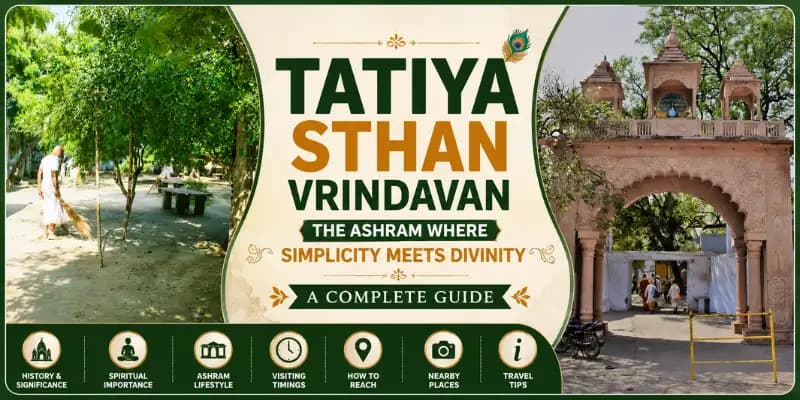
Tatiya Sthan Vrindavan: The Ashram Where Simplicity Meets Divinity, a Complete Guide
By Gurudutt, Experience My India·3 August 2026
Quick Answer
Quick Enquiry
Key facts at a glance
What it is | A famously austere ashram of bhajan in Vrindavan |
Famous for | Shunning electricity, lit by lamps after sunset |
The name | From tatiya, the bamboo fence that enclosed it |
Tradition | The Haridasi tradition of Swami Haridas |
The deity | Mohini Bihari |
Key festival | Radha Ashtami |
Tatiya Sthan: an overview
Amid the many grand and modern temples of Vrindavan, Tatiya Sthan stands apart as a place of profound and deliberate simplicity, a secluded ashram famous for shunning electricity and modern technology, lit only by lamps and candles after sunset and surrounded by ancient trees, where the old devotional way of life is lovingly preserved. It is a revered seat of intense bhajan, the singing and remembrance of the divine, in the Haridasi tradition of the great saint Swami Haridas and one of the most spiritually charged and atmospheric places in all Vrindavan.
Quieter and far less visited than the famous temples, Tatiya Sthan is cherished by those who seek the deeper, purer devotional heart of Vrindavan, its saints, its silence and its bhajan. This guide covers the ashram and its story, its rejection of technology, the Haridasi tradition it keeps, its deity Mohini Bihari and sacred relics, the festival of Radha Ashtami and how to reach and visit it with respect. It stands near the sacred grove of nidhivan, from which its tradition flows and the beloved banke bihari temple that Swami Haridas is revered to have revealed.
From the ground (Gurudutt): Tatiya Sthan is not a sightseeing temple but a living place of intense devotion and seclusion, so visit it gently and reverently, as a guest in a house of prayer: keep silence, dress simply, do not photograph the saints or the interior without leave and move quietly, so as not to disturb the bhajan and the sadhaks who have given their lives to it. Come to absorb its rare atmosphere of simplicity and devotion, not to tick off a sight. Approached this way, Tatiya Sthan gives a glimpse of the old, pure Vrindavan that few other places can. See our Mathura Vrindavan tour or message WhatsApp +91 7302265809.
The ashram at a glance
Here are the essentials of Tatiya Sthan in one place.
Detail | Information |
What it is | An austere ashram of bhajan in Vrindavan |
Famous for | Shunning electricity; lit by lamps after sunset |
The name | From tatiya, the bamboo fence that enclosed it |
Tradition | The Haridasi tradition of Swami Haridas |
The deity | Mohini Bihari |
Sacred relics | The slippers and utensils of Swami Haridas |
Key festival | Radha Ashtami |
Character | Secluded, natural, silent, deeply devotional |
In one line: Tatiya Sthan is the famously austere Vrindavan ashram that shuns electricity, a secluded seat of Haridasi bhajan lit by lamps and surrounded by trees, enshrining Mohini Bihari and the relics of Swami Haridas.
What is Tatiya Sthan?
Tatiya Sthan is an ashram, a place of bhajan and seclusion, in Vrindavan, revered as a seat of the Haridasi tradition of Swami Haridas, the great saint of Vrindavan. Its name comes from the tatiya, the bamboo fence or screen, that once enclosed it, for the place was originally a secluded spot, fenced with bamboo, where saints of the tradition withdrew for their bhajan, away from the world. So Tatiya Sthan means, in effect, the place of the bamboo enclosure, the secluded ashram.
By the tradition, it was the bhajan seat of the revered saint Lalit Kishori Ji and the saints in the line of Swami Haridas, who withdrew here, close to the Yamuna and away from the busier parts of Vrindavan, for their intense devotion. Over time it grew into the famous ashram it is today, still preserving the old, austere devotional way. So Tatiya Sthan is a living seat of the Haridasi saints, a place of bhajan and seclusion, cherished for its purity. We present its history and tradition as the sampradaya holds them, with respect.
The place without technology
What makes Tatiya Sthan famous and unlike almost any other place in Vrindavan, is its deliberate rejection of modern technology. The ashram has no electricity: you will find no bulbs, no fans, no modern devices and after sunset the place is lit only by lamps and candles, so that it falls into a natural darkness and lamplight as it would have centuries ago. This is no accident but a conscious choice, the saints preferring the natural and the godly over the artificial, keeping the old devotional way of life unbroken.
So Tatiya Sthan is a rare window into the Vrindavan of old, before electricity and modernity, a place where devotion is kept pure and simple, amid trees and lamplight and the sound of bhajan. It is also one of the greenest and most natural of Vrindavan's sacred places, surrounded by ancient trees, connecting devotees with nature as much as with the divine. To step into Tatiya Sthan is to step out of the modern world and into the timeless, simple heart of devotional Vrindavan. This simplicity is the very soul of the place.
Swami Haridas and the Haridasi tradition
Tatiya Sthan belongs to the Haridasi tradition, the sampradaya of the great saint Swami Haridas of Vrindavan, one of the towering figures of Braj devotion, revered as a saint of the highest order and, in the tradition, the guru who revealed the beloved deity of Banke Bihari at Nidhivan. Swami Haridas and his followers are cherished for their intense, secluded bhajan and their profound devotion to the divine couple, Shyama and Shyam, Radha and Krishna, worshipped in the sweet, loving mood of the tradition.
Swami Haridas did his bhajan in the seclusion of Nidhivan and his followers, in the same spirit, sought out secluded places for their own devotion; Tatiya Sthan grew as one such seat, where the saints of the line, including the revered Lalit Kishori Ji, withdrew for their bhajan. So Tatiya Sthan keeps alive the Haridasi tradition of pure, secluded, intense devotion and its saints are heirs to Swami Haridas. Our nidhivan guide covers the grove of Swami Haridas and the revelation of Banke Bihari. We present the Haridasi tradition as the sampradaya holds it, with respect.
The deity Mohini Bihari and the sacred relics
At the heart of Tatiya Sthan is the deity of Mohini Bihari, a captivating form of Krishna, worshipped by the saints of the ashram with deep devotion, whose darshan is the spiritual centre of a visit. Along with the deity, the ashram treasures the sacred relics of Swami Haridas, revered above all his slippers, or paduka and his utensils, cherished as the precious belongings of the great saint.
These sacred relics of Swami Haridas are brought out for the darshan of devotees especially at Radha Ashtami, drawing pilgrims who long to see the belongings of the beloved saint. So a visit to Tatiya Sthan brings darshan of Mohini Bihari and, at the festival, the relics of Swami Haridas, treasures of devotion rather than of grandeur. We present the significance of the deity and the relics as the tradition of the ashram holds them, cherished by the devotees of the Haridasi sampradaya.
Radha Ashtami and the festivals
The great festival of Tatiya Sthan is Radha Ashtami, the celebration of the birth of Radha, when the ashram, usually so secluded, opens to devotees from across the land who come for its special darshan and to see the sacred slippers and utensils of Swami Haridas, brought out for the occasion. It is the most fervent and beautiful time at Tatiya Sthan, when the austere ashram fills with devotion and pilgrims.
Through the year, the ashram keeps the round of the great festivals of Radha and Krishna, above all those dear to the Haridasi tradition, with its continuous bhajan and worship, though usually in seclusion and simplicity rather than public grandeur. So Radha Ashtami is the time to come for the fullest darshan of Tatiya Sthan and the relics of Swami Haridas, while other days offer the ashram's quieter, deeper devotion. Our braj festival calendar guide covers Radha Ashtami and the festivals of Braj and their dates.
The atmosphere and what to experience
The true experience of Tatiya Sthan is its atmosphere, unlike anywhere else in Vrindavan.
The bhajan: the continuous singing and remembrance of the divine by the saints, the soul of the ashram, a rare chance to hear the old Haridasi bhajan.
The simplicity: the absence of electricity and technology, the lamps and candles, the natural darkness after sunset, a glimpse of the old, pure Vrindavan.
The nature: the ancient trees and greenery that surround the ashram, connecting devotees with nature as well as the divine.
The saints and samadhis: the presence of the sadhaks who have given their lives to bhajan here and the samadhis, the resting places, of the great saints of the tradition.
So Tatiya Sthan is a place to be experienced in stillness and reverence, its bhajan, its lamplight, its trees and its saints, rather than merely seen. It offers something the grand temples cannot: a living glimpse of the timeless, simple, intensely devotional Vrindavan of old. For the pilgrim who comes quietly and with an open heart, it is one of the most moving and memorable of all the sacred places of the town. Come to feel it, not just to look.
Timings, darshan and etiquette
Tatiya Sthan is open to respectful visitors by day, with darshan of the deity and it follows the general rhythm of Vrindavan's places, quieter in the middle of the day; being lit only by lamps, it is best visited in the daylight hours. As a living ashram of seclusion and bhajan, rather than a public monument, it asks for particular respect. Darshan is free.
Keep silence and move quietly, so as not to disturb the bhajan and the saints at their devotion.
Dress simply and modestly and remove footwear as at all sacred places.
Do not photograph the saints or the interior without leave; photography is often not welcome in this place of seclusion, so ask and respect the answer.
Do not treat it as a tourist sight; come as a devotee or a respectful guest and follow the customs of the ashram.
So visit Tatiya Sthan with the reverence due to a living house of prayer, keeping silence, dressing simply, refraining from intrusive photography and honouring its customs. This respect is the price of the rare gift it offers, a glimpse of the pure, secluded devotion of old Vrindavan. Beware anyone pressing for large donations; keep any offering voluntary. Approached rightly, in a quiet and devotional spirit, Tatiya Sthan is deeply rewarding.
How to reach Tatiya Sthan
Tatiya Sthan is in the old town of Vrindavan, near Nidhivan and not far from the Yamuna, so reaching it means reaching the old-town core of Vrindavan.
Vrindavan is about 13 km from Mathura, 150 km from Delhi and 70 km from Agra; reach Vrindavan first, then the ashram within the old town.
Tatiya Sthan lies near Nidhivan, in the old-town area; reach the edge of the old town by auto or e-rickshaw, then walk the lanes.
The final approach is through the narrow old-town lanes on foot or by cycle-rickshaw, as in much of old Vrindavan.
The nearest major railway station is Mathura Junction and the nearest airports are Agra and Delhi.
Because it lies among the old-town lanes near Nidhivan, the final approach to Tatiya Sthan is best made on foot or by cycle-rickshaw and a local guide makes finding this quiet, secluded ashram easy in the maze of lanes. Our how to reach vrindavan guide covers arriving in Vrindavan and our how to commute in vrindavan guide getting around the old town. It stands near the great sites of old Vrindavan, so combine it with them and with the keshi ghat yamuna aarti on the river and the vrindavan parikrama route, for a fuller pilgrimage. We arrange respectful Vrindavan visits taking in Tatiya Sthan and the town's sacred places, with the transport, the routing and a knowledgeable local guide, so you experience the ashram rightly. A shared day tour starts from around ₹1,499 per person, with darshan free throughout and our one-day vrindavan tour package and two-day mathura vrindavan tour cover the twin cities. Our best time to visit vrindavan mathura guide helps you plan. Message me on WhatsApp at +91-7302265809 to arrange your visit.
Related guides
Meet Gurudutt — Your Mathura Vrindavan Guide
Not just a tour operator — Gurudutt was born and raised in Braj Bhoomi. He has spent over a decade personally guiding pilgrims through the sacred lanes of Mathura & Vrindavan.

Founder – Experience My India
Gurudutt
Founder · Experience My India