Travel Guide · Pilgrimage & Yatra · Updated November 2026
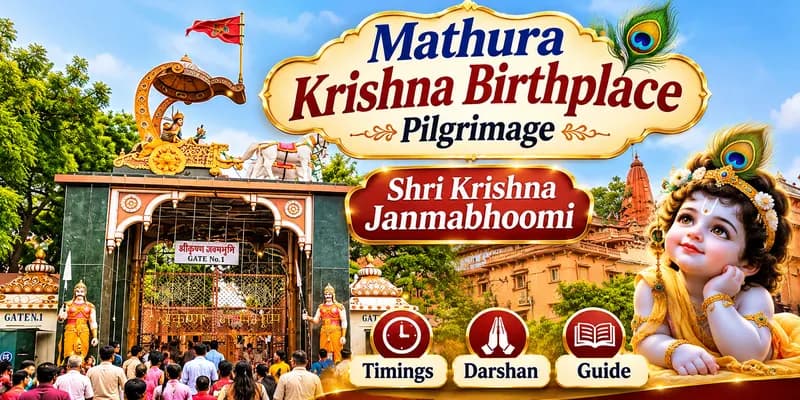
Mathura Krishna Birthplace Pilgrimage: Shri Krishna Janmabhoomi Timings, Darshan and Guide
By Gurudutt, Experience My India·17 November 2026
Quick Answer
Quick Enquiry
For a devotee, there is no more sacred spot in Mathura than the Janmabhoomi, this is where, by tradition, our Krishna was born, in Kamsa’s prison, at midnight, over 5,000 years ago. Standing in the Garbha Griha, the small, dim sanctum that marks the prison cell, is deeply moving. A few practical things I always tell my guests: the darshan is free, but phones, cameras and bags are strictly not allowed inside, so leave them in the cloakroom and carry only your ID. Come early on a weekday for a peaceful darshan and the shortest queue; on Janmashtami it is overwhelming. And do the full Mathura circuit, pair the Janmabhoomi with Dwarkadhish and the Vishram Ghat aarti. We arrange it all. Jai Shri Krishna and Radhe Radhe. See our Mathura Vrindavan tour Packages or message WhatsApp +91 7302265809.
The Shri Krishna Janmabhoomi: Krishna’s birthplace
The Shri Krishna Janmabhoomi, also called the Shri Krishna Janmasthan, is the temple complex in Mathura built over the site revered as the exact birthplace of Lord Krishna. By tradition, it was here, in the underground prison cell where King Kamsa had imprisoned Krishna’s parents Devaki and Vasudeva, that Lord Krishna, the eighth avatar of Vishnu, was born at midnight, over 5,000 years ago, to end Kamsa’s tyranny. These are cherished scriptural and devotional traditions.
Location: Janmabhoomi Marg, in the heart of Mathura city, Uttar Pradesh (281001), on the west bank of the Yamuna, in the ancient Katra Keshavdev area.
Entry: free (with a nominal charge for the cloakroom); see the rules below.
Why it matters: as the birthplace of Krishna, it is the spiritual heart of Braj Bhoomi and a central destination for millions of pilgrims, especially during Krishna Janmashtami.
For a pilgrim, standing at the Garbha Griha, the sanctum that marks the prison cell, is one of the most profound moments of a Braj pilgrimage. The rest of this guide covers the timings, aartis, shrines, history, rules and the wider Mathura circuit.
Darshan timings and daily aartis
The temple operates in two daily sessions, with an afternoon closure for the deity’s rest (bhog and shayan). Entry to the main complex is free. Timings shift between summer and winter, so treat these as general and confirm on the official Shri Krishna Janmasthan portal.
Schedule | Summer (about March to October) | Winter (about November to February) |
Morning darshan | 5:00 AM to 12:00 PM | 5:30 AM to 12:00 PM |
Afternoon closure | 12:00 PM to 4:00 PM | 12:00 PM to 3:00 PM (reopens about 3:30 PM) |
Evening darshan | 4:00 PM to 9:30 PM | 3:30 PM to 8:30 PM |
The key daily aartis. Worship begins early with the Mangala Aarti (around 5:00 to 5:30 AM), followed by the Shringar Aarti (about 7:30 to 8:00 AM) and the Rajbhog Aarti (about 11:30 AM to 12:00 PM). Evening rituals include the Sandhya Aarti (about 6:00 to 7:00 PM) and the Shayan Aarti before closing. For the great aartis of Braj, see our must-attend aarti guide.
Festival extensions. During Krishna Janmashtami and Holi, the temple hours extend past midnight to accommodate the massive crowds, Janmashtami above all, when the midnight birth celebration is the spiritual peak. Always verify the exact seasonal and festival schedule on the official Shri Krishna Janmasthan portal, as timings change.
Entry rules and what is prohibited
Security at the Janmabhoomi is strict, so knowing the rules in advance saves time and trouble.
Prohibited inside: mobile phones, cameras, smartwatches, large bags, leather items (belts, wallets) and pens are strictly banned inside the complex. These must be stored in the paid cloakrooms outside the security gates before you enter.
Carry a valid photo ID. You will need it at security.
Carry minimal items. Since phones and bags are not allowed in, carry as little as possible, ideally just your ID and some cash for the cloakroom and offerings.
Dress modestly. Wear modest attire covering the shoulders and knees, as at all the temples.
Entry is free. There is no entry or darshan fee, only the nominal cloakroom charge.
The phone and camera ban means you cannot photograph inside, so simply absorb the darshan. Plan for a short wait at the cloakroom and security, especially at busy times and arrive early on a weekday for the smoothest experience.
SECTION E · Key shrines in the complex
The Janmabhoomi is a large complex with several important shrines.
The Garbha Griha. The small, dimly lit underground sanctum that marks the exact prison cell where, by tradition, Krishna was born. It is the holiest spot in the complex and standing here is the heart of the pilgrimage.
The Keshavdev temple. The shrine honouring Krishna as Keshavdeva, preserving the ancient name of the temple site (the historic temple here was long known as the Keshavdeva temple).
The Bhagavata Bhavan. The towering main structure, completed in 1982, housing several shrines, including the main idols of Radha-Krishna, alongside deities such as Jagannath, Rama, Shiva and Durga. Its interior walls and ceilings depict scenes from the Srimad Bhagavatam.
The Potra Kund. A sacred stepped water tank just outside the complex, believed, by tradition, to be where the infant Krishna’s clothes were washed after his birth.
Together these make the Janmabhoomi not just a single shrine but a whole sacred complex, with the Garbha Griha at its devotional centre. For the wider Mathura temple circuit, see our places to visit in mathura guide.
The history of the Janmabhoomi
The site has a long and eventful history across the millennia, recounted here from tradition and historical accounts. These are cherished devotional and historical traditions and historians and sources differ on some details.
Ancient origins. By Hindu tradition, the first temple at the birthplace was built by Vajranabh, Krishna’s great-grandson, in ancient times. Archaeological excavations at Katra Keshavdev have uncovered settlement and structures dating back many centuries, with artefacts associated with periods from around the 6th century BCE onward.
The Gupta era. By historical accounts, around 400 CE, during the Gupta period (associated with Emperor Chandragupta II, Vikramaditya), a grand temple complex stood at the site.
Medieval cycles of destruction and rebuilding. Historical accounts hold that the temple here (long known as the Keshavdeva temple) was destroyed and rebuilt several times over the centuries, with raids in the early 11th century (Mahmud of Ghazni, around 1017 CE) followed by reconstruction (around 1150 CE), a later demolition in the early 16th century (Sikandar Lodi) and a magnificent rebuilding by Raja Vir Singh Bundela during the reign of Jahangir.
The Mughal era. By historical accounts, in 1669 to 1670 CE, under Emperor Aurangzeb, the Keshavdeva temple was demolished and the Shahi Eidgah was built adjacent to the site, which stands there to this day.
The modern complex. After the land changed hands in the colonial era, the Shri Krishna Janmabhoomi Trust was established in 1951 (associated with Pandit Madan Mohan Malaviya and the industrialist Jugal Kishore Birla) and the present-day temple complex was built between 1953 and 1982, with the support of industrialist families.
So the Janmabhoomi you visit today is a modern complex (1953 to 1982) standing on an ancient, repeatedly rebuilt sacred site, a testament to the enduring devotion to Krishna’s birthplace across the ages. (This guide covers the site’s history and devotional significance; for any current legal or administrative matters concerning the site, please refer to official and authoritative news sources.)
The significance of the birthplace
The Janmabhoomi’s significance flows from the story of Krishna’s birth. By tradition, King Kamsa of Mathura, warned by a prophecy that the eighth child of his sister Devaki would be his downfall, imprisoned Devaki and her husband Vasudeva and killed their first children. At midnight on the eighth lunar day (Ashtami), in that prison cell, Lord Krishna, the eighth avatar of Vishnu, was born, to end Kamsa’s tyranny and restore dharma. The Garbha Griha marks that very cell.
This is why Mathura is revered as Krishna’s Janmabhoomi (birthplace), and, together with Gokul (where the infant Krishna was carried and raised; see our gokulnath guide) and Vrindavan (the land of his childhood pastimes; see our places to visit in vrindavan guide), forms the heart of the sacred Braj Bhoomi. For devotees, to stand at the spot of the Lord’s birth and especially to be there on Krishna Janmashtami, is among the most profound experiences of a Hindu pilgrimage. These are cherished devotional beliefs.
The Mathura pilgrimage circuit
A visit to the Janmabhoomi is traditionally part of a wider Mathura circuit and pilgrims pair it with two other key sites in particular.
The Dwarkadhish temple. The historic temple (built in 1814 in the Rajasthani haveli style) in the old city, worshipping Krishna as the King of Dwarka, known for its architecture and swing festivals; see our dwarkadhish guide.
Vishram Ghat. The central and most sacred Yamuna ghat, where, by tradition, Krishna rested after defeating Kamsa and where the priests perform the grand evening Yamuna Aarti; see our vishram ghat guide and for the sacred riverfront, our braj yamuna ghats guide.
Beyond Mathura, a Braj pilgrimage naturally extends to Vrindavan, Krishna’s childhood home, with its great temples, banke bihari, prem mandir, the iskcon vrindavan temple, radha raman and nidhivan and to Gokul, Govardhan and Barsana. October to March is the most comfortable season (see our best time to visit guide) and early weekday mornings give the shortest queues and the most peaceful darshan.
How to reach and plan your visit
The Janmabhoomi is in the heart of Mathura city, at Janmabhoomi Marg in the Katra Keshavdev area. By rail, Mathura Junction (MTJ) is the nearest major railhead, with e-rickshaws and autos readily available outside for the short ride to the temple gates. By air, the nearest airports are Agra and Delhi (Indira Gandhi International), both connected to Mathura by taxi and bus via the Yamuna Expressway; see our delhi to vrindavan and how to reach vrindavan guides and for moving within Braj, our mathura to vrindavan distance guide.
For planning: come in the cool October-to-March season, arrive early on a weekday for the shortest queue, remember the strict no-phones-or-bags rule (use the cloakroom and carry only your ID) and pair the Janmabhoomi with Dwarkadhish and the Vishram Ghat aarti for the full Mathura circuit. For where to base yourself, see our where to stay in vrindavan guide and a ready-made mathura vrindavan tour plan helps you fit it all in. Confirm the current timings and rules on the official Shri Krishna Janmasthan portal before you go.
Let a Brajwasi plan your visit
A pilgrimage to Krishna’s birthplace is the heart of any Braj journey and with a Brajwasi beside you it is smooth, well-timed and deeply meaningful. As locals running Experience My India, we can plan your Mathura Krishna birthplace pilgrimage: time your Janmabhoomi darshan for the calmest hours (and guide you through the strict security and cloakroom), take you on the full Mathura circuit (the Janmabhoomi, Dwarkadhish and the Vishram Ghat Yamuna aarti) and extend it into a complete Braj pilgrimage, Vrindavan, Gokul, Govardhan and Barsana, the land of Krishna’s birth, childhood and pastimes. We handle the transport, the stay and the timing, so you can simply immerse yourself in the darshan and for Janmashtami especially, we get devotees to the heart of the midnight celebration safely. A shared Mathura and Vrindavan darshan starts from around 1,499 rupees per person; see our mathura vrindavan tour or our gokul tour to add Gokul. Message us on WhatsApp at +91-7302265809 and we will plan your pilgrimage to Krishna’s birthplace. Jai Shri Krishna and Radhe Radhe.
Related guides
Book Your Mathura - Vrindavan Trip Today
📞 +91-7302265809
💬 WhatsApp: +91-7302265809
We Reply in 30 Minutes
Packages start from ₹1,999/ person | Rated 4.5★ / 204+ Reviews
Explore all: Mathura Vrindavan Tour Packages
Jai Shri Krishna
Start with these
Meet Gurudutt — Your Mathura Vrindavan Guide
Not just a tour operator — Gurudutt was born and raised in Braj Bhoomi. He has spent over a decade personally guiding pilgrims through the sacred lanes of Mathura & Vrindavan.
Founder – Experience My India
Gurudutt
Founder · Experience My India