Travel Guide · Festivals & Events · Updated June 2026
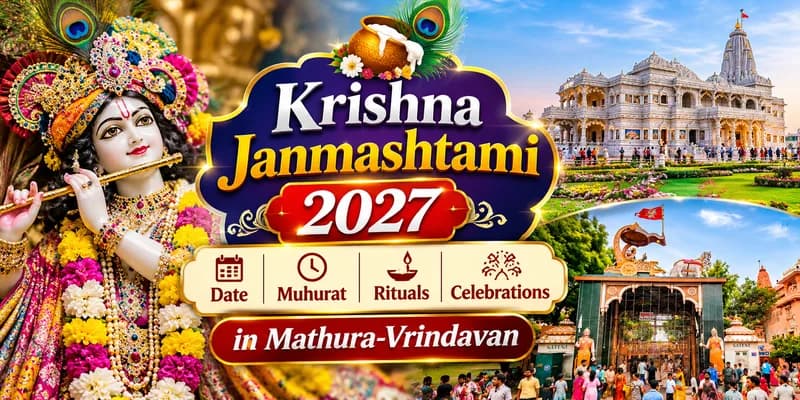
Krishna Janmashtami 2027: Date, Muhurat, Rituals and Celebrations in Mathura-Vrindavan
By Gurudutt, Experience My India·1 June 2026
Quick Answer
Quick Enquiry
Janmashtami in Mathura and Vrindavan is the greatest night of our year, this is the very city where Krishna was born, in the prison of Kamsa, at midnight. On Janmashtami night, the Shri Krishna Janmabhoomi and the temples fill with lakhs of devotees for the midnight abhishek, the moment of the Lord’s birth, with conches, bells and an ocean of joy. In 2027 it falls on 25 August, with the birth moment just after midnight. If you want to witness Janmashtami where it actually happened, come to Braj, but come prepared for immense crowds and plan the midnight darshan carefully. We arrange it all for our guests, the timing, the transport, the darshan. There is nothing like Janmashtami in the land of Krishna. Jai Shri Krishna and Radhe Radhe. See our Mathura Vrindavan tour Packages or message WhatsApp +91 7302265809.
What is Krishna Janmashtami?
Krishna Janmashtami (also called Janmashtami, Gokulashtami or Krishna Jayanti) is the festival celebrating the birth of Lord Krishna, the eighth avatar of Lord Vishnu. It is one of the most important and widely celebrated festivals in the Hindu calendar, observed on the Ashtami (eighth day) of the dark fortnight (Krishna Paksha) of the month of Bhadrapada, under the Rohini Nakshatra, the conditions under which, by tradition, Krishna was born at midnight in Mathura. These are cherished scriptural and devotional traditions.
In 2027, the festival marks the 5254th birth anniversary of Lord Krishna. It is a night of fasting, devotion and joy, culminating at midnight, the moment of the Lord’s birth, with abhishek (ceremonial bathing) of the infant Krishna, aarti and celebration. It is celebrated in homes and temples across India and the world, but nowhere more grandly than in Krishna’s own birthplace, Mathura and his childhood home, Vrindavan. The rest of this guide covers the 2027 date and muhurat, the rituals, the story and the celebrations in Braj.
Krishna Janmashtami 2027 date, timings and muhurat
Krishna Janmashtami 2027 falls on Wednesday, 25 August 2027. Here are the key astrological windows and puja timings for New Delhi (per Drik Panchang). Timings follow the Hindu calendar and vary by city, so treat these as the expected panchang timings for New Delhi and confirm for your own location.
Event / Muhurat | Date and time (IST) | Details |
Ashtami Tithi | 24 Aug (8:24 PM) to 25 Aug (7:19 PM) | The eighth day of the dark fortnight (Krishna Paksha) of Bhadrapada |
Rohini Nakshatra | 25 Aug (12:27 PM) to 26 Aug (11:42 AM) | The auspicious birth star under which Krishna was born |
Nishita Puja Muhurat | 26 Aug, 12:01 AM to 12:45 AM | The primary 44-minute midnight window for the birth rituals and aarti |
Mid-night moment | 26 Aug, about 12:23 AM | The moment marking the divine birth |
Parana (breaking the fast) | after 26 Aug, 12:45 AM (or 11:42 AM) | Broken after the midnight puja by custom or after Rohini ends per strict scriptural rules |
Dahi Handi / Nandotsav | Thursday, 26 August 2027 | Celebrated the day after Janmashtami |
A notable feature of 2027 is that both the Smarta (household) and Vaishnava (ISKCON) traditions observe Janmashtami on the same day, 25 August, which does not always happen. The heart of the festival is the midnight Nishita puja (around 12:01 to 12:45 AM on 26 August), when the birth of Krishna is celebrated. If you are observing the vrat (fast), note the parana (fast-breaking) rules above, after the midnight puja by custom or after the Rohini nakshatra ends per strict rules and follow your tradition.
A note on the date: Smarta, Vaishnava and solar-calendar regions
Janmashtami’s date can vary slightly by tradition and region, so it helps to know the picture for 2027.
Smarta and Vaishnava on the same day. Usually the Smarta (household) and Vaishnava (ISKCON and many temples) traditions can observe Janmashtami on consecutive days, as they follow slightly different rules. In 2027, unusually, both fall on the same day, 25 August, so there is no two-day split for most of India.
Solar-calendar regions. Regions following solar calendars, such as Kerala, Tamil Nadu and coastal Karnataka, observe the festival as Ashtami Rohini and in 2027 this falls on Tuesday, 24 August. So if you are in or from these regions, your date may be 24 August.
For most of India, including Mathura and Vrindavan, the festival is on 25 August 2027, with the midnight birth celebration into the small hours of 26 August. As always, confirm the date and timings for your specific tradition and city with the panchang.
SECTION E · Where Krishna Janmashtami is celebrated
Janmashtami is celebrated in homes and temples worldwide, but several places in India host iconic observances, foremost among them Krishna’s own Braj.
Mathura and Vrindavan (the birthplace and childhood home). This is the heart of Janmashtami. The shri krishna janmabhoomi temple in Mathura, built over the very prison cell where Krishna was born and the banke bihari temple in Vrindavan host grand midnight abhisheks, Jhulanotsav (swing festivals) and Raslila performances. Other great temples, such as radha raman, prem mandir, nidhivan and the Mathura dwarkadhish and the iskcon vrindavan temple, also hold magnificent celebrations. For the full circuits, see our places to visit in mathura and places to visit in vrindavan guides.
Dwarka and Dakor (Gujarat). The Dwarkadhish temple at Dwarka draws huge crowds for the Mangala Aarti, fairs and devotional singing.
Mumbai and Pune (Maharashtra). Famous for the exuberant Dahi Handi competitions on the day after (26 August 2027), where teams of Govindas form human pyramids to break pots of curd hung high above the streets.
Guruvayur (Kerala) and Udupi (Karnataka). Known for elaborate temple rituals, floral decorations and the tradition of drawing tiny rice-flour footprints of the infant Krishna leading into the home.
ISKCON temples worldwide. Major centres in Delhi, Bengaluru, Mayapur and across the globe hold day-long kirtans, Bhagavad Gita recitations and grand midnight maha-abhisheks.
Of all these, Mathura and Vrindavan, where the birth actually took place, offer the most profound and atmospheric Janmashtami of all.
The story and mythological origin
The story of Krishna’s birth is one of the most beloved in the Hindu tradition and knowing it deepens the festival. By the Bhagavata Purana and the Mahabharata, Krishna was born over 5,200 years ago as the eighth avatar of Lord Vishnu, to end the tyranny of the demon-king Kamsa. These are cherished scriptural and devotional traditions.
The prophecy and the imprisonment. A celestial prophecy warned King Kamsa of Mathura that the eighth child of his sister Devaki and her husband Vasudeva would be his downfall. Kamsa imprisoned the couple and killed their first six children.
The midnight birth. At midnight on the eighth lunar day (Ashtami), Krishna was born in the prison cell. By tradition, divine intervention caused the prison guards to fall into a deep sleep and the chains and locks to open of their own accord.
The crossing of the Yamuna. Vasudeva placed the newborn in a basket and carried him across the raging, storm-swollen Yamuna, which, by tradition, parted or calmed to let him pass. He reached Gokul, where he exchanged Krishna with the newborn daughter of the cowherd chief Nanda and his wife Yashoda, who then raised Krishna safely in the cowherd land of Braj. See our braj yamuna ghats guide for the sacred river and our gokulnath guide for Gokul, where the infant Krishna was raised.
This is why Mathura (the birthplace), Gokul (where he was raised) and Vrindavan (the land of his childhood pastimes) are so sacred and why Janmashtami in Braj is a remembrance of events that, by tradition, happened on this very ground.
Spiritual significance and the rituals
Janmashtami carries deep meaning and a rich set of devotional practices.
The significance. Janmashtami symbolises the triumph of dharma (righteousness) and hope over tyranny and evil, Krishna’s birth to end Kamsa’s reign. In spiritual philosophy, the story is also read inwardly: Kamsa as the ego, Devaki as the body, Vasudeva as the vital life force (prana) and the birth of Krishna as the awakening of pure divine joy (Anand-tattva) within the heart when the outward sensory distractions are stilled, a beautiful inner reading of the festival. These are cherished devotional traditions.
The rituals. Devotees traditionally:
Observe a day-long fast (vrat), often broken only after the midnight birth puja (see the parana rules above).
Perform the midnight abhishek. At midnight, the hour of the birth, idols of the infant Krishna (Laddu Gopal) are bathed in panchamrit (milk, curd, ghee, honey and sugar), then in water, dressed in beautiful new garments and ornaments and worshipped.
Rock the Lord in a cradle (jhula). The infant Krishna is placed in a decorated cradle and lovingly rocked and devotees sing to welcome him.
Offer bhog. Traditional offerings include makhan-mishri (white butter and rock sugar, Krishna’s beloved treat) and dhaniya panjiri (a coriander-seed sweet), among many others. For the food of Braj, see our famous food guide.
Sing, chant and celebrate through the night with kirtan, bhajan and the Lord’s name and attend the grand temple aartis; see our must-attend aarti guide.
The next day brings Nandotsav (the celebration of Nanda Maharaj’s joy at Krishna’s arrival in Gokul) and the Dahi Handi festivities.
Experiencing Janmashtami in Mathura and Vrindavan
To experience Janmashtami in Braj is to be where it all happened. On the night of 25 August 2027, the Shri Krishna Janmabhoomi in Mathura, built over Krishna’s traditional prison-cell birthplace, holds a grand midnight celebration, with the abhishek of the infant Krishna at the birth moment (around 12:23 AM), amid lakhs of devotees, conches, bells and overwhelming joy. The temples of Vrindavan, Banke Bihari foremost, celebrate magnificently through the night and Gokul and Nandgaon mark Nandotsav with special fervour the next day.
A few practical notes for a Braj Janmashtami: the crowds are immense, among the largest of the year, so plan the midnight darshan carefully, arrive early, keep your group together and be prepared for long waits and tight crowd controls. Book your stay months in advance (see our where to stay in vrindavan guide), as Janmashtami is peak season. The weather in late August is warm and can be humid or rainy (it is monsoon), so pack accordingly. For reaching Braj, see our how to reach vrindavan and delhi to vrindavan guides. Witnessing the midnight birth celebration at the Janmabhoomi, in the city where Krishna was born, is a once-in-a-lifetime experience for a devotee.
Planning your Janmashtami trip to Braj
To plan a Janmashtami trip to Mathura and Vrindavan for 2027: book your stay months ahead (it is the peak of peak season), plan to be at the Janmabhoomi or your chosen temple for the midnight celebration and arrange transport that accounts for the heavy crowds and road restrictions. A ready-made mathura vrindavan tour plan helps you structure the days and you can add Gokul (where Krishna was raised) and Govardhan; see our gokul tour for the Gokul leg and our mathura to vrindavan distance guide for moving between the towns.
Because the Janmashtami crowds in Braj are among the largest and the midnight darshan is the most time-sensitive moment of the year, a trusted local host makes an enormous difference, timing your darshan, handling the transport and crowd navigation and getting you to the birth celebration safely. Plan early and 2027’s Janmashtami in Krishna’s own land will be unforgettable.
Let a Brajwasi plan your visit
Janmashtami in Mathura and Vrindavan is the most profound night of the Braj year, the celebration of Krishna’s birth in the very city where it happened and with a Brajwasi beside you it is also smooth and safe amid the enormous crowds. As locals running Experience My India, we can plan your whole Janmashtami 2027 trip: secure your stay months ahead, time your midnight darshan at the Shri Krishna Janmabhoomi and Banke Bihari (and the abhishek at the birth moment), arrange your transport and crowd navigation and take you to Gokul and Nandgaon for Nandotsav the next day. We know how to get devotees to the heart of the celebration safely and can build it into a complete Braj pilgrimage, Mathura, Vrindavan, Gokul and Govardhan. A shared Mathura and Vrindavan darshan starts from around 1,499 rupees per person; see our mathura vrindavan tour. Message us on WhatsApp at +91-7302265809, well ahead of August 2027 and we will plan your Janmashtami in Krishna’s land. Jai Shri Krishna and Radhe Radhe.
Related guides
Book Your Mathura - Vrindavan Trip Today
📞 +91-7302265809
💬 WhatsApp: +91-7302265809
We Reply in 30 Minutes
Packages start from ₹1,999/ person | Rated 4.5★ / 204+ Reviews
Explore all: Mathura Vrindavan Tour Packages
Jai Shri Krishna
Meet Gurudutt — Your Mathura Vrindavan Guide
Not just a tour operator — Gurudutt was born and raised in Braj Bhoomi. He has spent over a decade personally guiding pilgrims through the sacred lanes of Mathura & Vrindavan.
Founder – Experience My India
Gurudutt
Founder · Experience My India