Travel Guide · Temple Guides · Updated August 2026
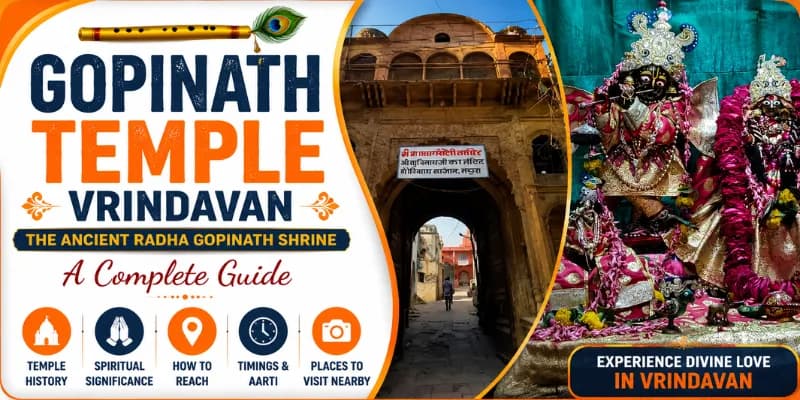
Gopinath Temple, Vrindavan: The Ancient Radha Gopinath Shrine, a Complete Guide
By Gurudutt, Experience My India·6 August 2026
Quick Answer
Quick Enquiry
Key facts at a glance
What it is | One of the seven ancient Goswami temples of Vrindavan |
Deity | Gopinath, Krishna the flute-player, with Radha |
By tradition | Worshipped by Vajranabha, rediscovered at Vamshivat |
Built | In 1632 by Rai Singh of Bikaner; rebuilt 1812 |
Original deity | Now worshipped at Jaipur |
Entry | Free |
Gopinath Temple: an overview
The Gopinath Temple or Radha Gopinath Temple, is one of the most ancient and revered temples of Vrindavan, a profound and beautiful shrine of the deep, historic devotion of the town. It is counted among the seven principal temples of the Goswamis, the Sapta Devalaya, the temples of the Thakurs of Vrindavan established by the great disciples of Chaitanya Mahaprabhu in the sixteenth century. Its deity is Gopinath, a name of Krishna meaning the lord of the gopis, worshipped here as the enchanting flute-player with Radha at his side.
Quieter and more historic than the great crowded modern temples, the Gopinath Temple is cherished by devotees of the Gaudiya tradition and by all who seek the profound old heart of Vrindavan. This guide covers the temple and its deity, the ancient rediscovery of the deity, the history of the temple, its place among the seven Goswami temples, its timings and entry and how to reach and visit it. It stands in the old town of Vrindavan, near the Yamuna and Vamshivat; see our radha raman temple and radha damodar temple guides for its sister Goswami temples nearby.
From the ground (Gurudutt): The Gopinath Temple rewards the pilgrim who comes knowing its depth: this is one of the seven original temples of the Goswamis, holding a deity revered, by the tradition, since the days of Krishna's great-grandson and its worship carries centuries of Gaudiya devotion. Come in a reverent, unhurried spirit, take darshan of Gopinath and Radha and picture the history and the leelas the place holds. It keeps the morning-and-evening rhythm of Vrindavan, closing in the midday and entry is free. Combine it with the other ancient Goswami temples and the Keshi Ghat nearby for a deep, historic Vrindavan pilgrimage. See our Mathura Vrindavan tour or message WhatsApp +91 7302265809.
The temple at a glance
Here are the essentials of the Gopinath Temple in one place.
Detail | Information |
What it is | One of the seven ancient Goswami temples of Vrindavan |
Deity | Gopinath, Krishna the flute-player, with Radha |
By tradition | Worshipped by Vajranabha; rediscovered at Vamshivat |
Built | In 1632 by Rai Singh of Bikaner |
Rebuilt | In 1812, after damage in the Mughal period |
Original deity | Now worshipped at Jaipur |
Timings | Morning from 5:00 am; evening 6:00 pm to 9:00 pm |
Entry | Free |
In one line: The Gopinath Temple is one of the seven ancient Goswami temples of Vrindavan, of Krishna as the flute-player with Radha, its deity revered since the days of Vajranabha, with free entry.
What is the Gopinath Temple?
The Gopinath Temple, also called the Radha Gopinath Temple or simply Gopinath Ji, is one of the most ancient and popular temples of Vrindavan, dedicated to Krishna in his form as Gopinath, the lord of the gopis, the enchanting flute-player. By the tradition, the worshipped deity is Murlidhar, Krishna playing the flute, standing with Radha at his right and Ananga Manjari at his left and the sakhis Lalita and Vishakha beside them, a beautiful composition of the divine and the loving companions of the leelas.
So the Gopinath Temple is a shrine of Krishna as the flute-player and of Radha, one of the seven great Goswami temples that form the deep, historic heart of Vrindavan's devotion. Its atmosphere is serene and profound, quieter than the famous modern temples and it is deeply cherished by devotees of the Gaudiya tradition and by the local people, who hold its deity dear. We present the deity and the worship with the reverence of the tradition. So the Gopinath Temple is one of the profound, ancient temples of Vrindavan, a treasure of its devotional heritage.
The deity and its rediscovery
The deity of Gopinath is revered as of great antiquity. By the tradition, it was worshipped in ancient times by Vajranabha, the great-grandson of Krishna, who, it is held, established many of the sacred images and sites of Braj to preserve the memory of his ancestor's leelas. Over the ages the deity was lost to view, and, by the tradition, it was rediscovered by the saint Paramananda Bhattacharya at Vamshivat, the sacred tamarind grove by the Yamuna in Vrindavan and its worship revived.
So the deity of Gopinath carries, in the tradition, a lineage of worship reaching back to the very kin of Krishna, rediscovered and re-established in the sixteenth-century revival of Vrindavan by the Goswamis and their associates. This ancient rediscovery is a large part of the deity's sanctity and fame. We present the worship by Vajranabha and the rediscovery at Vamshivat as the cherished belief and tradition of Braj and the Gaudiya sampradaya, held with faith, recounted with reverence rather than as documented historical fact. So the deity of Gopinath is revered as an ancient and sacred image of Krishna the flute-player.
The history of the temple
The history of the Gopinath Temple mirrors the ups and downs of Vrindavan and of the age. The original temple, by the record, was built in 1632 by Rai Singh of Bikaner, a prince of the royal house of Bikaner, a fine temple of its time. Like several of the great temples of Vrindavan, it suffered damage during the reign of the Mughal emperor Aurangzeb, a troubled period for the temples of Braj.
To protect the sacred deity from the troubles of the time, the original image of Gopinath was carried away to Jaipur, in Rajasthan, where it is worshipped to this day, as were the deities of several other great Vrindavan temples; and a pratibhu, a representative deity, was installed and worshipped in Vrindavan. In 1812, the temple was rebuilt with great devotion and it stands and serves to this day. So the Gopinath Temple has witnessed the whole saga of Vrindavan's history, its damage and its restoration. We present this history as the record and tradition of the temple hold it, neither sensationalized nor adjudicated, honouring the devotion that preserved the deity and rebuilt the shrine through hard times.
One of the seven Goswami temples
The Gopinath Temple is counted among the seven principal temples of the Goswamis of Vrindavan, the Sapta Devalaya, the temples of the Thakurs established by the great disciples of Chaitanya Mahaprabhu in the sixteenth-century revival of the sacred town. These are the deep, historic heart of Gaudiya Vrindavan and Gopinath stands among them with Govind Dev, Madan Mohan, Radha Raman, Radha Damodar, Radha Shyamsundar and Radha Gokulananda.
By the tradition, the worship of Gopinath in Vrindavan is associated with the Goswami Madhu Pandit and the Gaudiya line and the consort deities of Radha and the sakhis were added by later devotees, giving the shrine its beautiful composition. So the Gopinath Temple is one of the seven great Goswami temples, a profound centre of Gaudiya devotion. So a visit to Gopinath is a visit to the historic soul of Vrindavan, best combined with its sister temples like the radha raman temple and Govind Dev. We present the temple's place among the seven and its Gaudiya heritage as the tradition holds them, with reverence.
Timings, aarti and entry
The Gopinath Temple is open daily in the morning and the evening, closing through the middle of the day as is the custom of Vrindavan's temples. Here are the timings, which shift a little between summer and winter.
Session or aarti | Timing |
Morning darshan (summer) | 5:00 am to 12:15 pm |
Morning darshan (winter) | 5:30 am to 12:15 pm |
Evening darshan | 6:00 pm to 9:00 pm |
Mangala Aarti | 5:00 am (summer), 5:30 am (winter) |
Sandhya Aarti | 6:00 pm (summer), 6:30 pm (winter) |
Shayan Aarti | 8:30 pm (temple closes by 9:00 pm) |
Entry fee | Free |
So plan your visit for the morning, from about 5:00 am to 12:15 pm or the evening, from 6:00 pm to 9:00 pm and catch the Mangala Aarti at dawn, the Sandhya Aarti in the early evening or the Shayan Aarti before the temple closes for the fuller devotional experience. The exact times shift a little between summer and winter, as shown. Entry is free. So come within these hours, ideally for an aarti, to experience the Gopinath Temple at its most devotional. Do confirm the current timings locally, as they can change with the season and the temple's schedule.
Darshan, significance and etiquette
Darshan at the Gopinath Temple is of the beautiful deity of Gopinath, Krishna the flute-player, with Radha and the sakhis, in a serene and profound atmosphere, quieter than the great crowded shrines. By the tradition, the deity of Gopinath is held to be miraculous and wish-fulfilling and devotees come with deep faith to seek its blessing; in the tradition, a visit to Gopinath is cherished as a means of drawing near to Krishna and the devotion of Vrindavan. We present these beliefs as the cherished tradition of Braj, held with faith.
A few tips for the visit: dress modestly, covering shoulders and knees; remove your footwear before entering, using the stands; keep silence or a soft voice and move reverently; do not photograph the deity where it is not permitted; keep any offering voluntary, being wary of donation pressure; and guard your belongings and glasses from the monkeys, as at any Vrindavan temple. So visit with reverence and a little care. Our how to commute in vrindavan guide covers getting around the old town. So the Gopinath Temple rewards an unhurried, devotional visit to one of the ancient treasures of Vrindavan.
How to reach the Gopinath Temple
The Gopinath Temple stands in the old town of Vrindavan, near the Yamuna and the sacred Vamshivat, in the area of the ancient Goswami temples, so reaching it means reaching Vrindavan and then the old-town temple quarter.
Vrindavan is about 13 km from Mathura, 150 km from Delhi and 55 to 60 km from Agra; reach Vrindavan first, then the temple.
Within Vrindavan, the temple is in the old town near the Yamuna and the other Goswami temples, reached by cycle-rickshaw, e-rickshaw and on foot in the lanes.
It is easily combined with the other ancient temples, Radha Raman, Radha Damodar and Madan Mohan and the Keshi Ghat.
The nearest major railway station is Mathura Junction and the nearest airports are Agra and Delhi.
So reach Vrindavan by road from Delhi, Agra or Mathura or by train to Mathura Junction, then the Gopinath Temple in the old-town temple quarter by rickshaw and on foot. Our how to reach vrindavan guide covers arriving in full. The temple stands near the great sites of old Vrindavan, so combine it with the banke bihari temple the grove of nidhivan and the keshi ghat yamuna aarti for a fuller visit. Our best time to visit vrindavan mathura guide helps you plan the season. We arrange Vrindavan temple tours taking in the Gopinath Temple and the town's ancient and beloved temples, with the transport, the routing through the old-town lanes, the timing around the closures and a knowledgeable local guide to bring the deities, the Goswamis and their history alive. A shared day tour starts from around ₹1,499 per person, with darshan free throughout and our one-day vrindavan tour package and two-day mathura vrindavan tour cover the town and the twin cities. Message me on WhatsApp at +91-7302265809 to plan your visit.
Related guides
Meet Gurudutt — Your Mathura Vrindavan Guide
Not just a tour operator — Gurudutt was born and raised in Braj Bhoomi. He has spent over a decade personally guiding pilgrims through the sacred lanes of Mathura & Vrindavan.

Founder – Experience My India
Gurudutt
Founder · Experience My India