Travel Guide · Temple Guides · Updated August 2026
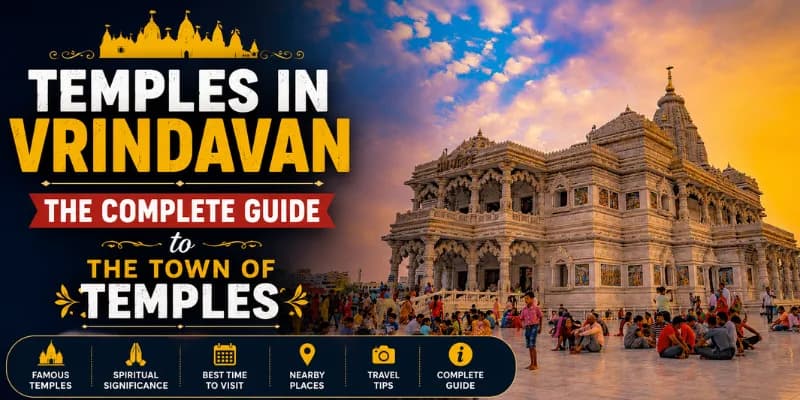
Temples in Vrindavan: The Complete Guide to the Town of Temples
By Gurudutt, Experience My India·4 August 2026
Quick Answer
Quick Enquiry
Key facts at a glance
Most beloved | The Banke Bihari temple |
Grandest modern | Prem Mandir and ISKCON |
The ancient seven | The Goswami temples, the Sapta Devalaya |
Oldest | Madan Mohan, on its hill |
Self-manifested | The deity of Radha Raman |
Darshan | Free everywhere in Vrindavan |
Temples in Vrindavan: an overview
Vrindavan, the town of Krishna's youthful pastimes, is truly a town of temples, said to hold thousands of them, from the world-famous and the grand to the tiny and the ancient, almost all dedicated to Radha and Krishna, worshipped here with a loving, tender intimacy found nowhere else. For the pilgrim, the temples of Vrindavan are the heart of a visit; for the lover of history and art, they are a treasury of five centuries and more of devotion and architecture.
This guide sets out the temples of Vrindavan, the famous, the ancient and the notable, with their deities, their stories and how to visit, so you can choose which to see. Do not try to see them all; choose a handful and take darshan unhurried, the true Vrindavan way. We cover the most beloved like the banke bihari temple, the ancient Goswami temples like radha raman temple and the grand and goddess temples and recount the leelas and revelations of their deities as the cherished belief and tradition of Braj, held with faith.
From the ground (Gurudutt): A few honest tips for temple-going in Vrindavan. Darshan is free everywhere, so beware anyone selling special or paid darshan and keep offerings voluntary. Come early in the morning, as the temples close through the middle of the day and reopen in the evening and the popular ones, above all Banke Bihari, are far calmer early. Wear slip-off footwear, as you will remove it at every temple and use the shoe stands. Guard your phone and glasses from the bold monkeys around the temples. Dress modestly, carry small cash for offerings and be ready to walk the narrow old-town lanes between the temples. See our Mathura Vrindavan tour or message WhatsApp +91 7302265809.
The most famous temples of Vrindavan
These are the most famous and visited temples of Vrindavan, the ones no first visit misses.
Banke Bihari: the most beloved temple of Vrindavan, of the enchanting deity Banke Bihari, revealed, by the tradition, by the great saint Swami Haridas; worshipped with a loving intimacy, the curtain drawn and redrawn so none gazes too long. The essential Vrindavan darshan, lively and thronged.
Prem Mandir: the vast white marble temple of Radha Krishna and Sita Ram, built by Kripalu Ji Maharaj and opened in 2012, dazzling by day and beautifully lit in the evening, with gardens, fountains and leela dioramas; a favourite of families.
ISKCON, the Krishna Balaram Mandir: the temple of Krishna and Balaram in Raman Reti, built by Srila Prabhupada, full of kirtan, with his samadhi and the well-loved Govinda's dining; welcoming to first-timers and foreign visitors.
Priyakant Ju and the newer temples: the beautiful lotus-shaped Priyakant Ju temple of Radha Krishna; and the towering Chandrodaya Mandir, under construction as one of the tallest temples in the world.
These famous temples, above all the banke bihari temple, are the heart of a first visit to Vrindavan, drawing the great crowds and offering the grandest and most beloved darshan. Come early to the popular ones, take darshan unhurried and enjoy the grandeur of Prem Mandir and the kirtan of ISKCON. We present the revelation of Banke Bihari and the deities of the temples as the cherished tradition of Braj, held with faith.
The ancient Goswami temples
The deep, historic heart of Vrindavan's devotion lies in the ancient Goswami temples, founded in the sixteenth century by the Six Goswamis of Vrindavan, the great disciples of Chaitanya Mahaprabhu who recovered and revived the sacred sites of the town. Seven of these are especially revered as the temples of the Thakurs of Vrindavan.
Radha Raman: of the deity self-manifested, by the tradition, from a shaligram shila for Gopala Bhatta Goswami, whose samadhi stands beside the appearance place; one of the most revered and beautifully served of all.
Govind Dev: the grand red-sandstone temple built for Rupa Goswami, once a magnificent seven-storey structure; the original deity is now worshipped at Jaipur.
Madan Mohan: the oldest temple of Vrindavan, on the Aditya Tila hill by the Yamuna, of Sanatana Goswami; the original deity is now at Karauli.
Radha Damodar: of Jiva Goswami, holding a sacred Govardhan shila with, by the tradition, Krishna's footprints, circumambulated in lieu of Govardhan itself.
Gopinath, Radha Shyamsundar and Radha Gokulananda: the temples of Madhu Pandit, Shyamananda and Lokanath Goswami, deep in devotion, with the samadhis of great saints.
These ancient temples, quieter than the famous modern ones, are the profound, historic soul of Vrindavan, cherished above all by devotees of the Gaudiya tradition and by lovers of its history. Several of their original deities, like those of Govind Dev, Gopinath and Madan Mohan, were moved to Rajasthan for safety in troubled times and are worshipped there to this day, while the Vrindavan temples continue their service. We present the self-manifestation of the deities and the histories as the cherished belief and tradition of Braj, held with faith.
Radha Vallabh and the sampradaya temples
Beyond the Gaudiya Goswami temples, Vrindavan holds the principal temples of the other great devotional traditions, the sampradayas, that flowered here.
Radha Vallabh: the chief temple of the Radhavallabh sampradaya of Hita Harivansh, devoted to the sweet ras-bhakti of Radha and Krishna; famously it has no deity of Radha, her presence marked instead by a crown beside Krishna.
The Haridasi and Nimbark temples: the temples and seats of the Haridasi tradition of Swami Haridas, of whom Banke Bihari is the beloved deity and of the Nimbark and Pushtimarg traditions, all richly represented in Vrindavan.
So the temples of Vrindavan represent not one tradition but several, the Gaudiya, the Radhavallabh, the Haridasi, the Nimbark and the Pushtimarg, each with its own beloved deities and mood of worship, together making the town a meeting-place of the great devotional streams of Braj. This rich variety is part of what makes the temples of Vrindavan so fascinating. We present the traditions and their deities as each sampradaya holds them, with respect.
The grand and the goddess temples
Vrindavan also holds grand temples of striking architecture and important temples of Shiva and the Goddess.
Rangji, the Sri Ranganatha temple: the grand South-Indian Dravidian-style temple of Lord Ranganath, a form of Vishnu, the largest in Vrindavan, with a tall gopuram, spacious courtyards and a golden pillar.
Shahji temple: the ornate temple built in 1876 by Shah Kundan Lal, of the deity Chhote Radha Raman, famous for its twelve spiral marble columns and the Basanti Kamra with its Belgian chandeliers.
Gopeshwar Mahadev: one of the oldest temples, of Shiva as Gopeshwar, established, by the tradition, by Vajranabha, the great-grandson of Krishna and worshipped, in the tradition, in the loving mood of a sakhi of the leelas.
Katyayani Peeth and the goddess: the Uma Shakti Peeth, one of the fifty-one Shakti Peeths, of the goddess Katyayani, especially revered at Navratri; and other goddess shrines.
Nidhivan and the Jaipur temple: the shrine within the mysterious grove of Nidhivan, of Swami Haridas and the nightly raas; and the opulent single-rock sandstone Jaipur temple.
These grand and goddess temples add to the astonishing variety of Vrindavan's temples, from the South-Indian grandeur of Rangji to the ornate beauty of Shahji, the ancient Shiva of Gopeshwar, the Goddess of Katyayani and the mystery of nidhivan. So Vrindavan's temples span every style, deity and tradition. We present the leelas, the self-manifestations and the mysteries, such as the nightly raas of Nidhivan, as the cherished belief and tradition of Braj, held with faith, recounted with reverence rather than as documented fact.
Temple timings and darshan etiquette
The temples of Vrindavan generally open early in the morning and close for a few hours through the middle of the day, reopening in the later afternoon and evening, following the daily service of the deities; the exact hours vary by temple and season. So plan darshan for the morning and the evening, around the midday closure and confirm the hours of a particular temple locally if it matters. Darshan is free at all of them.
As for etiquette: dress modestly, covering shoulders and knees; remove your footwear before entering, using the shoe stands; keep silence or a soft voice and move reverently; do not photograph the deities where it is not permitted; and keep any offering voluntary, being wary of donation pressure. Guard your belongings and glasses from the monkeys. So visit the temples with reverence and a little care and they will reward you richly. This respect honours the deities and the devotion of the town of temples.
How to plan a temple tour of Vrindavan
With so many temples, a little planning helps. Do not try to see them all; choose by your interest and time.
For a first, short visit: Banke Bihari, Prem Mandir and ISKCON, the essential famous three, with an evening at a ghat.
For the historic and devotional: add the ancient Goswami temples, Radha Raman, Govind Dev, Madan Mohan and Radha Damodar.
For the grand and the varied: add Rangji, Shahji, Gopeshwar Mahadev and the grove of Nidhivan.
Group the temples by area, the old-town core, the Raman Reti and ISKCON side and the parikrama marg, to save walking.
So plan your temple tour by grouping the temples by area and choosing a handful to see unhurried, rather than rushing. A local guide or a planned tour helps greatly, handling the routing through the crowded lanes, the timing around the midday closure and the stories of the deities and the traditions. Our vrindavan parikrama route guide covers the parikrama that links many sacred sites and our best time to visit vrindavan mathura guide the seasons. So see the temples of Vrindavan at a gentle, reverent pace for the richest experience.
How to reach Vrindavan
Vrindavan, the town of temples, is easy to reach, in the Braj region of Uttar Pradesh.
By road: about 13 km from Mathura, 150 km from Delhi (roughly 3 to 4 hours by the Yamuna Expressway) and 55 to 60 km from Agra.
By train: Mathura Junction is the major railway station, superbly connected across India; Vrindavan is reached from there.
By air: the nearest airports are Agra and the larger Delhi, with the new Jewar (Noida) airport also serving the region.
Within Vrindavan: get around the temples by cycle-rickshaw, e-rickshaw and on foot in the old-town lanes.
So reach Vrindavan by road from Delhi, Agra or Mathura or by train to Mathura Junction, then tour the temples by rickshaw and on foot. Our how to reach vrindavan guide covers arriving in full and our how to commute in vrindavan guide getting around the old town. We arrange Vrindavan temple tours covering the beloved, the ancient and the grand temples, with the transport, the routing through the lanes, the timing around the closures and a knowledgeable local guide to bring the deities and their leelas alive. A shared day tour starts from around ₹1,499 per person, with darshan free throughout and our one-day vrindavan tour package and two-day mathura vrindavan tour cover the town and the twin cities. Message me on WhatsApp at +91-7302265809 to plan your temple tour of Vrindavan.
Related guides
Meet Gurudutt — Your Mathura Vrindavan Guide
Not just a tour operator — Gurudutt was born and raised in Braj Bhoomi. He has spent over a decade personally guiding pilgrims through the sacred lanes of Mathura & Vrindavan.
Founder – Experience My India
Gurudutt
Founder · Experience My India