Travel Guide · Temple Guides · Updated November 2026
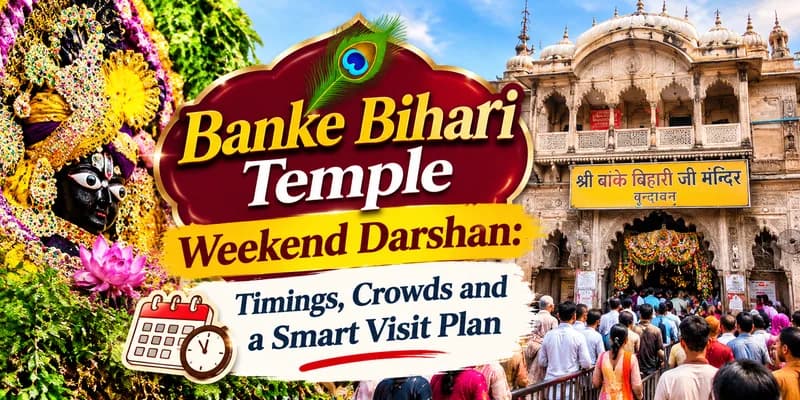
Banke Bihari Temple Weekend Darshan: Timings, Crowds and a Smart Visit Plan
By Gurudutt, Experience My India·17 November 2026
Quick Answer
Quick Enquiry
Banke Bihari Ji is the beating heart of Vrindavan and on a weekend the whole town flows toward his lanes. A few honest tips from home: go right at the opening bell, the first darshan of the session is always the calmest and by late morning on a Saturday the queues fill the market alleys. Do not fall for anyone selling a “VIP pass” or online darshan booking, there is no such thing here, darshan is free for everyone. Leave your phone and shoes at the authorised stands, keep your glasses in your pocket (the monkeys are quick) and just let the curtain open on that enchanting form. One more thing: park at Chhatikara and take an e-rickshaw in, do not try to drive to the temple. We handle all of this for our guests so the day stays peaceful. Jai Shri Banke Bihari Lal Ki and Radhe Radhe. See our Mathura Vrindavan tour Packages or message WhatsApp +91 7302265809.
Banke Bihari on a weekend: what to expect
The Shri Banke Bihari Ji temple sits in the heart of old Vrindavan, in Bankebihari Colony, close to the Yamuna riverfront and Nidhivan. It is the most visited and most beloved temple in Vrindavan and that popularity peaks on weekends.
Same timings every day. The temple runs the exact same seasonal schedule seven days a week, Saturdays and Sundays included. Weekends are not longer, they are just busier.
Massive weekend footfall. Saturdays and Sundays are among the busiest days, with crowds often reaching 30,000 to 40,000 or more visitors in a day, filling the narrow approach lanes.
Longer waits in the lanes. The real weekend bottleneck is the market alleys leading to the shrine and the barricaded queues, where waits can stretch during peak hours.
So a weekend darshan is wonderful, the atmosphere is electric, but it rewards planning: go at the right window, travel light and know the rules. The rest of this guide covers the timings, the best weekend windows, the Jhanki darshan, the rules and the history. For the complete temple reference, see our banke bihari guide.
Weekend darshan timings and seasonal schedule
The temple’s hours shift between summer and winter, with an extended afternoon closure so the deity can rest. These are the same every day of the week.
Session / ritual | Winter (about Nov to Feb) | Summer (about Mar to Oct) |
Morning opening | 8:45 AM | 7:45 AM |
Shringar Aarti | 9:00 AM | 8:00 AM |
Rajbhog and midday closing | 12:00 PM to 1:00 PM | 12:00 PM |
Evening opening | 4:30 PM | 5:30 PM |
Shayan Aarti and closing | 8:30 PM | 9:30 PM |
A note on the aartis. Because the Lord is worshipped as a child, the temple deliberately has no early-morning Mangala aarti on ordinary days (it is performed only once a year, on Krishna Janmashtami) and no loud bells or conches. The main daily rituals you may witness are the Shringar aarti after the morning opening and the Shayan aarti before the night closing. For the great aartis across Braj, see our must-attend aarti guide.
Always reconfirm. Hours adjust during solar and lunar eclipses and major festivals (Janmashtami, Holi, Sharad Purnima), when the temple can be far busier and the schedule different. Check the official Shri Banke Bihari Mandir portal before you travel.
The best weekend windows
If you are visiting on a Saturday or Sunday, timing your arrival is the single biggest thing in your control.
Arrive at the opening bell. The smoothest movement of the whole day is right at the morning opening (8:45 AM in winter, 7:45 AM in summer) or the evening opening (4:30 PM in winter, 5:30 PM in summer), before the peak surge builds. The first darshan of each session is the calmest.
Avoid the midday and mid-session peak. By late morning on a weekend, the lanes are at their fullest; the crowd swells through the middle of each session.
Prefer the morning over the evening if you can. Weekend evenings are beautiful but intense; a weekday or an early-opening weekend morning is gentler, especially for elderly pilgrims (see our mathura vrindavan with elderly parents guide).
Build in buffer time. On a busy weekend, allow extra time for parking, the e-rickshaw ride, the shoe and phone stands and the queue, do not schedule the darshan tight against a train or a checkout.
If your dates are flexible, an ordinary weekday morning is the single calmest time of all; but with the right window and a little patience, a weekend darshan is very doable.
SECTION E · The Jhanki darshan: the temple’s unique style
Banke Bihari darshan is unlike almost any other temple and knowing this in advance makes the experience richer.
The curtain (Jhanki) system. Rather than a continuous view of the deity, a curtain before Banke Bihari Ji is drawn shut and reopened every few minutes, giving a series of fleeting glimpses (jhankis). By tradition, the Lord’s gaze is so enchanting that uninterrupted eye contact could overwhelm a devotee or even tempt the playful Lord to leave with one, so the darshan is given in loving glimpses.
A calm, childlike setting. Because Bihari Ji is cared for as a young child (bal bhava), the temple keeps a gentle environment: no clanging bells, no blowing conches and no daily pre-dawn Mangala aarti, so as not to startle him.
Rare, special sights. By tradition, the deity holds a flute only once a year, on Sharad Purnima (see our sharad purnima guide) and his lotus feet are revealed to devotees only on Akshaya Tritiya. These are cherished devotional traditions.
So do not expect a long, still darshan; expect a series of soul-stirring glimpses of a playful child-God. That is the whole beauty of Banke Bihari.
Rules, free entry and the no-VIP truth
Knowing the rules keeps your weekend visit smooth and keeps you safe from touts.
Entry is completely free. General darshan at Banke Bihari is free for everyone. There is no ticket, no entry fee and crucially, no official VIP or paid fast-track darshan.
Ignore “VIP pass” and “online darshan booking” offers. The temple management does not run a paid VIP system or sell online darshan slots. Any tout in the lanes or any third-party website, claiming to sell special entry, VIP darshan or a skip-the-line pass is a scam, do not pay. The way to a smoother darshan is the right time window, not a purchased pass.
Prohibited inside. Footwear, leather items, mobile phones and cameras are strictly barred inside the main complex. Leave them at the authorised shoe stands and lockers before you join the barricaded queues. Photography inside is prohibited.
Dress modestly. Traditional, modest attire covering the shoulders and knees is expected.
Watch the monkeys. In the approach lanes, monkeys frequently snatch eyeglasses, phones, wallets and small bags; keep everything tucked away and held close.
Carry minimal items. Since phones and bags are awkward anyway, carry as little as possible, it speeds you through the stands and the queue.
This honest, free-for-all darshan is part of what makes Banke Bihari so special, do not let anyone sell you otherwise.
Getting there and last-mile access
The temple is in Bankebihari Colony in old Vrindavan, in the Mathura district of Uttar Pradesh, near the Yamuna and Nidhivan.
By rail. Mathura Junction (MTJ) is the nearest major railway station, about 10 to 14 km away. From the station, take an e-rickshaw or auto into Vrindavan. See our how to reach banke bihari temple from delhi guide for the full journey.
By air. The nearest airport is Delhi (Indira Gandhi International), about 150 to 180 km away via NH 44 or the Yamuna Expressway; our delhi to vrindavan and how to reach vrindavan guides cover the options.
Last-mile (important on weekends). Private vehicles cannot enter the narrow lanes immediately around the shrine, the final roughly 300 metres are restricted. Park at a designated outer lot (such as the Chhatikara parking) and take an e-rickshaw or walk the final stretch through the market alleys. See our chhatikara road guide for the main parking-and-approach corridor and our mathura to vrindavan distance guide for moving within Braj.
On a weekend, the last mile is where the time goes, plan to park early, ride in and walk the alleys with patience.
History and origin
Banke Bihari has a rich history, recounted here from tradition and historical accounts.
Manifestation in Nidhivan. By tradition, the black-stone Tribhanga image of Banke Bihari was manifested by the great saint and musician Swami Haridas (born 1478 CE), in the sacred grove of Nidhivan. It is said that Radha and Krishna appeared before him in the groves and, at his request, merged into a single enchanting form, first worshipped as Kunj Bihari. See our nidhivan temple guide and our nidhivan mystery guide for the grove where it all began.
The move and the temple. Disciples later named the deity Banke Bihari. The present Rajasthani-style temple was built around 1862 to 1864 by Swami Haridas’s Goswami descendants, who moved the idol from Nidhivan to its current location.
The meaning of the name. “Banke” means bent in three places, referring to the idol’s graceful Tribhanga stance and “Bihari” means the supreme enjoyer, the divine enjoyer of Vrindavan’s groves. The deity embodies the unified essence of both Radha and Krishna.
So when you stand before Bihari Ji, you are seeing a form that, by tradition, a saint drew out of the very groves of Nidhivan, a cherished devotional belief at the heart of Vrindavan.
Making it a full Vrindavan day
A Banke Bihari weekend darshan pairs beautifully with the rest of old Vrindavan, which is walkable from the temple.
Close by are Nidhivan (the sacred grove of the manifestation) and the great temples of Vrindavan, radha raman, radha vallabh, the grand prem mandir and the iskcon vrindavan temple, along with the Yamuna ghats at keshi ghat and the wider braj yamuna ghats. For the full roster, see our places to visit in vrindavan guide and for the devotional walk, our vrindavan parikrama guide. The lanes around the temple are also a lively market, see our vrindavan market guide and for Braj food, our famous food guide.
For planning, October to March is the most comfortable season (see our best time to visit guide) and for where to base yourself, our where to stay in vrindavan guide. A ready-made mathura vrindavan tour plan helps you fit it all into a weekend.
Let a Brajwasi plan your visit
A Banke Bihari weekend darshan is magical and with a Brajwasi beside you it stays smooth instead of stressful. As locals running Experience My India, we plan your visit around the calmest darshan window, get you parked at the right lot and into the lanes by e-rickshaw, steer you past the “VIP pass” touts (there is no such thing) and handle the shoe-and-phone stands so you simply walk in for the Jhanki. We can build the full Vrindavan day around it, Nidhivan, Prem Mandir, ISKCON, the Radha Raman and Radha Vallabh temples and the Yamuna ghats and extend it into a complete Braj pilgrimage with Mathura, Gokul, Govardhan and Barsana. For festival weekends like Janmashtami, Holi or Sharad Purnima, a local host is the difference between chaos and a joyful darshan. A shared Mathura and Vrindavan darshan starts from around 1,499 rupees per person; see our vrindavan tour package or our mathura vrindavan tour. Message us on WhatsApp at +91-7302265809 and we will plan your Banke Bihari darshan. Jai Shri Banke Bihari Lal Ki and Radhe Radhe.
Related guides
Book Your Mathura - Vrindavan Trip Today
📞 +91-7302265809
💬 WhatsApp: +91-7302265809
We Reply in 30 Minutes
Packages start from ₹1,999/ person | Rated 4.5★ / 204+ Reviews
Explore all: Mathura Vrindavan Tour Packages
Jai Shri Krishna
Meet Gurudutt — Your Mathura Vrindavan Guide
Not just a tour operator — Gurudutt was born and raised in Braj Bhoomi. He has spent over a decade personally guiding pilgrims through the sacred lanes of Mathura & Vrindavan.

Founder – Experience My India
Gurudutt
Founder · Experience My India