Travel Guide · Travel Guides · Updated September 2026
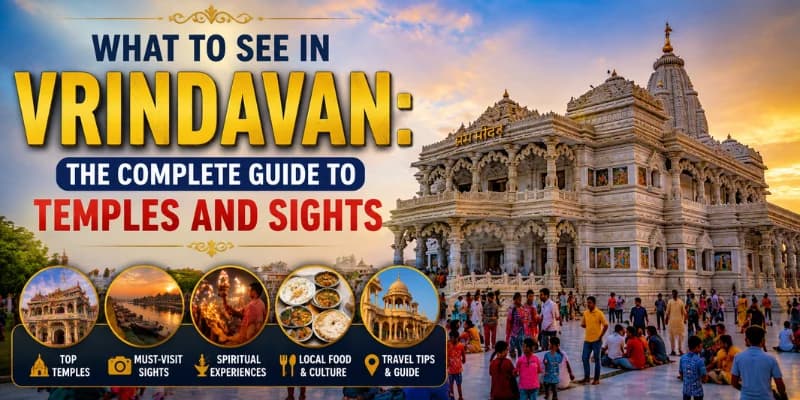
What to See in Vrindavan: The Complete Guide to Temples and Sights
By Gurudutt, Experience My India·2 September 2026
Quick Answer
Quick Enquiry
What to see at a glance
Sight | Type | Known for |
Banke Bihari Mandir | Temple | The most beloved; curtain darshan, no bells |
Prem Mandir | Temple | 54-acre marble temple, evening light show |
ISKCON Krishna-Balaram | Temple | Round-the-clock kirtan, serene aarti |
Nidhivan | Sacred grove | The raas-leela mystery, sealed at night |
Seven Goswami temples | Temples | Radha Raman, Radha Damodar, Madan Mohan and more |
Rangji Mandir | Temple | Grand South Indian Dravidian style |
Keshi Ghat | Ghat | The evening Yamuna aarti and boat ride |
Vrindavan Parikrama | Experience | The 13 km circumambulation of the Dham |
What to see in Vrindavan: an overview
Vrindavan is a town made of devotion. It is the land where Krishna spent his childhood and played his eternal leelas with Radha and the gopis and it holds thousands of temples, from tiny shrines in the old-town lanes to vast modern marble halls. To see Vrindavan is to move from one form of the Lord to another through the day, from the tender glimpse of Banke Bihari to the luminous night of Prem Mandir and to end at the Yamuna as the evening aarti lamps float on the water. There is far more here than a single day can hold, so this guide sets out everything worth seeing, the great temples and the hidden ones, the ghats and the groves, so you can plan a visit that misses nothing; and if you would like it all arranged and guided, a mathura vrindavan tour package with Experience My India brings it within reach.
From the ground (Gurudutt): People ask me what to see first and I always say: begin with Bihari Ji early, before the crowds, then let the day open like a flower. See the grand temples, yes, but do not rush past the small old ones in the lanes, for they hold the oldest love of Vrindavan. Take the evening at Keshi Ghat for the aarti, walk a stretch of the parikrama if your feet allow and buy a bead-bag in Loi Bazar to chant. Vrindavan is not a checklist; it is a feeling. Radhe Radhe. See our Mathura Vrindavan tour Package or message WhatsApp +91 7302265809.
The must-see temples
If your time is short, these four are the heart of Vrindavan:
Banke Bihari Mandir
The most beloved temple of Vrindavan, the banke bihari temple enshrines Krishna as Bihari Ji in a tender child form, standing in the graceful three-bent Tribhanga pose. Its darshan is unlike any other: there are no bells or conches and a curtain is drawn open and closed every few moments, so the Lord is seen only in brief, stolen glimpses, said to be for the devotee's own good, so overwhelming is his beauty. Deep in the old-town lanes where cars cannot go, it is reached on foot and by e-rickshaw and its darshan is the soul of a Vrindavan visit.
Prem Mandir
The great modern marvel of Vrindavan, prem mandir vrindavan, the Temple of Love, spreads across a vast garden campus, a two-storey temple of white Italian marble carved with scenes from the lives of Radha-Krishna and Sita-Ram. Built by Jagadguru Kripalu Ji Maharaj, it is loveliest after dark, when the marble is bathed in changing colours and a musical fountain plays, drawing crowds every evening. The gardens, the leela scenes and the sheer scale make it a highlight for every visitor.
ISKCON Krishna-Balaram Mandir
In the Raman Reti area, the iskcon temple vrindavan, the Sri Sri Krishna-Balaram Mandir, is known for its serenity and its round-the-clock kirtan, a continuous chanting of the holy names that has gone on without pause for decades. Founded through the efforts of Srila Prabhupada, it draws devotees from across the world; step into its hall and you are carried at once into the sankirtan. Its morning aarti and its calm, welcoming atmosphere make it a favourite and Srila Prabhupada's samadhi is here too.
Nidhivan
Nidhivan is a dense, ancient grove of tulsi and short, intertwined trees near the old town and one of the most mysterious and sacred spots in Vrindavan. It is held to be a place where Krishna and Radha perform the divine raas even now, each night; and by long tradition the grove is sealed after the evening aarti, with no soul, not even a bird or monkey, said to remain and small beds and offerings left within are found disturbed by morning. It is treated with the deepest reverence and is unlike anywhere else you will visit.
The seven Goswami temples
Beyond the famous four are the seven ancient temples established by the Goswamis, the great saints sent by Sri Chaitanya Mahaprabhu to reveal the lost holy places of Vrindavan. These are the old heart of the town's devotion, quieter and deeply atmospheric:
Radha Raman Temple. Established in 1542 by Gopal Bhatta Goswami, it enshrines a deity of Krishna self-manifested from a shaligram shila; no separate idol of Radha stands here, her presence shown by a crown beside the Lord and Gopal Bhatta's samadhi lies within. One of the most revered of the seven.
Radha Damodar Temple. The bhajan place and samadhi of Rupa Goswami, this temple holds the Giriraj shila, a sacred stone of Govardhan given by Krishna to Sanatana Goswami, whose parikrama here is said to equal circling Govardhan itself.
Madan Mohan Temple. Among the oldest temples in Vrindavan, set on a rise by the Yamuna and connected with Sanatana Goswami; it is said Krishna rested here after subduing the serpent Kaliya and the view over Vrindavan from it is beautiful.
Govind Dev Temple. Once a magnificent seven-storey red-sandstone temple built in the time of Rupa Goswami, its original deity was later moved to Jaipur for safety; what remains is still grand and historic, a monument of Vrindavan's golden age.
Gopinath, Shyamsundar and Gokulananda. The remaining Goswami temples, Radha Gopinath, Radha Shyamsundar and Gokulananda, each hold their own beloved deities and quiet devotion, completing the seven and rewarding those who seek the older Vrindavan.
More temples worth seeing
Vrindavan rewards the unhurried visitor with many more temples, each with its own character:
Radha Vallabh Temple. The chief temple of the Radhavallabh tradition, which places Radha above all; here too no idol of Radha stands beside the Lord, only her crown, in a beautiful expression of her supremacy.
Rangji (Ranganatha) Temple. A grand temple in the South Indian Dravidian style, rare in the north, with a soaring gopuram tower, a gold-plated pillar and a spacious complex; it honours Lord Ranganatha and comes alive at its Brahmotsav festival.
Shahji Temple. Built in 1876 by Shah Kundan Lal, famous for its hall of twelve spiralling marble pillars, the Basanti Kamra and its Belgian glasswork; the deity here is known as Chhote Radha Raman.
Gopeshwar Mahadev Temple. An ancient temple to Lord Shiva, revered as the one who took the form of a gopi to witness Krishna's raas; a reminder that even the greatest yogi longs for Vrindavan's love.
Katyayani Peeth. Also called the Uma Shakti Peeth, one of the fifty-one Shakti Peethas, where a part of the goddess Sati is said to have fallen; a sacred stop for those who honour the Devi.
Meerabai Temple and Seva Kunj. A temple recalls the saint-poetess Meerabai, whose love for Krishna filled her songs; and the grove of seva kunj vrindavan, like Nidhivan, is revered as a raas-leela site, sealed at night and rich in the sweetness of the divine dance.
Keshi Ghat and the Yamuna
No visit is complete without the river. braj yamuna ghats and leela sites include Keshi Ghat, the main and most beautiful ghat of Vrindavan, built in the seventeenth century and named for the leela in which Krishna slew the horse-demon Keshi. Its riverside temples and steps and the old havelis rising above, keep a timeless, vintage beauty. Two things draw pilgrims here:
The evening Yamuna aarti. At dusk, the grand aarti to Yamuna Maharani is performed at Keshi Ghat, lamps circling and the crowd singing, one of the loveliest sights in all of Braj; arrive a little early for a good place.
A boat ride on the Yamuna. Boats wait at the ghat for a gentle ride on the river, a peaceful way to see the ghats and havelis from the water; agree the fare before you set off.
Things to do beyond the temples
Vrindavan is not only temples; it is a way of being. Beyond darshan, do not miss:
The Vrindavan Parikrama. The 13 km circumambulation of Vrindavan Dham, walked barefoot by devotees, especially on Ekadashi; much of the path keeps its old greenery, with peacocks, cows and quiet groves and to complete it is said to equal visiting every temple in the town.
The night light show at Prem Mandir. After dark, the marble of Prem Mandir glows in shifting colours and the musical fountain plays, a spectacle the whole family enjoys.
The round-the-clock kirtan at ISKCON. Step into the continuous chanting at the Krishna-Balaram temple and let the holy names carry you; many find it the most moving hour of their visit.
Shopping at Loi Bazar. The main market, always thronged, sells deity dresses and ornaments, gopi dresses, dhoti-kurtas, spiritual books, prasad and japa beads; a lively, colourful stop and the place to buy a bead-bag to chant.
For the darshan hours at every temple, our mathura vrindavan temple timings guide is essential, as most temples close for a few hours at midday and keep special hours on festivals.
Best time to visit
October to March is the most pleasant season, with cool, comfortable weather for the temples, the parikrama and the ghats.
The month of Kartik, around October and November, is especially holy and beautiful in Vrindavan, though very crowded.
Janmashtami, Radhashtami and Holi are the town's greatest festivals, magnificent but thronged; plan and book far ahead.
Start each day early to reach the temples before the midday closing and to beat both the heat and the crowds.
Summer is very hot and best avoided unless you travel in the cooler hours; carry water at all times.
How to get around Vrindavan
Vrindavan is compact and getting around is part of the experience:
On foot. Many of the main temples, ISKCON, Prem Mandir, Radha Damodar, Radha Shyamsundar, Nidhivan, Radha Raman, lie within a couple of kilometres and walking the lanes is a joy in itself.
By e-rickshaw. The small electric rickshaws thread the narrow lanes quickly and cheaply; agree the fare first, as first-time visitors are often quoted high.
Mind the old-town lanes. Cars are kept out of the inner old town around Banke Bihari, so park at the edge and finish by e-rickshaw and on foot.
Our how to commute in vrindavan guide explains the e-rickshaws and the lanes in full and our mathura vrindavan tour itinerary helps you order the sights into a comfortable day or two.
Tips for your visit
Begin early with Banke Bihari before the crowds, then move outward to the larger temples through the day.
Dress modestly, remove footwear as required and follow each temple's customs on photography, which is often not allowed inside.
Keep phones and valuables secure and watch for monkeys, especially near the ghats, where they snatch spectacles and bags.
Wear comfortable footwear for the lanes, the parikrama and the temple steps and carry water in the warmer months.
Keep a little change for e-rickshaws, boat rides and offerings and buy japa beads in Loi Bazar to chant as you go.
We guide pilgrims through all of Vrindavan's temples and sights, with a comfortable vehicle, the e-rickshaw and darshan arranged and a Braj-born guide who knows the quiet hours and the hidden shrines. A shared day tour starts from around ₹1,499 per person, with darshan free. Our vrindavan tour package covers Vrindavan in a day, our mathura vrindavan tour adds Mathura and the braj 84 kos yatra the whole of Braj. To plan where to stay, see our 4 star hotels in vrindavan guide and to add the birthplace, the krishna janmabhoomi at Mathura; message me on WhatsApp at +91-7302265809.
Related guides
Meet Gurudutt — Your Mathura Vrindavan Guide
Not just a tour operator — Gurudutt was born and raised in Braj Bhoomi. He has spent over a decade personally guiding pilgrims through the sacred lanes of Mathura & Vrindavan.
Founder – Experience My India
Gurudutt
Founder · Experience My India