Travel Guide · Travel Guides · Updated October 2026
Vrindavan to Kedarnath Distance: 579 km, Routes and Travel Time
By Gurudutt, Experience My India·2 October 2026
Quick Answer
Quick Enquiry
At a glance
Detail | Value |
Road distance | About 579 to 582 km (Vrindavan to the Kedarnath road head) |
Aerial distance | About 378 km (straight line) |
Driving time | About 11 to 14 hours to Gaurikund, via Haridwar and Rishikesh |
Final stretch | Road ends at Gaurikund; 16 to 18 km on foot, pony, palki or helicopter |
Fastest way | Delhi to Dehradun (Jolly Grant) by air, then road |
The shrine | Lord Shiva, a Jyotirlinga; open about May to November only |
Best time | May to June and September to October; avoid the monsoon |
Vrindavan to Kedarnath distance: the short answer
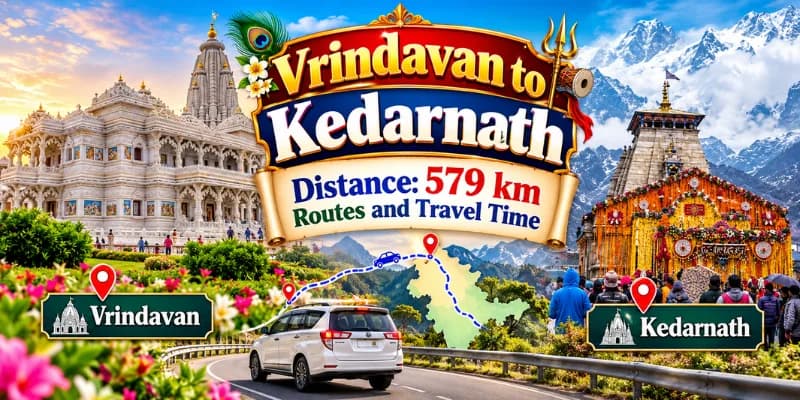
The distance from Vrindavan to Kedarnath is about 579 to 582 km by road, and about 378 km in a straight line by air. The road runs north through Haridwar and Rishikesh and climbs into the Garhwal Himalayas, taking roughly 11 to 14 hours to the Kedarnath road head. But Kedarnath is a high mountain shrine, and no road reaches it: the drive ends at Gaurikund, after which the temple is a further climb. For reaching Braj itself from across India, our how to reach vrindavan guide compares train, road and flight. See our Mathura Vrindavan tour Package or message WhatsApp +91 7302265809.
From the ground (Gurudutt): I am honest with pilgrims about Kedarnath, because it is not like our other distance guides. The number, around 580 km, only gets you to Gaurikund; the Lord sits higher still, and you earn the last stretch on foot, by pony, or by helicopter. It is a mountain yatra, seasonal and weather-bound, and it asks for respect and a little fitness. The sensible plan for most families is to enjoy Braj unhurried, then fly Delhi to Dehradun and take the mountain road, breaking the journey with a night in the hills. The figures below are honest and complete, but please read the trek, season and safety sections before you plan, for this is the high Himalaya.
Distance and travel options compared
Here are the distances and the main ways to make the journey from Vrindavan to Kedarnath:
Option | Distance | Time |
By road via Haridwar and Rishikesh | 579 to 582 km | About 11 to 14 hr to Gaurikund |
Aerial (straight-line) distance | About 378 km | Not applicable |
By air then road (via Dehradun) | Flight plus mountain road | Fastest overall |
So by road it is about 579 to 582 km and 11 to 14 hours to Gaurikund, while the aerial distance is about 378 km, and the quickest way combines a flight to Dehradun with the mountain road. So choose road for a full overland yatra, or air and road to save time. These distances and times are the author's verified figures for this route.
Why the road does not reach the temple
This is the single most important thing to understand before you go. Kedarnath sits high in the Himalayas, and no motorable road reaches the shrine itself. By road you travel through Haridwar, Rishikesh, Devprayag, Rudraprayag and Guptkashi to Sonprayag, and then a short local shuttle to Gaurikund, where the road ends. From Gaurikund, the temple is a further 16 to 18 km up the mountain.
From Gaurikund you can continue by: your own feet, on the well-trodden trek; by pony or by palki (a carried seat) for those who cannot walk the climb; or by helicopter from helipads at Phata, Guptkashi or Sirsi, which must be booked in advance. So the last 16 to 18 km is a trek or a helicopter ride, never a drive. So plan your fitness, your footwear and, if you wish, your helicopter booking before you arrive. We present this as general guidance; confirm the current road and shuttle arrangements before you travel.
The fastest way: by air via Dehradun
For a faster overall journey, combine air and road. Drive or take a train from Braj to Delhi, fly from Indira Gandhi International Airport to Dehradun, at Jolly Grant Airport, and continue by road into the mountains toward the Kedarnath road head, then climb or take a helicopter for the last stretch. This is quicker than the full 11 to 14 hour drive from Vrindavan and spares you part of the long mountain road. Our vrindavan mathura itinerary helps you plan the Braj days before you head north.
So the fastest route is Delhi to Dehradun by air, then road and the final climb. So book the flight early, especially in the yatra season when demand is high. We present this as general guidance; verify current flight and helicopter details before you travel.
Who is the Lord of Kedarnath: Shiva and the Pandavas
Kedarnath is a shrine of Lord Shiva, and one of the holiest in all of India. It is one of the twelve Jyotirlingas, the self-manifest lingas of Shiva, and the highest among them; it is one of the Panch Kedar, and part of the Chota Char Dham of Uttarakhand, together with Yamunotri, Gangotri and Badrinath. By the tradition, its story reaches back to the Mahabharata: after the great war, the Pandavas, whom Krishna had guided through the epic, sought Lord Shiva in the Himalayas to be freed of the sin of having killed their own kin. Shiva, unwilling to face them at first, took the form of a bull and plunged into the ground at Kedarnath, leaving behind his hump, which is worshipped there as the sacred form to this day; his other parts are honoured at the Panch Kedar shrines. Our vrindavan dham guide places Braj within this wider sacred geography of the dhams.
Pilgrims climb to the Lord with the great cry of Shiva on their lips:
हर हर महादेव
Har Har Mahadev
Hail Shiva, the Great Lord
So Kedarnath is Shiva's Jyotirlinga, bound to the Pandavas of the Mahabharata. So for a devotee of Krishna, it stands as the Himalayan companion to the Vishnu shrine of nearby Badrinath, and a visit to one often draws the pilgrim to the other. We present this as the cherished belief and tradition, held with faith and recounted with reverence.
When Kedarnath is open and the best time to go
Kedarnath is a snowbound Himalayan shrine, and it is open only for part of the year, usually from late April or May, around Akshaya Tritiya, to October or November, around Bhai Dooj; through the deep winter the temple is closed and the Lord is worshipped at Ukhimath instead. Within the open season, the best windows are May to June and September to October, when the skies are clearer and the trek safer. The monsoon months of July and August are best avoided, for heavy rain brings landslides and road closures in these hills.
So Kedarnath is open about May to November, and the best time is May to June or September to October. So plan within the season, avoid the monsoon, and check the exact dates and the weather for the year. Our places to visit in vrindavan guide helps you plan the Braj leg around the mountain season. We present this guidance for pilgrims with care.
Registration, helicopter and safety
Register for the yatra. Pilgrims to Kedarnath and the Uttarakhand Char Dham must register, usually online through the state's Char Dham system or at counters; carry the registration and a photo ID. Rules are updated each season, so check the current ones.
Book the helicopter early. Services from Phata, Guptkashi and Sirsi save the climb but are limited and weather-bound; book well in advance and keep a flexible day.
Prepare for altitude and cold. Kedarnath stands very high; carry warm clothing and a raincoat, walk slowly to acclimatise, and consult a doctor if you have heart or breathing concerns.
Travel light and wear good shoes. The 16 to 18 km climb needs sturdy footwear; carry water, basic medicines and only what you need.
Watch the weather. Mountain weather changes fast; follow local advisories and never push on against a landslide or a storm warning.
Combining Vrindavan with a Char Dham yatra
Braj and the Himalayan shrines sit on the same northern pilgrimage map, and many devotees join them. A much-loved plan is to see Mathura and Vrindavan, the land of Krishna, and then travel north through Haridwar and Rishikesh to Kedarnath and the Char Dham. Because the mountain leg is seasonal and demanding, it is planned on its own; we take care of the Braj part of your journey and also arrange Himalayan yatra packages for the season, such as our yamunotri yatra package.
So Braj and a Kedarnath or Char Dham yatra combine naturally into one northern pilgrimage, with the Braj leg by us and the mountain leg planned for the season. So you give each its due, unhurried and safe. A shared Mathura and Vrindavan day tour starts from around ₹1,499 per person, with darshan free, and our one-day vrindavan mathura tour covers Braj for those short on time. Message me on WhatsApp at +91-7302265809 to plan it.
Related guides
Meet Gurudutt — Your Mathura Vrindavan Guide
Not just a tour operator — Gurudutt was born and raised in Braj Bhoomi. He has spent over a decade personally guiding pilgrims through the sacred lanes of Mathura & Vrindavan.

Founder – Experience My India
Gurudutt
Founder · Experience My India