Travel Guide · Travel Guides · Updated July 2026
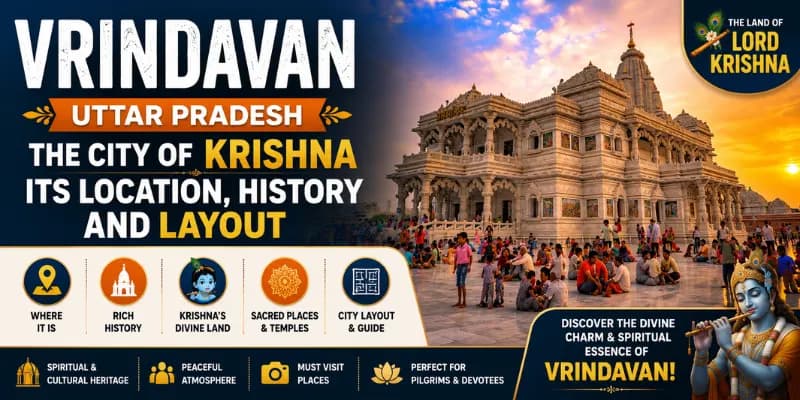
Vrindavan, Uttar Pradesh: The City of Krishna, Its Location, History and Layout
By Gurudutt, Experience My India·28 July 2026
Quick Answer
Quick Enquiry
Key facts at a glance
What it is | A sacred city in Mathura district, Uttar Pradesh, on the Yamuna |
Where | In the Braj region, about 13 km from Mathura and 150 km from Delhi |
PIN code | 281121, in Mathura district, Uttar Pradesh |
Why sacred | Revered as the city where Krishna spent his childhood |
Known for | Its roughly five thousand temples and the Banke Bihari and ISKCON temples |
The name | From vrinda, the holy basil or tulsi and van, a grove or forest |
What and where is Vrindavan?
Vrindavan is one of the holiest cities in India, revered above all as the place where Krishna spent his childhood, playing among the cowherds, dancing the raas with Radha and the gopis in its groves. It is a historic city in the Mathura district of Uttar Pradesh, set in the Braj region on the west bank of the sacred Yamuna, about 13 km north of Mathura city and roughly 150 km south of Delhi. Its PIN code is 281121.
So when people ask where Vrindavan is, or in which state, the answer is that it is a city in Mathura district, Uttar Pradesh, in the Braj land of Krishna, on the Yamuna. Today it is part of the Mathura-Vrindavan Municipal Corporation, a city of some sixty thousand residents that swells with millions of pilgrims each year and it is famous the world over for its thousands of temples. This guide explains the city, its name, its history, its layout, its temples and its living present in full.
From the ground (Gurudutt): Vrindavan is a city best understood as a devotional town rather than a modern one: a dense weave of narrow temple lanes, ghats, ashrams and markets around the old heart, ringed by the Parikrama Marg and spreading out to newer temple complexes on the edges. Knowing its layout, which this guide maps in words, turns a confusing tangle of lanes into a city you can read. See our Mathura Vrindavan tour or message WhatsApp +91 7302265809.
Vrindavan city: key facts at a glance
Here are the essential facts about Vrindavan city in one place, the kind of details people most often look for.
Detail | Information |
City | Vrindavan, also spelt Brindavan or Vrindaban |
State | Uttar Pradesh |
District | Mathura |
Region | Braj, or Braj Bhoomi |
River | On the west bank of the Yamuna |
Distance from Mathura | About 13 km |
Distance from Delhi | About 150 km |
PIN code | 281121 (Chhatikara, the ISKCON side, is 281406) |
Governing body | Mathura-Vrindavan Municipal Corporation |
Population | About 63,000 (2011 census) |
Languages | Hindi and Braj Bhasha |
STD code | 0565; vehicle registration UP-85 |
Known as | The city of Krishna, the city of temples |
In one line: Vrindavan is a sacred city in Mathura district, Uttar Pradesh, on the Yamuna, about 13 km from Mathura, revered as the childhood home of Krishna and famous for its roughly five thousand temples.
The name Vrindavan: the forest of Tulsi
The name Vrindavan is beautifully simple in origin: it comes from vrinda, meaning the holy basil, or tulsi and van, meaning a grove or forest, so Vrindavan is the forest of tulsi. The tulsi plant is sacred to Krishna, its leaves offered in his worship and the town was by tradition once a grove of it. Two of those ancient groves, Nidhivan and Seva Kunj, are still revered in the heart of the city today.
In another cherished reading, the name honours Vrinda Devi, a form of the sacred tulsi and a beloved presence in the Krishna tradition, so that Vrindavan is her forest. Either way, the name carries the memory of a green, sacred grove, which is what Vrindavan was before the centuries of temple-building and, latterly, urban growth. We share these meanings as they are held within the tradition.
Why Vrindavan is sacred
Vrindavan's sanctity flows entirely from Krishna. By tradition, it is here that Krishna spent the years of his childhood and youth, after his infancy at Gokul, herding cows, playing his flute, lifting the hearts of the people of Braj and dancing the raas leela, the great circle dance of divine love, with Radha and the gopis in its moonlit groves. For devotees, Vrindavan is not merely a place where these pastimes happened; it is held to be eternally present, the very land of Krishna's love.
This is why Vrindavan is among the foremost pilgrimage cities of the Vaishnava tradition, a central jewel of the Krishna pilgrimage circuit that also takes in Mathura, Gokul, Govardhan, Barsana, Nandgaon and beyond. Saints and devotees across the centuries have held that the dust of Vrindavan is sacred and that to live or even to die here is a blessing. We share this as the devotional understanding of the tradition, held with deep reverence by millions.
A short history of Vrindavan
Vrindavan is an ancient place, revered in tradition since the age of Krishna, held to be some five thousand years ago and mentioned across the Vaishnava scriptures. As a lived city, though, much of what we see today springs from the sixteenth century onward.
The turning point was the coming of Chaitanya Mahaprabhu, the great Bengali saint, who by tradition rediscovered the lost sacred sites of Vrindavan around 1515, reviving it as a centre of Krishna devotion. His followers, the Six Goswamis of Vrindavan, settled here and established the great temples and the theology of Gaudiya Vaishnavism, uncovering and worshipping the deities and the leela-sites. Rulers such as Raja Man Singh of Amber, who built the Govind Dev temple in 1590 and later patrons endowed the city's temples.
From those foundations Vrindavan grew over the following centuries into the dense city of temples it is today, its ancient groves gradually giving way, especially over the last couple of hundred years, to lanes, ashrams and, more recently, wider urban growth. Through all of it, its identity as the city of Krishna's love has remained its whole reason for being. We attribute the ancient tradition to belief and the temple history to record.
Understanding the layout: a Vrindavan city map in words
Vrindavan can feel like a bewildering tangle of lanes to a first-time visitor, so it helps to hold a simple map of it in your mind. Picture the Yamuna running along the eastern edge, with the ghats, above all Keshi Ghat, along it. The old heart of the city, a dense knot of narrow lanes, holds the most famous temple, Banke Bihari and the main market, Loi Bazaar, along with many of the oldest temples and the sacred groves of Nidhivan and Seva Kunj.
Around this old town runs the Parikrama Marg, the roughly ten to eleven kilometre pilgrim path that loops the city and orients everything. To the west, the main approach from the Delhi-Agra highway comes in along the Chhatikara Road, where the great ISKCON temple, the Krishna-Balaram Mandir, stands, along with the newer colonies of Chaitanya Vihar. The magnificent Prem Mandir sits on this western side too, near Raman Reti, the ashram belt to the south of the city. Here is the layout in brief.
Area or landmark | Where it is | Known for |
Banke Bihari and Loi Bazaar | The old heart of the city | The most famous temple and the main market lanes |
Keshi Ghat and the ghats | The eastern edge, on the Yamuna | The riverfront, ghats and the evening Yamuna aarti |
Nidhivan and Seva Kunj | In the old town | The revered surviving sacred groves |
Parikrama Marg | Looping around the city | The pilgrim circumambulation path, about 10 to 11 km |
Chhatikara Road and ISKCON | The western approach | The ISKCON Krishna-Balaram temple and the main entry road |
Prem Mandir and Raman Reti | The south-western side | The grand Prem Mandir and the ashram belt |
Rangaji and Attalla Chungi | Between old town and the bypass | The large South-Indian-style Rangaji temple and a main junction |
The bypass and outskirts | Sunrakh, Jait and the edges | Newer roads, the rising Chandrodaya temple and approach routes |
With that picture, ghats to the east, old temple town at the heart, Parikrama Marg looping it, ISKCON and the western approach on the Chhatikara side, Prem Mandir and the ashrams to the south-west, the city becomes far easier to read. For moving around it, our how to commute in vrindavan guide covers the e-rickshaws and lanes and for the pilgrim loop our vrindavan parikrama guide covers the Parikrama Marg.
The city of temples
Vrindavan is famous above all as a city of temples, with estimates ranging from around five thousand to five and a half thousand shrines dedicated to Radha and Krishna, from tiny lane-side altars to vast modern complexes. It would take many visits to see even the principal ones. A handful, though, are essential to understanding the city.
Banke Bihari temple, the most beloved and busiest, whose deity was revealed in Nidhivan by Swami Haridas, known for its curtained darshan.
The ISKCON Krishna-Balaram temple, on the Chhatikara side, the great international temple that has carried Vrindavan's name across the world.
Prem Mandir, the magnificent modern marble temple on the western side, luminous under its evening lights.
The historic temples of the Six Goswamis, above all the Sapt Devalaya or seven principal temples, including Radha Raman, Radha Vallabh, Govind Dev, Gopinath, Madan Mohan, Radha Damodar and Banke Bihari's tradition.
The sacred groves of Nidhivan and Seva Kunj, revered as places of the nightly raas, quiet amid the city.
Each of these has its own timings, customs and story and darshan at them is free. Because there are so many, planning which to see and when, around the long midday closures, matters more than in most cities. Our mathura vrindavan local sightseeing guide covers the key temples and how to see them and the nidhivan guide covers that revered grove in detail.
The Yamuna and the ghats
Vrindavan sits on the west bank of the Yamuna, the sacred river woven through every Krishna story and its ghats are among the most atmospheric places in the city. Keshi Ghat, the grandest, is where by tradition Krishna slew the horse-demon Keshi and its sandstone steps and the evening Yamuna aarti, when lamps are offered to the river, are among the most moving experiences Vrindavan offers.
Honesty matters here: the Yamuna's water quality is poor in this stretch and visitors should revere the river without treating the water as clean for bathing. The beauty of the ghats and the devotion of the aarti are real and worth seeking out all the same. Our keshi ghat yamuna aarti guide covers the riverfront and the aarti in full, including the honest picture and the best time to go.
Vrindavan today: the living city
Vrindavan today is a living, breathing pilgrimage city, not a museum. Its lanes throng with pilgrims, sadhus, cows, cycle-rickshaws and the calls of vendors; its ashrams and bhajan halls resound with kirtan; and its markets sell everything from deity clothes and prayer beads to the famous Braj sweets. It is intense, crowded and utterly alive and that intensity is part of its character.
Vrindavan is also, poignantly, sometimes called the city of widows, because for generations many widows, especially from Bengal, have come here to live out their lives in devotion in its bhajan ashrams, a social reality that has in recent years drawn charitable and government support to care for them with dignity. And like many Indian towns, Vrindavan wrestles with rapid growth, traffic and the pressure of its own popularity on its old lanes and groves. We mention these honestly and with respect, because an understanding of Vrindavan should include its present, not only its past.
Festivals in Vrindavan
Vrindavan's festivals are extraordinary. Holi here, in the land of Krishna, is world-famous and lasts far longer and more intensely than elsewhere, with the temple Holi at Banke Bihari and the wider Braj Holi drawing enormous crowds. Janmashtami, Krishna's birth and Radhashtami, Radha's appearance, fill the city with devotion and pilgrims and the whole month of Kartik, in autumn, is a especially sacred season here.
Guru Purnima, the Yamuna aartis, Ekadashis and countless temple festivals mark the year. These occasions are magnificent but extremely crowded and the city can be overwhelming at their peak. For the dates, which follow the lunar calendar and for choosing when to come, see our best time to visit vrindavan mathura guide, which covers the seasons and festivals in detail.
How to reach and get around Vrindavan
Vrindavan is easy to reach. By road it is about 13 km from Mathura and roughly 150 km from Delhi, around three to four hours via the Yamuna Expressway; the nearest major railhead is Mathura Junction, about 13 km away, with a small Vrindavan station too and the nearest airports are Agra, around 70 km and Delhi, roughly 150 km. Our how to reach vrindavan guide covers every route in detail.
Within the city, much of the old temple quarter is best explored on foot, since vehicles are restricted in the narrow lanes, with cycle-rickshaws, e-rickshaws and autos covering the longer stretches between the temple clusters. It is a walking city at heart. To plan a full trip, our how to plan a vrindavan mathura trip guide sequences the temples, timings and days. We arrange complete Vrindavan visits and Braj circuits, with the darshan, timing and transport handled; a shared day tour starts from around ₹1,499 per person and our vrindavan tour package covers the city with darshan free throughout. Message me on WhatsApp at +91-7302265809 with your dates to plan it.
Related guides
Meet Gurudutt — Your Mathura Vrindavan Guide
Not just a tour operator — Gurudutt was born and raised in Braj Bhoomi. He has spent over a decade personally guiding pilgrims through the sacred lanes of Mathura & Vrindavan.
Founder – Experience My India
Gurudutt
Founder · Experience My India