Travel Guide · Travel Guides · Updated November 2026
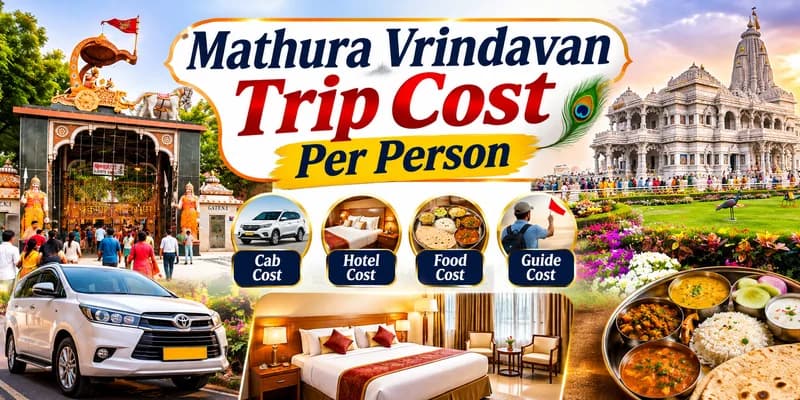
Mathura Vrindavan Trip Cost Per Person: Cab, Hotel, Food and Guide Costs
By Gurudutt, Experience My India·14 November 2026
Quick Answer
Quick Enquiry
People are often surprised how affordable a Braj pilgrimage is, the darshan itself is free at every big temple, so your money goes on the stay, the local transport and the food. You can do it very cheaply (an ashram bed, a shared e-rickshaw, a plate of kachori-sabzi and Mathura peda) or very comfortably (a nice hotel and a private car) and both are wonderful. My honest advice: the single biggest saving is to travel as a group and share the cab and room, that drops the per-person cost a lot. Carry small cash, the ATMs are few in the lanes and the e-rickshaw drivers want cash. And if you hire a guide, insist on a government-approved one. We also do all-inclusive packages from around 1,499 per person, which take the guesswork out of the budgeting. Radhe Radhe. See our Mathura Vrindavan tour Packages or message WhatsApp +91 7302265809.
What does a Mathura Vrindavan trip cost?
Here are the headline figures, so you can budget at a glance. These are per-person estimates and they vary with your tier, your group size and the season.
One-day budget trip: about 1,000 to 2,000 rupees per person (excluding long-distance travel to and from the region). With a few comforts, up to around 2,500 rupees.
Two-day comfortable trip: about 3,500 to 7,000 rupees per person, covering a mid-range stay, local transport, food and a guide.
All-inclusive guided package: from around 1,499 rupees per person for a same-day tour and about 2,499 to 3,499 rupees per person for a two-day trip.
The reason the range is wide is tier: a budget traveller in a dharamshala on shared transport spends a fraction of what a mid-range or premium traveller spends. And because all major temple darshan is free (see below), nearly all your spend is on the controllable costs of stay, transport and food. The rest of this guide breaks each of these down.
The cost breakdown by category (per person)
Here is a category-by-category breakdown for a typical trip. All figures are approximate, per person unless noted and should be confirmed at the time of booking, as prices change with season and demand.
Category | Budget (per person) | Mid-range / private | Key details |
Intercity travel (to the region) | about 200 to 400 rupees (train or bus) | about 3,500 to 5,500 rupees per car (sedan round-trip from Delhi) | A private sedan takes about 4 passengers, so roughly 900 to 1,400 rupees per person in a group |
Local transport | about 100 to 250 rupees (shared e-rickshaws) | about 800 to 1,200 rupees (full-day reserved auto or e-rickshaw) | Shared autos cost about 200 to 300 rupees per person |
Hotel / stay (per night) | about 500 to 1,200 rupees (ashram or dharamshala) | about 1,800 to 3,500 rupees (3-star or standard AC room) | Based on double occupancy, so about 900 to 1,750 rupees per person |
Food and meals (per day) | about 200 to 400 rupees | about 600 to 1,000 rupees | Covers Mathura peda, kachoris, thalis and temple bhog |
Tour guide | 0 rupees (self-guided) | about 500 to 1,000 rupees half-day, 1,500 to 2,500 rupees full-day | A flat rate per group, not per person; hire only government-approved guides |
Temple entry and darshan | Free | Free | General entry and darshan at all major temples is completely free |
The standout line is the last one: temple darshan is free, so unlike many destinations, your sightseeing itself costs nothing. Your budget is really about how comfortably you want to stay, travel and eat.
Budget, mid-range and premium tiers
To see how the total shifts with comfort level, here are the same costs grouped into three tiers for a two-day trip (per person, approximate).
Expense | Budget tier | Mid-range / comfort | Premium tier |
Accommodation (per night) | about 500 to 1,200 rupees (dharamshala / ashram) | about 1,500 to 3,500 rupees (3-star hotel) | about 5,000 rupees or more (luxury resort / 4-star) |
Local cab and transport | about 100 to 300 rupees (shared e-rickshaws at about 10 to 30 rupees a ride) | about 800 to 1,000 rupees (full-day private auto or e-rickshaw) | about 2,000 to 3,500 rupees (full-day AC sedan or SUV) |
Food and meals (per day) | about 150 to 300 rupees (street food, poori-sabzi, temple canteens) | about 300 to 600 rupees (casual vegetarian restaurants) | about 800 to 1,500 rupees (fine dining / hotel buffets) |
Local tour guide | 0 rupees (self-guided) | about 500 to 1,000 rupees (shared half or full-day guide) | about 1,500 to 2,500 rupees (dedicated private specialist guide) |
Temple entry and darshan | Free | Free | Free |
So a budget pilgrim can do two days very cheaply, while a premium traveller with a private AC cab, a 4-star stay and fine dining will naturally spend several times more. Most visitors land in the mid-range tier, which the roughly 3,500 to 7,000 rupees per person for a comfortable two days reflects. For where to stay across these tiers, see our where to stay in vrindavan guide and for the famous food of Braj, our famous food guide.
Intercity cab, packages and a cash tip
A few specifics on getting there and on all-inclusive options.
Intercity cab from Delhi NCR. Hiring a private round-trip AC cab from Delhi costs roughly 3,500 to 8,000 rupees for the whole vehicle, which, split among a group of four, works out to about 900 to 2,000 rupees per person. For the route and options, see our delhi to vrindavan guide. By train or bus, the intercity cost drops to about 200 to 400 rupees per person; see our how to reach vrindavan guide.
Guided tour packages. All-inclusive packages covering Delhi transfers, hotel, local cab and a guide start from around 1,499 rupees per person for a same-day tour and about 2,499 to 3,499 rupees per person for a two-day trip; see our mathura vrindavan tour and two-day mathura vrindavan tour. A package takes the budgeting guesswork out and often works out competitively once you add up the separate costs.
Carry small cash. ATMs are sparse in the narrow temple lanes and e-rickshaw drivers and many small vendors rarely accept digital payments, so carry small-denomination cash for transport, shoe stands, offerings and street food.
Whether you self-plan or take a package, the trip is affordable by any standard, because the darshan is free and only the comforts cost.
Temple timings and free darshan
A key budgeting fact: general entry and darshan at all the major temples is free. You pay nothing to have darshan at Banke Bihari, the Krishna Janmabhoomi, Prem Mandir, ISKCON and the rest. Here are the main temples and their general timings. Most close in the afternoon (roughly 12:00 PM to 4:30 PM) for the deity’s rest (bhog and shayan) and timings shift by 30 to 60 minutes between summer and winter, so treat these as general and confirm locally.
Temple / site | Morning | Evening | Key note |
Shri Krishna Janmabhoomi, Mathura | about 5:00 AM to 12:00 PM | about 4:00 PM to 9:30 PM | Marks the sacred prison cell (Garbha Griha) of Krishna’s birth; phones, smartwatches, cameras, leather items and bags prohibited inside (free cloakrooms outside) |
Dwarkadhish, Mathura | about 6:30 AM to 10:30 AM | about 4:00 PM to 7:00 PM | Historic Rajasthani-style temple, famous for its jhula (swing) festivals |
Vishram Ghat, Mathura | dawn aarti | evening Yamuna aarti about 6:45 PM to 7:15 PM | The main bathing ghat where, by tradition, Krishna rested after defeating Kansa |
Banke Bihari, Vrindavan | winter about 8:45 AM to 1:00 PM; summer about 7:45 AM to 12:00 PM | winter about 4:30 PM to 8:30 PM; summer about 5:30 PM to 9:30 PM | The most iconic shrine, known for the curtain-drawn jhanki darshan; four-wheelers barred in the lanes |
Prem Mandir, Vrindavan | about 8:30 AM to 12:00 PM | about 4:30 PM to 8:30 PM | White-marble monument; musical fountain and light show about 7:00 PM to 7:30 PM in winter |
ISKCON Krishna Balaram, Vrindavan | about 4:30 AM to 12:45 PM | about 4:00 PM to 8:30 PM | Continuous kirtan and a clean, affordable prasadam canteen |
Radha Raman, Vrindavan | about 8:00 AM to 12:30 PM | about 6:00 PM to 8:30 PM | 16th-century Goswami temple with a self-manifested (swayambhu) deity |
Nidhivan, Vrindavan | about 5:00 AM to 12:00 PM | about 4:00 PM to 7:00 PM | Mystical grove; strictly vacated by visitors after sunset |
For the full circuits, see our places to visit in mathura and places to visit in vrindavan guides. Also lovely is keshi ghat for the evening aarti.
How to keep the trip cheap (money-saving tips)
If you are travelling on a budget, here is how to keep the per-person cost low without missing anything that matters.
Remember the darshan is free. The main experience, temple darshan, costs nothing, so you only pay for stay, transport and food.
Travel as a group and share. Sharing a cab (a sedan splits among four) and a room (double occupancy) is the single biggest saving, dropping the per-person cost sharply.
Stay in a dharamshala or ashram. These offer clean, simple stays from about 500 to 1,200 rupees a night, far cheaper than hotels.
Use shared e-rickshaws. At about 10 to 30 rupees a ride, shared e-rickshaws are the cheapest way around the lanes.
Eat the local street food and temple canteens. Kachori-sabzi, poori, Mathura peda and the ISKCON prasadam canteen are delicious and cheap.
Go self-guided or share a guide. A guide is optional; if you want one, a shared guide splits the flat per-group fee. If you hire one, use only government-approved guides.
Come by train or bus. The intercity cost drops to about 200 to 400 rupees per person versus a private cab.
With these, a devout, comfortable budget trip is very achievable. If you would rather not plan the pieces, an all-inclusive package from around 1,499 rupees per person bundles it simply.
History and spiritual significance
Mathura and Vrindavan are twin holy cities on the banks of the Yamuna in the Braj region of Uttar Pradesh, about 150 km south of Delhi and about 12 to 14 km apart, together forming one of Hinduism’s most sacred pilgrimage circuits. These are cherished devotional and scriptural traditions.
Mathura is revered as one of the seven holy cities (Sapta Puri) of Hinduism and as the birthplace of Lord Krishna (Janmabhoomi), where, by tradition, he was born in a prison cell under the rule of King Kansa. The region is referenced in the Mahabharata and the Puranas, with a long and rich cultural heritage; Mathura was historically the capital of the Surasena kingdom and later a major centre of art under the Kushan and Gupta empires. Vrindavan is the forest land of Krishna’s childhood, celebrated for his divine pastimes (leelas) with Radha, the cowherd boys and the Gopis, the lifting of Govardhan Hill and the sacred Raas Lila. Known as a city of countless temples, Vrindavan was revived in the 16th century by Chaitanya Mahaprabhu and the Six Goswamis, who, by tradition, rediscovered its lost sacred sites and established enduring traditions of kirtan and temple worship.
A note on the beloved Banke Bihari: by tradition, the deity was manifested in Nidhivan by the saint-musician Swami Haridas, stands in the graceful bent Tribhanga posture and is given curtain-drawn (jhanki) darshan every few minutes so devotees are not overwhelmed by gazing directly into the deity’s eyes, with no bells or conches sounded, so as not to disturb the child deity. Prem Mandir, built under the guidance of Jagadguru Kripalu Parishat, is a white Italian Carrara marble complex with detailed carvings of the Raas Lila and Govardhan Leela. Knowing these stories makes the free darshan all the richer.
Essential visitor rules
A few rules are worth knowing before you go and they cost nothing to follow.
Electronics restrictions at the Janmabhoomi. Mobile phones, smartwatches, cameras and leather items are strictly prohibited inside Shri Krishna Janmabhoomi; free cloakrooms are available outside the gate, so carry little there.
Monkey precautions. Keep eyeglasses, phones and food securely tucked away near Banke Bihari and in the old Vrindavan lanes, as the local monkeys frequently snatch loose items. Keep spectacles in a hard case and phones in a zipped bag.
Dress code. Modest, traditional or casual attire covering the shoulders and knees is expected across all the shrines; a shawl helps (and keeps you warm in the cold mornings and evenings).
Carry small cash. As noted, ATMs are sparse in the lanes and small vendors and e-rickshaw drivers prefer cash.
Following these keeps your visit smooth, respectful and free of the common mishaps.
Planning your trip and choosing your tier
To budget your own trip, decide your tier (budget, mid-range or premium), your group size (sharing cuts the per-person cost most) and your number of days (two days is the comfortable minimum for Mathura and Vrindavan; add a day for Govardhan, Barsana or Agra). Then add up the stay, transport and food for your tier, remembering the darshan is free. For timing, mid-November to March is the most comfortable season; see our best time to visit guide and note that festival periods (Janmashtami, Holi, kartik) push prices up and need earlier booking.
For the logistics between the towns, see our mathura to vrindavan distance guide and a ready-made mathura vrindavan tour plan helps you structure the days. If budgeting the pieces feels fiddly, an all-inclusive package fixes the cost up front and for wider Braj, see our govardhan barsana tour and agra mathura vrindavan tour.
Let a Brajwasi plan your visit
The beauty of a Braj pilgrimage is that it fits almost any budget, the darshan is free and you choose how simply or comfortably to stay, travel and eat. As Brajwasis running Experience My India, we can plan a trip to your budget: advise honestly on the cheapest sensible way to do it or arrange a comfortable mid-range or premium trip with a private cab, a good stay and a government-approved guide. We can bundle it all, Delhi transfer, hotel, local cab, e-rickshaws and guide, into a clear all-inclusive price with no surprises and build in Govardhan, Barsana, Gokul or Agra as your days and budget allow. A shared Mathura and Vrindavan darshan starts from around 1,499 rupees per person and a two-day trip from about 2,499 to 3,499 rupees per person; see our mathura vrindavan tour. Message us on WhatsApp at +91-7302265809 with your dates, group size and tier and we will give you an honest, itemised cost. Radhe Radhe.
Related guides
Book Your Mathura - Vrindavan Trip Today
📞 +91-7302265809
💬 WhatsApp: +91-7302265809
We Reply in 30 Minutes
Packages start from ₹1,999/ person | Rated 4.5★ / 204+ Reviews
Explore all: Mathura Vrindavan Tour Packages
Jai Shri Krishna
Start with these
Meet Gurudutt — Your Mathura Vrindavan Guide
Not just a tour operator — Gurudutt was born and raised in Braj Bhoomi. He has spent over a decade personally guiding pilgrims through the sacred lanes of Mathura & Vrindavan.
Founder – Experience My India
Gurudutt
Founder · Experience My India